
Courts of Justice Act Ontario: 7 Essential Court Basics
🔥 The Ontario exam question and the correct answer
Question: Which statute establishes the organization of the courts in Ontario?
A) Courts of Justice Act
B) The Constitution of Canada
Correct answer: A) Courts of Justice Act.
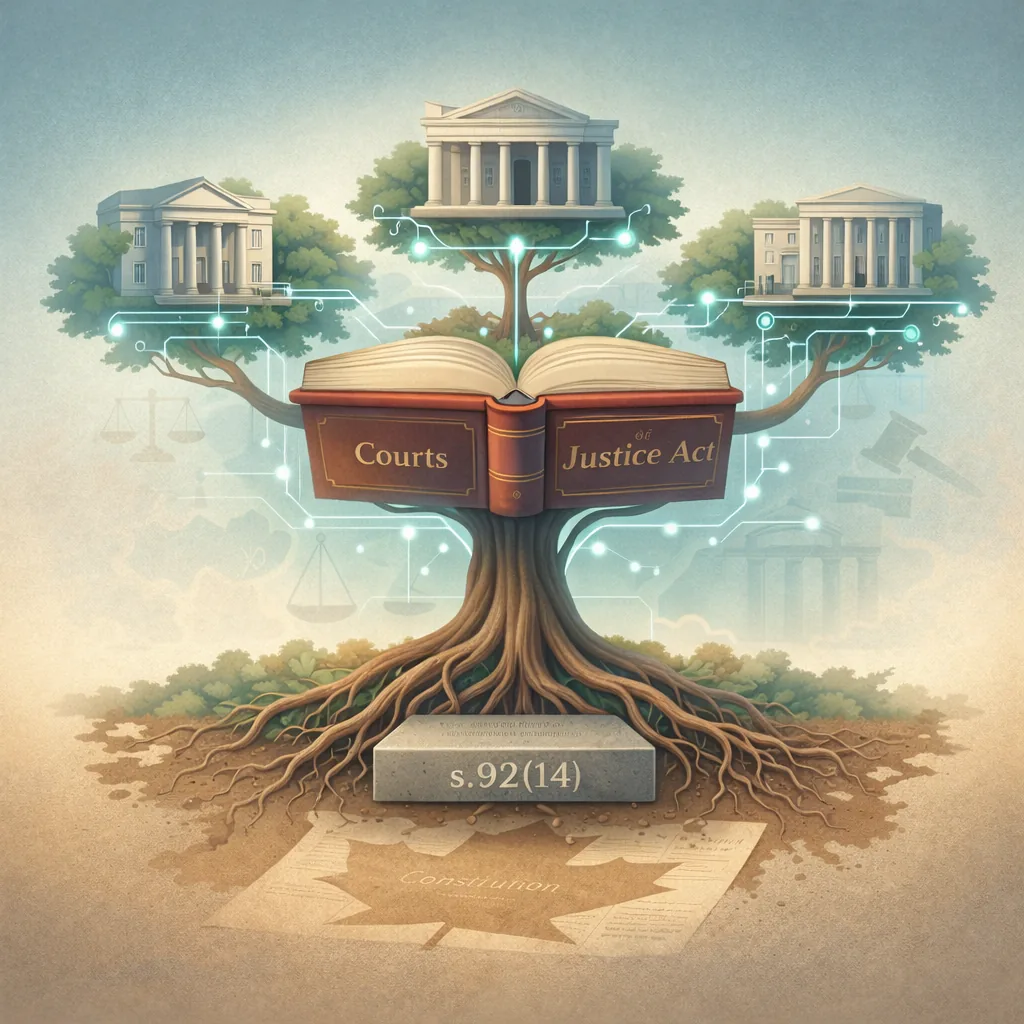
Here's the key exam idea: the Constitution gives Ontario the power to organize courts, but the Courts of Justice Act is the statute that actually lays out Ontario's court structure in detail. In other words, the Constitution is the "permission slip," and the Courts of Justice Act is the "blueprint." (Laws and Regulations of Canada)
Ontario's Courts of Justice Act sets out the main Ontario courts, how they relate to each other, and plenty of "nuts and bolts" details that show up in licensing exams and day-to-day practice. (Ontario)
🏛️ What the Courts of Justice Act Ontario really does
The Courts of Justice Act Ontario is the practical, provincial "how the court system works" statute. It's the one you point to when someone asks:
- What are Ontario's main courts?
- How are they structured?
- Where do appeals go?
- How does the system get administered?
Ontario's e-Laws version of the Act is the cleanest official reference for exam study and citation. (Ontario)
🧩 Why the Constitution still matters
Now for the trap that exam writers love: the Constitution matters a lot, just not in the way the question asks.
Canada's Constitution sets out who (federal or provincial) has authority over different areas. For courts, the Constitution gives provinces authority over the "Administration of Justice" in the province, including the "Constitution, Maintenance, and Organization of Provincial Courts." (Laws and Regulations of Canada)
So yes, Ontario's ability to pass the Courts of Justice Act comes from constitutional authority. But the Constitution doesn't spell out Ontario's court names and structure. It doesn't say "here is the Ontario Court of Justice" in a neat list. Ontario does that through legislation. (Laws and Regulations of Canada)
🧱 Section 92(14) explained without legal fog
If you're studying, you'll see this quoted constantly:
Section 92(14) of the Constitution Act, 1867 assigns provinces control over the administration of justice, including the organization of provincial courts. (Laws and Regulations of Canada)
Plain-English translation:
- Provinces run the justice "machine" inside the province.
- Provinces can create and organize provincial courts.
- Provinces can set many court procedures (especially civil procedure in provincial courts).
That's why the correct exam answer is Courts of Justice Act: Ontario uses its s.92(14) power to build the real court structure through provincial law. (Laws and Regulations of Canada)
🏢 Courts of Justice Act Ontario: the three main courts
Ontario's court system (in the way you'll usually be tested on it) is commonly described as having three main courts:
- Court of Appeal for Ontario
- Superior Court of Justice
- Ontario Court of Justice
You'll also hear about branches or components like Divisional Court and Small Claims Court, which sit within the Superior Court structure. (Ontario Courts)
🏁 Court of Appeal for Ontario: what it hears
The Court of Appeal for Ontario is Ontario's top court.
In a simple flow:
- Trial happens in the Ontario Court of Justice or Superior Court.
- Appeals often go to the Superior Court (in some OCJ matters) or straight to the Court of Appeal depending on the case type and the statute.
- The Court of Appeal is the main provincial "final stop" for most Ontario appeals (with a further possible step to the Supreme Court of Canada in some cases). (Ontario)
For exam purposes, remember: Court of Appeal = big appeals court for Ontario. (Ontario)
⚖️ Superior Court of Justice: the big trial court
The Superior Court of Justice is Ontario's main superior trial court. It deals with major matters in:
- Civil
- Family
- Criminal
- Divisional Court
- Small Claims Court
Ontario Courts' official Superior Court site lays out these areas clearly. (Ontario Courts)
If you're thinking practically: when the case is bigger, more complex, or involves certain remedies and jurisdiction rules, you tend to see the Superior Court show up. (Ontario Courts)
🧾 Divisional Court and Small Claims Court: the branches
Divisional Court
Divisional Court is a branch of the Superior Court of Justice. It's a big deal in administrative law because it hears many statutory appeals and is a primary forum for judicial review of government action in Ontario. (Ontario Courts)
Small Claims Court
Small Claims Court is also within the Superior Court umbrella. It handles civil disputes up to a set limit. Ontario's official Superior Court page states Small Claims Court hears disputes up to $50,000 (plus certain other specific applications). (Ontario Courts)
If you're studying: memorize that Small Claims is part of the Superior Court world, not the Ontario Court of Justice world. (Ontario Courts)
👩⚖️ Ontario Court of Justice: the everyday workhorse
The Ontario Court of Justice (OCJ) handles a huge volume of everyday court work, including:
- Adult criminal matters (many of them)
- Youth criminal matters
- Family matters (certain types)
- Child welfare
- Provincial offences (often through municipal/provincial administration)
That's directly reflected in the OCJ's own "General Information" page. (Ontario Courts)
A federal Justice Canada overview also explains, in general terms, that provincial/territorial courts handle many criminal offences (except the most serious), many family issues (but not divorce), youth matters, and provincial regulatory offences. (Ministère de la Justice)
🔀 Superior vs Ontario Court: quick jurisdiction map
If the exam asks you to compare courts, use this mindset:
- OCJ = high-volume criminal/youth + specific family/child welfare + provincial offences
- Superior Court = bigger civil + divorce + serious criminal + broader family (and branches like Divisional + Small Claims)
Here's a fast comparison:
| Topic | Ontario Court of Justice (OCJ) | Superior Court of Justice (SCJ) |
|---|---|---|
| Criminal | Many criminal matters, bail and other proceedings | Most serious criminal charges, broader inherent jurisdiction |
| Family | Many parenting/support/child welfare matters (depending on location and issue) | Divorce + property issues + broader family jurisdiction |
| Civil lawsuits | Not the main civil trial court | Main civil trial court (larger disputes) |
| Small Claims | No | Yes (up to $50,000) |
| Judicial review / many tribunal appeals | No | Yes (Divisional Court branch) |
(That's the clean "test-day" version. Real life has extra wrinkles, but this passes most exam questions.) (Ontario Courts)
🧭 Criminal matters: who hears what
A safe exam approach is:
- OCJ hears a lot of criminal matters and related proceedings in Ontario. (Ontario Courts)
- Superior Court hears the most serious criminal matters and has a broader "superior" jurisdiction footprint. (Ontario Courts)
And if you want one extra "why" that helps you remember: Canada's federal Justice department explains that provincial/territorial courts deal with most criminal offences, except the most serious ones. (Ministère de la Justice)
👨👩👧👦 Family matters: where people get lost
Family jurisdiction confuses people because "family law" is not one single bucket.
A practical way to remember:
- Divorce lives in the Superior Court world. (Ontario Courts)
- The OCJ handles many family and child welfare matters (depending on the issue and location). (Ontario Courts)
Ontario's Superior Court jurisdiction page stresses that family jurisdiction depends on the specific issue and the laws involved. (Ontario Courts)
So if an exam question says "Which court deals with divorce?" — your reflex should be Superior Court, not OCJ. (Ontario Courts)
💼 Civil, estates, and judicial review: where they land
For most civil lawsuits (especially beyond small claims), you're looking at the Superior Court. The Superior Court's own site is the best "official" mental anchor for that. (Ontario Courts)
For Small Claims, the Superior Court's page clearly sets out the forum and the $50,000 limit. (Ontario Courts)
For judicial review and many tribunal appeals, your buzzword is Divisional Court, a branch of the Superior Court. (Ontario Courts)
🗂️ Rules, admin, and judges: how the system runs
The Courts of Justice Act isn't just a list of courts. It also supports the machinery around them, such as:
- Administrative structures that keep courts functioning
- Rule-making and procedure frameworks (through committees and rules)
- Court-related bodies and governance structures
For practical reading, Ontario's official Courts pages and Divisional Court resources point you to key rules, procedures, and guides used in real proceedings. (Ontario Courts)
When exam questions talk about "organization", think beyond buildings and courtrooms. Think: structure, relationships, and how the system gets managed.
📝 How to remember this for the LSO / paralegal exams
Use this memory chain:
- Constitution = authority (Ontario is allowed to organize courts)
- Courts of Justice Act = structure (Ontario actually organizes the courts) (Laws and Regulations of Canada)
Then keep the court ladder in your head:
- OCJ (busy, day-to-day criminal/family/provincial offences) (Ontario Courts)
- Superior Court (big civil + divorce + serious criminal + Divisional + Small Claims) (Ontario Courts)
- Court of Appeal (appeals at the top of Ontario's system) (Ontario Courts)
CTA (practical next step): If you need legal support or paralegal services, reach out through Contact or Helpdesk Support. We can help with forms, document preparation, filing guidance, tribunal and small-claims support, and practical next-step planning so you're not guessing your way through the process.
❓ Frequently Asked Questions
❓ Which statute organizes Ontario's courts in detail?
The Courts of Justice Act Ontario does. The Constitution gives authority, but the Act sets the structure. (Ontario)
❓ Why isn't the Constitution the correct answer on this question?
Because the Constitution gives the power to organize courts, but it doesn't list Ontario's court structure the way the Act does. (Laws and Regulations of Canada)
❓ What does section 92(14) actually say (in plain English)?
It gives provinces control over administration of justice, including organizing provincial courts. (Laws and Regulations of Canada)
❓ What are the three main courts in Ontario?
Court of Appeal for Ontario, Superior Court of Justice, and Ontario Court of Justice. (Ontario Courts)
❓ Is Divisional Court a separate court?
No. It's a branch of the Superior Court of Justice. (Ontario Courts)
❓ Is Small Claims Court part of the Ontario Court of Justice?
No. It's part of the Ontario Superior Court of Justice structure. (Ontario Courts)
❓ What is the Small Claims Court limit in Ontario right now?
Ontario's Superior Court says Small Claims handles disputes up to $50,000. (Ontario Courts)
❓ What kinds of cases does the Ontario Court of Justice hear?
Adult criminal, youth criminal, family, child welfare, and provincial offences (among others). (Ontario Courts)
❓ What kinds of cases does the Superior Court hear?
Major civil, family, criminal matters, plus Divisional Court and Small Claims. (Ontario Courts)
❓ Which court handles divorce in Ontario?
Divorce is in the Superior Court system. (Ontario Courts)
❓ Which court handles judicial review of government decisions?
Often the Divisional Court, a Superior Court branch. (Ontario Courts)
❓ If I see "provincial offences," what court should I think of first?
The Ontario Court of Justice (often administered through municipal/provincial systems). (Ontario Courts)
❓ Is the Courts of Justice Act Ontario worth reading for exam prep?
Yes—because it's where the exam question is pointing you: organization and structure. (Ontario)
❓ What's the fastest way to answer this question under time pressure?
If the question says "establishes the organization," pick the Courts of Justice Act, not the Constitution. (Ontario)
❓ How do I avoid confusing "authority" vs "structure"?
Say it this way: Constitution = authority, Courts of Justice Act = structure. (Laws and Regulations of Canada)
❓ Where can I find official Ontario court info (not random blogs)?
Use Ontario Courts' official sites for the OCJ and SCJ. (Ontario Courts)
❓ Where can I read the Courts of Justice Act Ontario online?
Ontario's e-Laws site hosts it as an official public copy. (Ontario)
❓ Where can I read section 92(14) online?
Justice Laws (federal) publishes the Constitution Acts, including s.92. (Laws and Regulations of Canada)
❓ Does Justice Canada explain how courts are organized in general?
Yes—the federal Justice site has a plain-language overview of Canada's court system. (Ministère de la Justice)
❓ What's one study trick that actually works?
Write a one-line flashcard: "Courts of Justice Act Ontario organizes the courts; s.92(14) allows it." (Ontario)
Sources & References
- Ontario e-Laws — Courts of Justice Act (R.S.O. 1990, c. C.43) (Ontario)
- Justice Laws — Constitution Act, 1867 (s.92, incl. 92(14)) (Laws and Regulations of Canada)
- Ontario Superior Court of Justice (official site) (Ontario Courts)
- Ontario Court of Justice — General Information (official) (Ontario Courts)
- Divisional Court — Ontario Superior Court of Justice (Ontario Courts)
- Small Claims Court — Ontario Superior Court of Justice (Ontario Courts)
Related Videos:
