
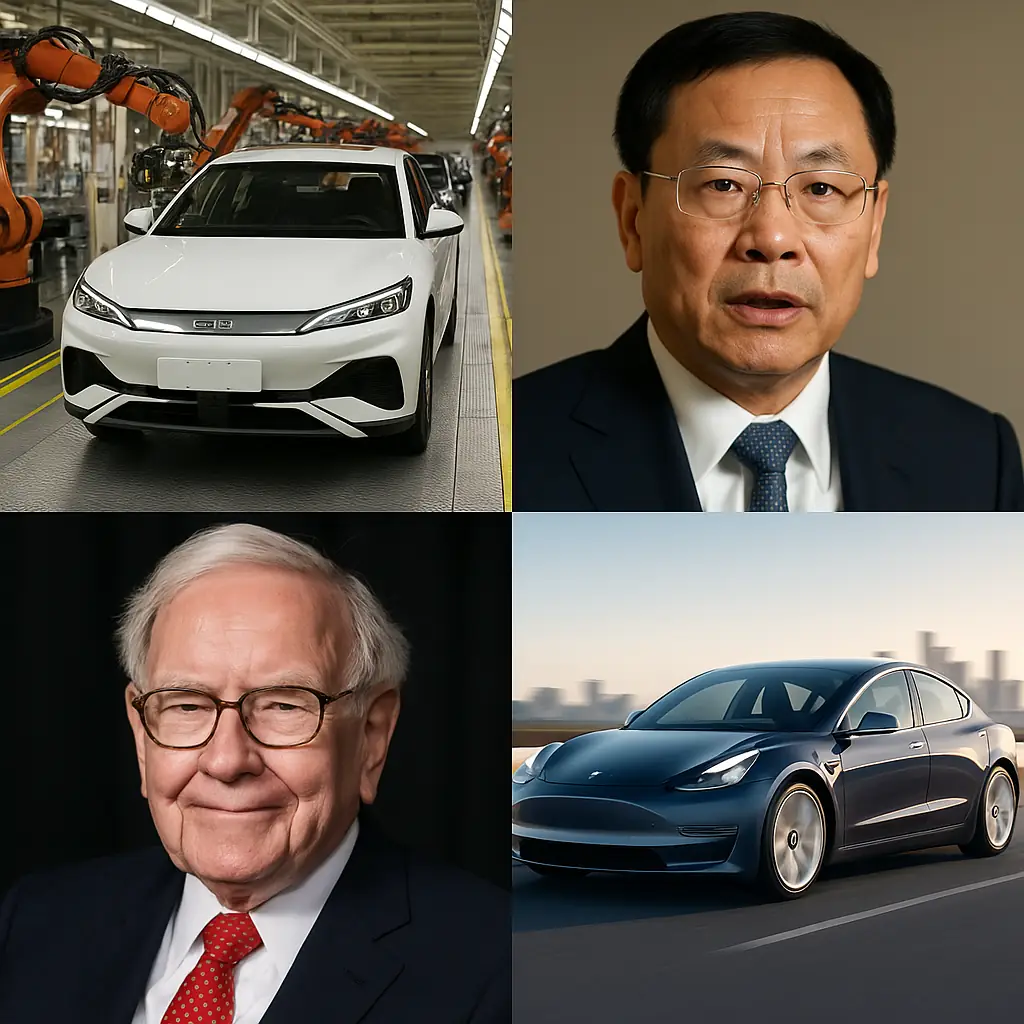
BYD Surpasses Tesla in Global EV Sales: How China’s Rising Star Is Shaking Up the Electric Vehicle Market
When BYD surpasses Tesla in global EV sales, it’s not just a fanboy scoreboard moment. It’s a flashing red warning light for the entire auto industry.
In 2024, BYD officially overtook Tesla in global battery-electric vehicle (BEV) sales for the first time, and 2025 data shows BYD pulling even further ahead, with an estimated lead of hundreds of thousands of pure EVs worldwide.
This isn’t just “China doing well.” It’s a structural shift driven by batteries, brutal cost discipline, and a supply chain that runs right through the world’s critical minerals.
Let’s walk through what it really means that BYD surpasses Tesla in global EV sales – and whether we’ve just traded oil dependence for something even trickier.
⚡ What it really means when BYD surpasses Tesla in global EV sales
On paper, the headline is simple: BYD sold more EVs than Tesla.
But inside that headline are a few big truths:
- BYD’s EV and plug-in hybrid volumes in China are massive, and its BEV-only sales have now passed Tesla globally.
- Tesla’s growth has slowed, especially in Europe, where its registrations plunged while BYD’s rose and even overtook Tesla in some months.
- Chinese brands, led by BYD, are now price-setters in the global EV market, not price followers.
When BYD surpasses Tesla in global EV sales, it proves that:
- Affordable EVs are technically and economically possible now, not 10 years from now.
- The real bottlenecks are politics, tariffs, and mineral supply, not the technology itself.
This is why executives from Detroit to Tokyo are suddenly looking very nervous.
🚗 Who is BYD and how did it get here?
BYD didn’t start as a car company.
It began in 1995 as a battery manufacturer, building cheaper rechargeable batteries for phones and electronics and undercutting Japanese and Korean incumbents. Wang Chuanfu, a chemist by training, focused on:
- High-volume production
- Relentless cost cutting
- Good-enough quality at a much lower price
From there, BYD:
- Bought a struggling automaker in the early 2000s
- Launched low-cost sedans that became popular in China
- Gradually shifted the lineup from combustion cars to hybrids and full EVs
Today, after BYD surpasses Tesla in global EV sales, the company is:
- A major global EV producer
- A dominant battery player
- A key piece of China’s broader industrial strategy around electrification
It’s not a side project. BYD is the core of China’s EV push.
🧪 Wang Chuanfu’s “from orphan to EV boss” origin story
Wang Chuanfu’s story reads like a grounded, slightly grittier version of a startup fairy tale.
- He grew up poor in rural China and lost his parents young.
- Older siblings kept him in school, where he excelled in chemistry and metallurgy.
- He became a government researcher in battery materials, then walked away from the safe path to start BYD with borrowed money.
Instead of going full Elon with memes and rockets, Wang:
- Stays obsessively focused on engineering and manufacturing
- Avoids the spotlight and media drama
- Spends his time on product, process, and factory optimization
The result: while the world was busy watching Tesla’s stock chart, Wang built a company capable of making EVs so cheap that everyone else has to either adapt fast or get steamrolled.
💸 Why BYD’s prices are freaking out the rest of the auto industry
Here’s the part that keeps global CEOs awake.
In 2025, BYD’s Seagull — a small city EV — offers usable range, modern features, and solid build quality starting at roughly US$11,000 in China.
Meanwhile, in North America, the average new car is now comfortably above US$45,000–50,000, with many EVs costing more than that once you add options and taxes.
Do the math:
- Suppose BYD can build and ship a solid EV for about US$20,000.
- Slap on a 25% “China EV” tariff plus a 2.5% import duty and you’re at ~US$26,500.
- That’s still way below what many buyers are paying today for a new car.
That’s why when BYD surpasses Tesla in global EV sales, it’s not just about bragging rights. It’s a sign that Chinese EVs could, if allowed in at scale, detonate the pricing structure in Western markets.
🔋 The battery advantage: owning the EV supply chain
The key to BYD’s cost advantage is simple: batteries.
Batteries typically account for 30–40% of an EV’s total cost.
If you can build batteries cheaper than anyone else, you can build cheaper EVs than anyone else.
BYD’s edge:
- It designs and manufactures its own battery cells, including its well-known LFP “Blade” batteries.
- It builds modules and packs in-house.
- It produces much of its power electronics and key drivetrain components itself.
- It’s tightly integrated with China’s mineral refining and cell-manufacturing ecosystem, which dominates global capacity.
This level of vertical integration is what lets BYD price cars in a way that makes other automakers’ spreadsheets cry.
🌍 BYD vs tariffs: why you don’t see its cars everywhere yet
If the Seagull and its siblings are so cheap and effective, why isn’t your street full of them?
Because governments — especially in the U.S. and parts of Europe — have basically said:
“We want EVs, but not those EVs, at least not too fast.”
- The United States has slapped hefty tariffs and restrictions on Chinese-made EVs and components. These don’t make BYD impossible, but they make large-scale imports financially painful.
- The European Union is probing Chinese EV subsidies and considering punitive duties to slow a flood of cheap cars from China.
This buys time for local automakers to:
- Build their own battery plants
- Cut costs
- Catch up on technology and software
But it doesn’t erase the fact that BYD surpasses Tesla in global EV sales without even having full access to the richest car market on earth.
⛏️ What’s really inside an EV battery?
Now let’s plug in the mining stats you laid out, because this is where some people call EVs “a scam.”
A large EV battery might require:
- 12 tonnes of rock containing lithium
- 5 tonnes of cobalt-bearing minerals
- 3 tonnes of nickel ore
- 12 tonnes of copper ore
From all that, you get roughly:
- 12 kg of lithium
- 30 pounds of nickel
- 22 kg of manganese
- 15 pounds of cobalt
- 100 kg of rare earth metals
- 200 kg of aluminum, steel and plastic for the pack and housing
Those numbers are ballpark and vary by chemistry and pack size, but they communicate a very real point: EV batteries are material-hungry.
Giant machines like the Caterpillar 994A can burn around 1,000 liters of diesel in 12 hours of mining operations. That’s not nothing.
When people point at all this and say, “And then you slap a ‘zero emissions’ badge on the back? Biggest scam in history,” you can see where the feeling comes from.
But it’s not the full picture.
🏗️ The mining reality behind “zero-emissions” cars
Let’s be honest: mining is ugly.
- It tears up landscapes.
- It can poison water if mismanaged.
- It has real social and human rights implications, especially in places like the Democratic Republic of Congo for cobalt.
EVs front-load a lot of this impact into the manufacturing phase, especially into the battery. Gasoline cars front-load less, but then keep emitting every time you press the accelerator.
This is where lifecycle analysis matters:
- A 2025 study from TD Economics found that battery-electric vehicles have significantly lower lifecycle emissions than gasoline cars, even after accounting for higher emissions in battery production.
- The International Council on Clean Transportation (ICCT) shows that in the EU, BEVs can have up to 73% lower life-cycle emissions than gasoline vehicles, thanks to a cleaner grid.
- The U.S. EPA also notes that while EV manufacturing can be more carbon-intensive, total lifetime emissions are typically lower than for gasoline cars.
So no, this isn’t “free.” But calling EVs a pure scam ignores the fact that a dirty upfront footprint can still beat 15 years of burning fuel.
🌐 Where all those EV battery materials come from
Your material breakdown is a good jumping-off point, so let’s map it to real-world geography:
- Lithium:
- Australia produces about half the world’s lithium.
- Chile and Argentina supply much of the rest, with China also significant.
- Cobalt:
- The Democratic Republic of Congo dominates cobalt mining, with China owning or financing many of the major projects.
- Nickel:
- Indonesia and the Philippines lead in nickel ore production, increasingly supplying battery-grade material for EVs.
- Copper:
- Chile and Peru are top producers, with strong links to global electrification demand.
- Manganese:
- South Africa and Australia are major producers, with China also in the mix.
- Aluminum, steel, plastics:
- These come from a wide set of industrial nations, but China stands out again as a top producer of both steel and aluminum.
And crucially:
Even when mining happens in Australia, Chile, Congo, or Indonesia, a huge share of refining and processing happens in China.
That’s where the “we’re shifting from oil dependence to Chinese-owned resources” concern becomes very real.
🧭 From oil dependence to mineral dependence (and China in the middle)
For a century, geopolitics has revolved around oil:
- Who controls the wells
- Who controls the shipping lanes
- Who controls the refineries
Now we’re quietly sliding into a new system built around critical minerals:
- Lithium, cobalt, nickel, copper, manganese, graphite, rare earths
- Mining in one set of countries
- Processing and refining dominated by a small set of others — with China in first place
The International Energy Agency’s critical minerals outlook makes it clear:
- China is the top processor of multiple key battery metals.
- Western countries currently have only a small share of global refining capacity.
So yes, we may be shifting away from oil… straight into another dependency web where China has far more leverage than OPEC ever did in the EV space.
🏭 How Ford, Chrysler, Toyota and Honda are responding
Now zoom out to the big non-Chinese automakers you mentioned: Ford, Chrysler (via Stellantis), Toyota, and Honda.
They all see the same thing:
BYD surpasses Tesla in global EV sales because it controls batteries, costs, and scale.
So what are they doing?
- Ford is investing heavily in its own EV architecture and battery plants, licensing LFP technology from Chinese firms to reduce costs while building production in North America. The F-150 Lightning is a key flagship, backed by serious investment in lightweight battery enclosures and aluminum structures to offset battery mass.
- Stellantis (Chrysler) is signing deals with battery makers and mining firms, creating joint ventures for cell factories in Europe and North America to avoid being completely price-killed by cheaper imports.
- Toyota — long the hybrid king — is now rushing EV platforms to market and pouring money into solid-state and next-gen lithium-ion batteries to claw back leadership.
- Honda is partnering with others (including GM in some markets) to share EV platforms and spread battery costs over more vehicles.
Everyone is:
- Investing in new technologies and production capacity
- Trying to diversify away from over-reliance on any single region
- Quietly accepting that some level of China-linked tech and minerals is unavoidable for now
In other words, your line is dead-on: the heavy reliance on China is forcing these companies to adapt, invest, and rethink everything.
💥 Are we heading for a global EV price war?
Short answer: yes, and BYD lit the fuse.
Signals that a price war is either here or close:
- Chinese brands (led by BYD) are undercutting European and Korean rivals in markets like Europe and Latin America.
- Tesla has slashed prices repeatedly and still sees sales sliding in some regions because competition is finally catching up.
- Independent analysts expect EVs to reach full cost parity with gasoline cars in the next few years as battery costs fall further, even without subsidies.
If and when trade walls come down, cheap EVs like the Seagull will not just “compete.” They will force everyone else to choose between:
- Cutting prices hard
- Moving upmarket and focusing on premium niches
- Or watching volume drain away
The fact that BYD surpasses Tesla in global EV sales before those doors fully open tells you how strong its cost position really is.
🚘 What this shift means for everyday drivers
If you’re just trying to decide what to drive in the next 5–10 years, here’s the distilled reality:
- EV sticker prices today are artificially high in some markets because cheaper Chinese models are kept out by tariffs and politics.
- BYD’s success proves that sub-US$25k solid EVs are absolutely possible with current technology and scale.
- Over a full life cycle, EVs typically emit significantly less CO₂ than gasoline cars, even with all the mining and battery manufacturing accounted for.
For you as a buyer:
- Expect more choices and falling prices over the next decade.
- Expect fierce debate about where the cars and batteries come from, not just how they perform.
- Expect that the day a $20k–$25k practical EV hits your local market in volume, the resale value of expensive gas vehicles will look a lot less pretty.
✅ Key takeaways: BYD surpasses Tesla in global EV sales
Let’s put it in plain bullet points:
- BYD surpasses Tesla in global EV sales because it owns the battery stack and executes brutally on cost.
- EVs are resource-intensive to build, but they still typically beat gasoline cars on total life-cycle emissions.
- The world is moving from oil dependence to mineral dependence, with China dominating the processing and midstream.
- Ford, Chrysler (Stellantis), Toyota, and Honda are pouring billions into EV tech, battery plants, and supply diversification to avoid being wiped out on price.
- The real long-term risk isn’t “EVs are a scam,” it’s who controls the supply chains that feed them.
❓ FAQs about BYD, Tesla and EV batteries
❓ Q1: Did BYD really surpass Tesla in global EV sales?
Yes. BYD has overtaken Tesla in global sales of battery-electric vehicles and holds a clear lead through 2025, with hundreds of thousands more BEVs sold than Tesla. This is on top of its already huge plug-in hybrid volumes.
❓ Q2: Why are BYD’s EVs so much cheaper than Tesla’s and others?
Because BYD:
- Manufactures its own batteries and many key components
- Sits in the middle of China’s hyper-optimized EV supply chain
- Designs platforms for cost and scale from day one
This combination lets BYD price cars at US$11k–$20k in China and still make money, which is a big reason BYD surpasses Tesla in global EV sales.
❓ Q3: Is it true that building an EV battery requires 250 tonnes of earth to be moved?
The number varies by ore grade and mining method, but yes, a lot of rock is moved to extract small amounts of lithium, cobalt, nickel and copper. Heavy machinery burns diesel and impacts land and water. However, even after you account for this, lifecycle studies still show EVs emitting far less CO₂ per kilometer than gasoline cars over their lifetime.
❓ Q4: Are EVs really “zero emissions”?
Tailpipe: yes. Lifecycle: no.
All-electric vehicles have zero tailpipe emissions, but the electricity and batteries behind them do create emissions. That said, in most regions, an EV run on the local grid still emits less overall than a gasoline car when you add up manufacturing + fuel + use.
❓ Q5: Who controls most of the world’s EV battery materials?
It’s split:
- Mining: Australia (lithium), Chile/Peru (copper), DRC (cobalt), Indonesia/Philippines (nickel), South Africa (manganese), etc.
- Processing: China dominates refining of lithium, cobalt, and other critical minerals, plus cathode/anode production and cell manufacturing.
That’s why people say we’re shifting from oil to China-linked mineral supply chains.
❓ Q6: Why don’t I see many BYD cars in North America yet?
Because tariffs and political risk are acting like a very strict bouncer at the door. The U.S. has high import duties and policy barriers aimed at Chinese EVs, and Canada is closely aligned. This makes large-scale BYD imports uneconomical — at least for now.
❓ Q7: Will EV prices really drop in the future?
Yes, barring some massive policy shock.
Battery costs are trending down, production efficiency is improving, and global competition is ramping up. Once more affordable EVs are allowed into highly protected markets, it’s very likely that $20k–$25k EVs will become normal. BYD’s current lineup proves the technology is already there.
❓ Q8: How are companies like Ford and Toyota dealing with Chinese battery dominance?
They’re trying to hedge:
- Building local battery plants in the U.S., Canada, and Europe
- Licensing some Chinese technology (like LFP chemistries) but doing the manufacturing locally
- Partnering with miners and refiners outside China to diversify supply
They know that if they don’t get their battery and cost strategies right, they’ll keep losing ground as BYD surpasses Tesla in global EV sales and pressures everyone else.
❓ Q9: Are plug-in hybrids part of BYD’s success?
Yes. BYD sells a mix of BEVs and plug-in hybrids (PHEVs), especially in China. That combination gave it huge volume and manufacturing scale early on. However, even looking at pure BEVs, BYD now leads Tesla in global sales.
❓ Q10: Does buying an EV still make sense if my grid is dirty?
Usually, yes.
In very coal-heavy grids, the advantage shrinks, but studies still find EVs tend to have lower lifetime emissions than gasoline cars because:
- Electricity, even if dirty, is often cleaner per kilometer than burning gasoline
- Grids typically get cleaner over time, while your gas car never does
❓ Q11: How does BYD compare to Tesla on tech, not just price?
Tesla still leads on:
- Global fast-charging network
- Mature software ecosystem and over-the-air updates
- Brand recognition in many Western markets
BYD is closing the gap fast with:
- Strong in-house battery tech
- Solid driver-assistance systems
- Rapidly improving infotainment and connectivity
BYD surpasses Tesla in global EV sales right now mostly because of cost and scale, but the tech gap is not what it used to be.
❓ Q12: What’s one thing buyers should watch in the next 3–5 years?
Watch for the moment when:
- Tariffs ease or local BYD factories come online outside China
- A reliable, sub-US$25k EV with decent range hits your market
- Legacy automakers are forced to either match that price or retreat upmarket
That’s when the real disruption hits ordinary buyers, not just stock charts.
🔚 Conclusion: BYD surpasses Tesla in global EV sales – and the bigger question we should be asking
When BYD surpasses Tesla in global EV sales, it tells us three uncomfortable but important things:
- Affordable EVs are already here — just not necessarily in your country yet.
- The world is actively shifting from dependence on oil to dependence on critical minerals and processing capacity that are heavily influenced by China.
- The real risk isn’t that EVs are a “zero-emissions scam,” it’s that we might be sleepwalking into a new era of resource dependence without a serious, diversified strategy.
We might be shifting our dependence from oil to Chinese-owned or China-controlled resources.
Something to think about.
If you want to dive deeper into the tech and policy side, link this piece internally to:
And if this whole shift raises questions about the future of cars, jobs, and energy, reach out via your Contact page so readers can ask follow-ups or suggest new topics:
👉 CTA: Have questions about EVs, batteries, or how this impacts your business or career? Contact us here and let’s unpack it properly.
📚 Sources & References
- Electrek — BYD overtakes Tesla as China’s EV giants dominate global sales (Electrek)
- CarNewsChina — BYD surpasses Tesla in global pure-electric vehicle sales (CarNewsChina.com)
- Autovista24 — Which brand sold the most EVs in the first half of 2025? (Autovista24)
- ICCT — Life-cycle greenhouse gas emissions from passenger cars (theicct.org)
- TD Economics — Lifecycle carbon footprint comparison between internal combustion and electric vehicles (TD Economics)
- Our World in Data — Which countries have the critical minerals needed for the energy transition? (Our World in Data)
- U.S. EPA — Electric Vehicle Myths (US EPA)
- USGS & IEA reports on critical mineral production and processing (U.S. Geological Survey)
Related Videos:

Related Posts:
Sony and Honda announces their new EV brand Afeela
Law and Legal Research: Core Methods, Ethics, and Tools
Law of Evidence in Canada: The Principled Revolution
Interviewing Skills for Legal Professionals: Step-by-Step Guide to Better Client Interviews
Canadian Criminal Law Explained: Rights, Risks, and Precrime
Tort and Contract Law: The Pillars of Private Law Explained in Depth
Where automotive cyber security is headed
The Amazing Ways The Ford Motor Company Uses Artificial Intelligence And Machine Learning
The auto industries race to the electric and autonomous car
Hacking Autonomous Vehicles: Is This Why We Don’t Have Self-Driving Cars Yet?