
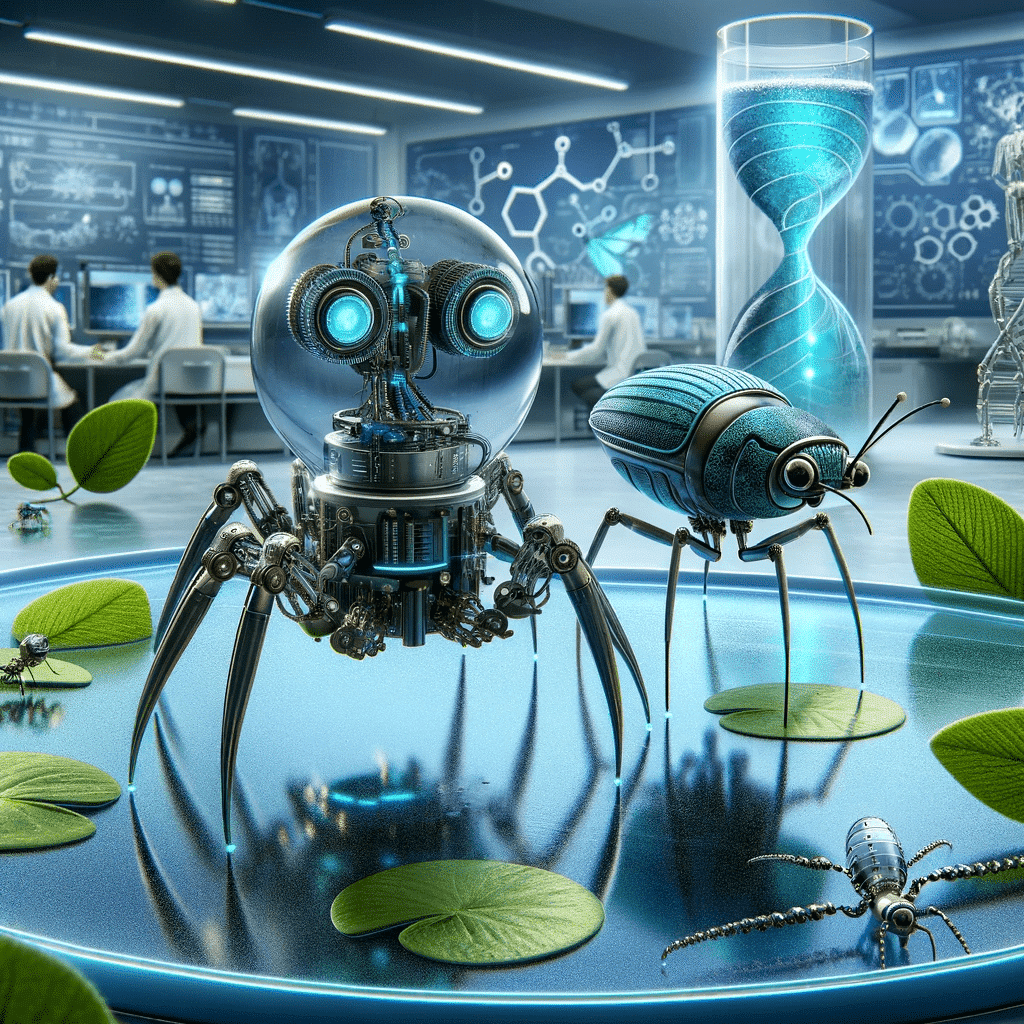
Nature-Inspired Micro-Robots: Tiny Machines, Huge Impact
Nature doesn’t waste anything. An ant carries multiples of its own weight. A water strider skims across a pond like gravity forgot to apply.
Now engineers are turning that evolutionary cheat sheet into nature-inspired micro-robots — tiny autonomous machines that weigh less than a raindrop, yet can flap, crawl, and glide with surprising strength.
In early 2024, researchers at Washington State University (WSU) unveiled two insect-like micro-robots — a “mini-bug” and a “water strider” — that may be the smallest, lightest, fastest fully functional micro-robots built so far.
These nature-inspired micro-robots are not sci-fi props. They’re early prototypes of machines that could one day monitor toxic sites, assist surgeons inside the body, crawl through collapsed buildings, or even help pollinate crops when bee populations crash.
Let’s break down what makes them special, what still sucks (for now), and where this tech is heading in the next decade.
🔎 What Are Nature-Inspired Micro-Robots?
Nature-inspired micro-robots are tiny machines — millimeter to sub-centimeter scale — whose shape, movement, or behavior is modeled on real organisms:
- Insects (ants, beetles, water striders, bees)
- Microorganisms (bacteria, algae, sperm cells)
- Aquatic creatures (fish larvae, water-walking bugs)
They typically share three traits:
- Extreme miniaturization – masses in the milligram range, sometimes less than a grain of sand.
- Bio-inspired locomotion – walking, rowing, flying, or swimming modes copied from nature.
- Unconventional actuation – instead of big electric motors, they use shape memory alloys (SMA), soft actuators, magnetic fields, light, or chemical reactions.
The core idea: use nature’s proven designs, then shrink robotics down until you’re basically building an insect-sized machine with just enough brains and power to do a useful job.
🐜 Meet the Record-Breaking Mini-Bug and Water Strider
The WSU team’s two flagship nature-inspired micro-robots are:
- Mini-bug robot – about 8 milligrams
- Water strider robot – about 55 milligrams, designed to move on water surfaces
To give you a sense of scale, 8 mg is roughly:
- Less than a grain of salt.
- Far, far lighter than a typical house ant.
Both robots use the same basic recipe:
- A tiny frame with multiple legs or “fins”
- Flexible joints driven by ultra-light actuators
- Tethered power supply (wired, for now)
- Motion designed to echo how insects move across solid surfaces or water
In tests, the bots can move at around six millimeters per second. That’s nowhere near the physical performance of a real insect (a few-milligram ant can hit close to a meter per second), but for a fully functional, controllable robot of this mass, it’s a major milestone.
These prototypes are proof that you can build working, steerable robots at this scale without stacking bulky motors and gears on a tiny skeleton.
⚙️ Shape Memory Alloy Actuators: Tiny Muscles for Tiny Bots
The real breakthrough in these nature-inspired micro-robots isn’t just their size — it’s how they move.
Instead of motors, the WSU robots use shape memory alloy (SMA) actuators:
- Each actuator is made from two SMA wires about 1/1000 of an inch in diameter.
- When current flows through a wire, it heats up and changes shape (contracts).
- When the current stops, it cools and returns to its original length.
By alternating current between the two wires, the actuator flexes back and forth like an artificial muscle. This gives you:
- Up to ~40 movement cycles per second (40 Hz)
- Force strong enough to lift more than 150× the actuator’s own weight
- Actuators weighing under 1 mg each, keeping the whole robot ultra-light
In large robots, SMA often feels slow and inefficient. But at the micro scale, where everything is tiny and heat can dissipate quickly, SMA suddenly becomes a surprisingly useful option.
For the mini-bug and water strider:
- The mini-bug uses SMA “muscles” to drive its legs.
- The water strider uses SMA-powered fins or paddles to push against the water surface.
This SMA approach removes the need for traditional electrical motors, gearboxes, and other heavy hardware — which simply don’t scale down well to the milligram level.
🚀 Why Nature-Inspired Micro-Robots Are a Big Deal
So why should anyone care about nature-inspired micro-robots that currently move slower than a real ant and need a power wire?
Because they unlock capabilities you can’t get from larger robots:
- Access to ultra-confined spaces
Crawl through cracks, pipes, or inside small cavities where standard robots (and humans) can’t go. - Minimal disturbance to the environment
Their tiny mass means they can move inside fragile environments (e.g., organs, coral reefs, sensitive equipment) without smashing things. - Low material and energy cost per unit
Micro-robots can be manufactured in large numbers and potentially deployed as swarms — think hundreds of bots cooperating on tasks. - Bio-matching scales
They operate at the same scale as cells, microfluidic channels, and tiny cracks — ideal for medical, environmental, and industrial settings.
We’re basically building a robotic counterpart to insects: small, specialized, and potentially deployable in huge numbers.
🏥 Micro-Robots in Medicine and Surgery
One of the most hyped use cases for nature-inspired micro-robots is inside the human body.
Researchers are actively exploring microrobots for:
- Targeted drug delivery
Deliver medication directly to a tumor, clot, or inflamed area instead of flooding the whole body. - Minimally invasive surgery
Assist surgeons by navigating tiny spaces, clearing blockages, or manipulating tissue under imaging guidance. - Diagnostics and biopsies
Take micro-samples from hard-to-reach locations, or map internal conditions at higher resolution.
Some experimental designs are magnetically actuated microrobots that move through fluids under external magnetic fields; others use SMA coils or helical tails to swim through liquid environments.
We’re not yet injecting WSU’s mini-bug into people (and no, we’re not letting a robot crawl freely in your arteries), but the same principles — ultra-light bodies, novel actuators, bio-inspired locomotion — are directly relevant to future medical devices.
🌱 Micro-Robots for Environmental Monitoring and Pollination
Outside the body, nature-inspired micro-robots could become frontline workers for the environment:
- Monitoring hazardous or remote sites
Check radiation levels, toxins, or structural integrity in places that are too risky or too small for humans and conventional robots. - Artificial pollination
As a backup when bee populations decline, tiny aerial robots or crawling bots might help pollinate crops in greenhouses or controlled farms. - Precision environmental sensing
Swarms of micro-robots equipped with sensors could map temperature, humidity, pollutants, or microplastics over fine-grained areas.
The WSU team explicitly points to artificial pollination and environmental monitoring as likely future uses for their mini-bug and water strider designs.
If that sounds wild, remember: nature already runs the largest “robot swarm” on Earth — insects. We’re just trying to build a version we can program.
🧭 Micro-Robots in Search-and-Rescue and Hazardous Environments
Search-and-rescue is another natural fit for nature-inspired micro-robots:
- After an earthquake, small bots could crawl through collapsed structures to:
- Locate survivors with tiny microphones and sensors
- Map voids and obstacles for human rescuers
- Deliver first doses of medication or water in extreme cases
- In industrial plants or offshore platforms, micro-robots could scout for:
- Gas leaks
- Structural cracks
- Corrosion and micro-damage
Because these robots are cheap and tiny, losing a few in dangerous environments isn’t catastrophic. They become consumables in the service of human safety.
🧪 Power, Control, and the Hard Engineering Problems
Right now, the biggest limitation of the WSU nature-inspired micro-robots is simple but brutal:
They need to be plugged in.
Both the mini-bug and water strider are wired to an external power supply. That’s fine for lab demos, but useless in a collapsed building or human body.
Other big challenges:
- Onboard power – finding batteries or combustion systems small and light enough but still useful.
- High-speed, precise control – SMA is nonlinear and hysteretic; controlling it precisely at high speed isn’t trivial.
- Robust wireless communication at tiny scales.
- Reliable sensing – packing cameras, depth sensors, or environmental sensors into milligram platforms.
The WSU team is already exploring tiny batteries and catalytic combustion systems to cut the power tether and give their micro-robots true autonomy.
🔋 Tiny Power Systems: Batteries, Wireless Power, and Combustion
Engineers are looking at three main strategies for powering nature-inspired micro-robots:
- Micro-batteries
Emerging solid-state and thin-film batteries can store enough energy for short missions, but integrating them without killing mobility is tricky. - Wireless power
Laser or RF beams can deliver energy to tiny receivers onboard the robot. A separate insect-scale robot powered by laser beams has already been demonstrated as a proof of concept. - Catalytic combustion
Using tiny amounts of fuel (e.g., hydrogen, methanol) and catalysts to generate heat or motion. This is what the WSU group mentioned as a path to future untethered versions.
Each approach trades off endurance, control complexity, and safety. We’re in early days — think “Wright brothers,” not Boeing.
🧬 What Biology Still Does Better (and What Robots Might Catch Up On)
For all the hype, nature-inspired micro-robots are still embarrassingly inferior to real insects in several ways:
- Speed – The WSU mini-bug crawls at ~6 mm/s; a similar-mass ant can sprint around 1 m/s.
- Energy efficiency – Insects run on chemical energy and insanely optimized muscle-tendon systems.
- Autonomy – No microprocessor we can fit on a mini-bug matches the efficiency of an insect nervous system.
- Self-repair and reproduction – Obvious, but crucial. Insects heal and reproduce; robots don’t.
But robots have potential long-term advantages:
- Reprogrammability – Change behaviors with code instead of genetics.
- Sensor flexibility – Mix thermal, chemical, acoustic, and visual sensors in combinations nature never evolved.
- Industrial scalability – Manufacture millions of consistent robots with predictable behavior.
Realistically, nature-inspired micro-robots won’t replace insects; they’ll complement them in domains where you need programmability, precise control, or operation in environments that are lethal to living organisms.
🔭 The Next 5–10 Years of Nature-Inspired Micro-Robots
Looking ahead, several trends are emerging from recent roadmaps and review papers on micro- and nano-robots:
- More bio-inspired designs
Not just insects: algae-like swimmers, bacteria-inspired corkscrew robots, seed-like gliders, and springtail-style jumpers. - Integrated 3D printing and microfabrication
High-resolution 3D printing is making it easier to prototype micro-robots with complex geometries and embedded components. - Swarm behaviors
Instead of one hero robot, hundreds of simple robots coordinating via local rules — much closer to how ants and bees actually work. - Closer coupling to AI
Onboard or edge AI will help interpret sensor data, plan movements, and adapt in real time, especially in messy, real-world environments. - Early niche deployments
Expect limited, tightly controlled uses first: guided catheters with micro-robotic tips, micro-cleaners for high-value industrial equipment, or pollination robots in closed indoor farms.
The WSU mini-bug and water strider are part of that roadmap — real, working platforms that show what’s possible when you mix SMA actuators, clever mechanics, and biologically inspired design.
📊 Nature vs Nature-Inspired Micro-Robots: Side-by-Side Snapshot
Here’s a quick comparison between a real insect and one of today’s nature-inspired micro-robots:
| Feature | Real Ant (≈5 mg) | Mini-Bug Micro-Robot (8 mg, WSU) |
|---|---|---|
| Locomotion | Muscles + tendons, multi-legged walking | SMA actuators driving tiny legs |
| Top speed | Up to ~1 m/s on flat surfaces | ~6 mm/s in lab tests |
| Power source | Metabolism (food → chemical energy) | External wired power (future: micro-batteries/combustion) |
| Sensing | Eyes, antennae, chemical and tactile sensors | Limited; basic lab sensors, future onboard modules |
| Control | Biological nervous system | External controller; future microcontrollers & edge AI |
| Manufacture | Biological reproduction | Microfabrication and assembly, scalable in factories |
❓ FAQs on Nature-Inspired Micro-Robots
💡 What are nature-inspired micro-robots?
Nature-inspired micro-robots are tiny machines modeled on animals or microorganisms, especially insects and aquatic bugs. They copy natural locomotion — crawling, swimming, or walking on water — using artificial “muscles” such as shape memory alloys, soft actuators, or magnetic materials.
🐜 How small are the WSU mini-bug and water strider robots?
The WSU mini-bug robot weighs about 8 milligrams, while the water strider robot weighs about 55 milligrams, making them among the smallest and lightest fully functional micro-robots reported to date.
⚙️ How do shape memory alloy actuators move these robots?
Shape memory alloy (SMA) wires contract when heated by an electric current and relax when cooled. The WSU robots use pairs of ultra-thin SMA wires as actuators; by pulsing current, the wires heat and cool rapidly, flexing legs or fins up to 40 times per second and lifting loads much heavier than the actuator itself.
🚀 Are nature-inspired micro-robots faster than real insects?
Not yet. The WSU mini-bug moves at around 6 mm/s, while a similar-mass ant can reach about 1 m/s, which is orders of magnitude faster. Current micro-robots trade speed for controllability, limited power, and the constraints of experimental setups.
🩺 How close are we to using micro-robots in human surgery?
We’re in the early experimental stage. Research labs have demonstrated microrobots that move through fluids, respond to magnetic fields, and interact with cells in controlled environments, but clinical use will require rigorous proof of safety, biocompatibility, controllability, and reliable imaging. Think years to decades, not months.
🌱 Can nature-inspired micro-robots really help with pollination?
In principle, yes. Tiny flying or crawling robots could carry pollen between flowers, especially in controlled indoor farms where natural pollinators struggle. Prototypes from MIT and other labs already show insect-scale flying robots that can hover and carry payloads, and WSU explicitly mentions artificial pollination as a future application of their micro-robots.
🧯 What about environmental risks if micro-robots spread in nature?
That’s a serious concern. Potential risks include:
- Becoming micro-litter if not retrieved
- Interfering with real ecosystems
- Being misused for surveillance or biological manipulation
Most current proposals keep early deployments constrained — for example, in closed greenhouses, controlled water systems, or supervised industrial spaces — while regulatory frameworks catch up.
🔋 Why don’t these robots have onboard batteries yet?
At the milligram scale, batteries are still:
- Too heavy relative to the robot’s mass
- Too limited in energy capacity
- Difficult to integrate without collapsing performance
That’s why many nature-inspired micro-robots remain tethered to external power or use magnetic or optical energy delivered from outside. Research into micro-batteries, wireless power transfer, and catalytic combustion is ongoing.
🧠 How does AI fit into nature-inspired micro-robots?
AI will be vital for:
- Swarm coordination – managing hundreds of micro-robots working together.
- Sensor fusion – combining noisy data from tiny sensors into useful information.
- Autonomous navigation – deciding where to move next in complex, uncertain environments.
Right now, most “AI” runs off-board (e.g., on a nearby computer), but as microelectronics shrink further, some intelligence will migrate onto the robots themselves.
🧭 How soon will micro-robots be used in everyday life?
You probably won’t see nature-inspired micro-robots buzzing around your house this decade. More realistic timelines:
- Short term (0–5 years): niche industrial and lab tools; museum demos; experimental medical devices under strict supervision.
- Medium term (5–10+ years): tightly controlled use in agriculture, high-value infrastructure monitoring, and early-stage clinical systems.
Like drones and 3D printers, they’ll likely start as specialized tools before becoming mainstream.
📌 Conclusion: Why Nature-Inspired Micro-Robots Are Worth Watching
The WSU mini-bug and water strider are not yet sci-fi swarms cleaning up oil spills or fixing arteries. They’re early, fragile prototypes — but they prove something important:
You can build controllable, insect-scale machines that move using artificial muscles, weigh only a few milligrams, and still do useful work.
As nature-inspired micro-robots grow more autonomous, better powered, and smarter, they could transform how we:
- Inspect and repair dangerous or tiny environments
- Deliver drugs and perform micro-scale medical interventions
- Monitor ecosystems and support pollination in a warming, stressed world
If you’re working on robotics, AI, medtech, or deep-tech content and want help turning complex ideas like this into clear, high-performing articles or product explainers, reach out through our Contact page. Let’s make sure your next innovation doesn’t stay stuck in the lab.
📚 Sources & References
- Washington State University – press release on mini-bug and water strider micro-robots.(news.wsu.edu)
- Tanaka Precious Metals – summary of WSU micro-robots and SMA actuator details.(en | TANAKA)
- Interesting Engineering – coverage of “smallest, lightest, fastest” micro-robots.(Interesting Engineering)
- Nature Communications – review of 3D-printed microrobots and their applications.(Nature)
- RSC & other reviews on bioinspired microrobots and biomedical uses.(RSC Publishing)
Related Videos:

Related Posts:
The impact of technology in the Food Industry
Canadian Criminal Law Explained: Rights, Risks, and Precrime
Tort and Contract Law: The Pillars of Private Law Explained in Depth
Employment Law in Canada: Essential Guide for Workers & Employers (Ontario Focus)
The Dynamic Landscape of Family Law in Canada: Rights, Duties, and Changing Families
NSO permanently barred from targeting WhatsApp users — Historic $4M Win
Mark Zuckerberg’s Bold Vision: Meta’s Pioneering Journey into Artificial General Intelligence (AGI) Development