
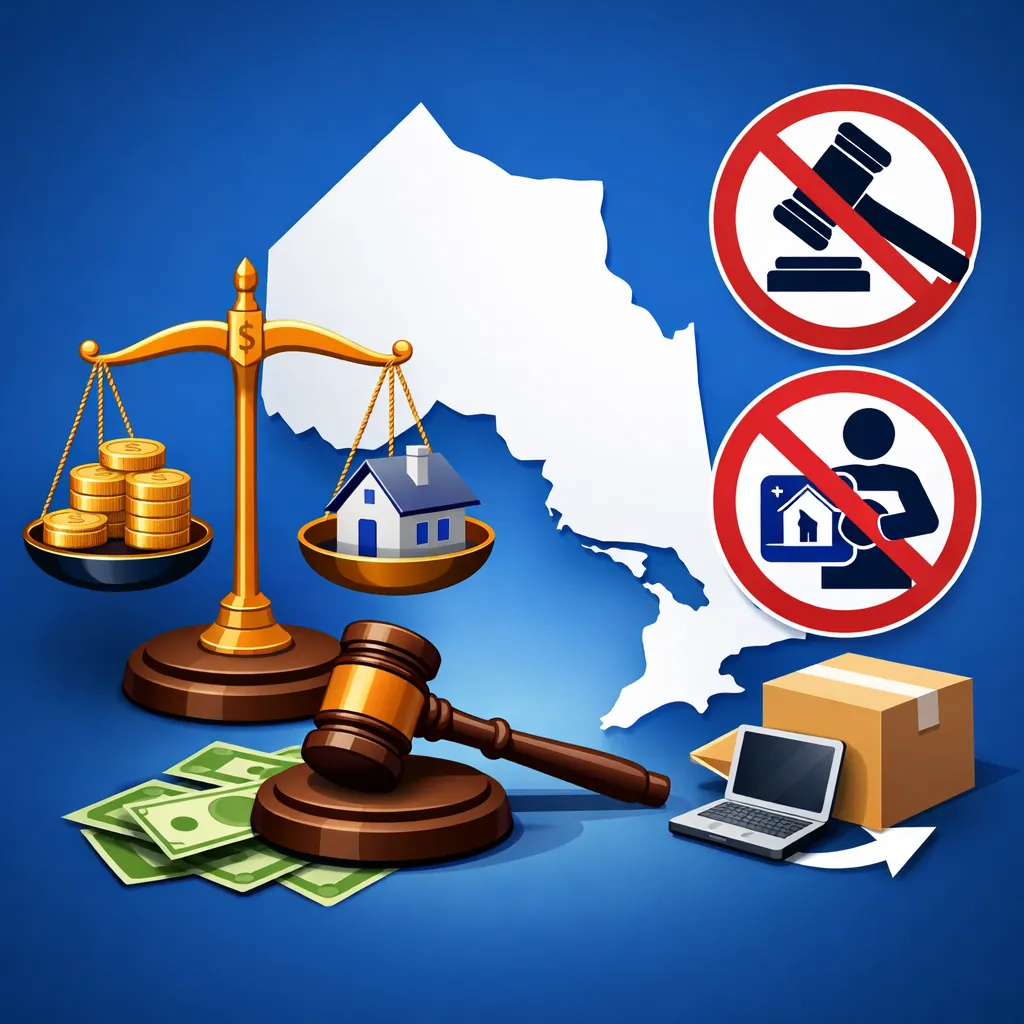
Small Claims Court Equitable Relief in Ontario (Grover v. Hodgins Explained)
⚖️ Small Claims Court equitable relief in Ontario: the straight answer
The answer is Yes, but with specific and significant limitations.
Ontario’s Small Claims Court can apply equitable principles and grant equitable remedies only when the end result is the payment of money or the return of personal property. That’s the key takeaway from the Ontario Court of Appeal’s decision in Grover v. Hodgins (2011). (WeirFoulds LLP)
If you walk into Small Claims asking for a pure “equity-only” order—like an injunction—you’re not being “bold.” You’re just asking the court for something it doesn’t have power to give. (WeirFoulds LLP)
🧩 Equity vs equitable relief: what you’re really asking for
People mix up two ideas:
- Equity (rules/principles): fairness-based legal rules courts use to reach a just result (like unjust enrichment).
- Equitable relief (remedies/orders): what the court actually orders at the end (like an injunction, rescission, or specific performance).
Small Claims can use equity as the reasoning—but it can’t hand out every equity-style remedy. The court stays inside its “money or stuff” lane. (WeirFoulds LLP)
📜 The Courts of Justice Act clash: s.96 vs s.23
The confusion comes from two sections of the Courts of Justice Act that look like they’re fighting each other:
- Section 96(3): says only the Court of Appeal and the Superior Court of Justice—exclusive of the Small Claims Court—may grant equitable relief (unless otherwise provided). (Government of Ontario)
- Section 23(1): gives Small Claims jurisdiction in actions for payment of money or recovery of possession of personal property up to the prescribed limit. (Government of Ontario)
And here’s the modern reality check: the Small Claims monetary limit is $50,000 (it used to be $35,000—so older notes and older exam materials often show $35k). (Ontario Courts)
🏛️ Why Small Claims can use equity at all
Small Claims Court isn’t a separate “toy court.” It’s a branch of the Ontario Superior Court of Justice, designed for faster, cheaper civil justice.
Ontario’s Superior Court itself describes Small Claims as the “People’s Court,” hearing disputes up to $50,000 where someone wants money or the return of personal property. (Ontario Courts)
That “people’s court” design is exactly why the system needs equity principles: real disputes don’t always fit neat contract boxes, and judges still need fair tools to fix unfair outcomes—as long as the fix ends in money or personal property. (WeirFoulds LLP)
🚪 Grover v. Hodgins: the “money or property” gate
In Grover v. Hodgins, 2011 ONCA 72, the Court of Appeal resolved the tension.
What the Court said (in practical terms):
- Equity is administered: under s. 96(1), Ontario courts administer equity and common law together (including Small Claims). (Miller Thomson)
- “Exclusive” doesn’t mean “no equity ever”: it means Small Claims cannot grant standalone equitable remedies that fall outside its statutory mandate. (WeirFoulds LLP)
- Jurisdictional gatekeeper: Small Claims can grant equitable relief only if the final result is money or return of personal property (not injunctions, not declarations, not specific performance). (WeirFoulds LLP)
Leave to appeal to the Supreme Court of Canada was denied. (Supreme Court of Canada)
✅ The remedy menu: what Small Claims can order
After Grover, you can think of Small Claims like a vending machine: it has lots of buttons, but every button drops either money or personal property.
Here’s the clean division:
| Permitted (Can Grant) | Prohibited (Cannot Grant) |
|---|---|
| Unjust enrichment: payment of money to prevent unfair gain | Injunctions: orders to stop / start doing something |
| Rescission: unwind a contract so money paid is returned | Specific performance: order a person to complete a specific act (finish the job) |
| Quantum meruit: pay the fair value of services | Declaratory relief: statement of rights with no money award |
| Return of personal property: order the item returned (car, equipment, goods) | Trust claims over real estate: e.g., constructive trust in land |
That’s the lane. Stay in it, and equity can help you. Step out of it, and the court will shut it down. (WeirFoulds LLP)
⛔ The hard no list: what Small Claims cannot order
Small Claims generally cannot grant:
- Injunctions (“cease and desist,” “don’t contact me,” “take the sign down”) (Government of Ontario)
- Specific performance (“finish the renovation,” “deliver the custom product,” “transfer the shares”) (Government of Ontario)
- Declarations (“the court declares I own X” without money attached) (Miller Thomson)
- Equitable real property remedies (especially anything tied to land/real estate) (WeirFoulds LLP)
If you need these, you’re usually in Superior Court territory.
💰 Unjust enrichment: the workhorse claim
Unjust enrichment is the most common way equity shows up in Small Claims.
In plain English:
If someone benefited, you lost something, and there’s no good legal reason for it, the court can order them to pay you back.
Grover v. Hodgins itself dealt with this kind of logic—using equity to justify a money award inside Small Claims jurisdiction. (WeirFoulds LLP)
Common Small Claims unjust enrichment examples:
- You paid for materials that stayed with the other party.
- You did work, they kept the benefit, then refused to pay.
- Someone kept your deposit with no real justification.
🔁 Rescission: getting your money back after a bad deal
Rescission means “undo the deal.”
If you can show the contract should be unwound (misrepresentation is a common reason), Small Claims can use rescission-style reasoning as long as the order ends in money back (or personal property returned). (WeirFoulds LLP)
Example:
You bought equipment based on false claims. You return the equipment (or it gets returned), and the court orders the seller to refund the purchase price—that fits.
But if you want the court to force a business to perform a contract going forward, that drifts into specific performance, and Small Claims usually can’t do it. (Government of Ontario)
🧮 Quantum meruit: “pay me what it was worth”
Quantum meruit means “the amount it’s worth.”
This is perfect for Small Claims because it’s basically equity’s way of saying:
“Even if the contract is messy, you don’t get free labour.”
If you provided services and the other side accepted them, the court can award a fair value payment—again, a money judgment, which fits the mandate. (WeirFoulds LLP)
🧾 Practical pleading tips for Form 7A (Plaintiff’s Claim)
If you want Small Claims Court equitable relief, write your claim so the judge can actually grant it.
Practical rules:
- Ask for money (or return of personal property), not court “commands.”
- Put the equity theory in the reasons, but keep the remedy in dollars.
- Plead in layers: contract or unjust enrichment or quantum meruit.
A clean “Relief Requested” section might look like:
- Judgment for $X for unjust enrichment (or quantum meruit),
- Pre-judgment and post-judgment interest (if applicable),
- Costs (within Small Claims rules).
If you write “I want an injunction,” you’re handing the defence a free and easy target.
🛡️ Practical defence tips for Form 9A (Defence)
If you’re defending a Small Claims equity claim, attack the gate and the elements.
Good defence angles:
- Wrong remedy: they’re really seeking an injunction/specific performance dressed up as “money.” (If so, push jurisdiction.) (Government of Ontario)
- Juristic reason: there was a legal reason for the benefit (contract terms, gift, settlement, statute).
- No real benefit: you didn’t actually receive what they claim you did.
- Value dispute: even if quantum meruit applies, the fair value is much lower.
And don’t ignore settlement conference leverage—Small Claims is built to settle early.
🧠 Strategy: picking the right court and not wasting a year
Here’s the blunt truth: forum mistakes cost people more than “bad facts.”
Use Small Claims when:
- You want money, or
- You want your personal property returned, and
- The amount is within the limit (now $50,000). (Ontario Courts)
Consider Superior Court when:
- You need an injunction, specific performance, or a declaration.
- The dispute is tied to real estate.
- The remedy is the point, not the money.
🧷 Common traps that get claims struck or dismissed
These are the classic self-rep pitfalls:
- Asking for relief the court can’t grant (injunctions, declarations).
- Writing a story but not proving the elements (especially for unjust enrichment).
- Suing the wrong legal party name (business names matter).
- Claiming $50k+ and thinking the judge will “just reduce it.”
Small Claims is friendly, but it’s not a free-for-all. It runs on rules and clean remedies. (Ontario Courts)
✅ Conclusion: use equity, but aim for a money judgment
The Small Claims Court has this limited equitable jurisdiction because, as a branch of the Superior Court, it must be able to apply the “rules of equity” to reach a just result. However, its powers are strictly limited by its statutory mandate, which is confined to resolving simple disputes over money and tangible personal goods. (Ontario Courts)
If you keep your remedy request inside that lane, Small Claims Court equitable relief can be powerful. If you don’t, you’ll spend months arguing jurisdiction instead of winning your case.
If you’d like help drafting a Plaintiff’s Claim or a Defence that uses these equitable principles properly, reach out through Contact or open a ticket at Helpdesk Support.
Online research verification: Jurisdiction limit and mandate verified with Ontario Superior Court of Justice guidance and Ontario regulations; equity limits verified with Grover v. Hodgins summaries and statutory references. (Ontario Courts)
🔗 Sources & References
- Ontario Superior Court of Justice – Small Claims Court (Ontario Courts)
- Ontario Regulation 626/00 – Small Claims Court Jurisdiction (Government of Ontario)
- Courts of Justice Act (Ontario) (Government of Ontario)
- Supreme Court of Canada docket (leave record reference) (Supreme Court of Canada)
- Department of Justice Canada – How courts are organized (Ministère de la Justice)
- Case summary: Grover v. Hodgins (WeirFoulds) (WeirFoulds LLP)
Related Videos:

Related Posts:
What is the monetary jurisdiction of the Small Claims Court in Ontario as of 2026?
Question: What are the two divisions of the Courts of Ontario?
Question: Which one of the following is not a regulation created under the CJA?
Question: Which statute establishes the organization of the courts in Ontario?