
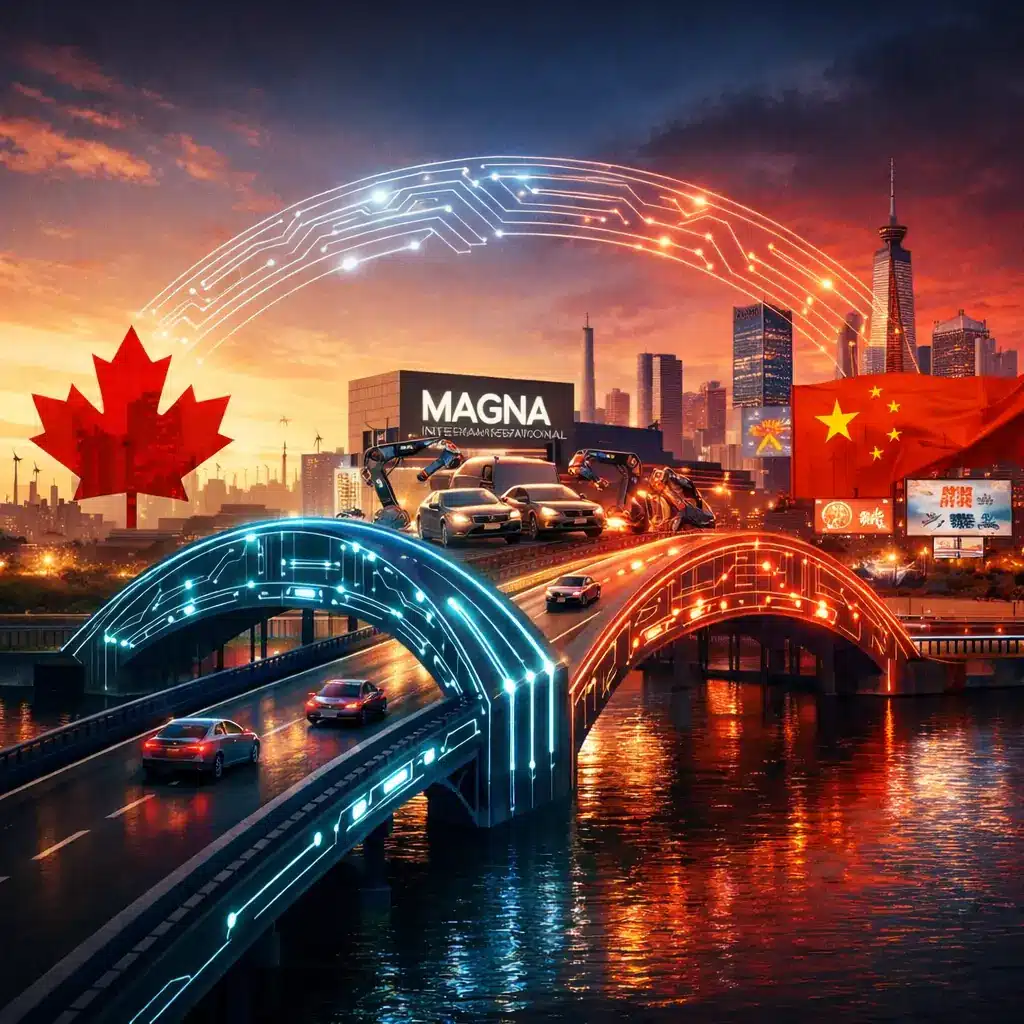
Magna EV strategy: Canada’s 2026 survival plan for the EV era
Canada's auto sector is staring at a brutal truth: if we only fight for assembly, we lose the future. The Magna EV strategy below is a hard pivot—Magna International stops playing "parts supplier" and becomes the integration gatekeeper every EV brand needs to build and sell in Canada.
This is a strategy memo, not investment advice. It's built for the 2026 landscape: managed market entry for Chinese EVs, affordability pressure, software-defined vehicles, and regulators who now treat cybersecurity like seatbelts. Therefore, the winning move is to own the compliance-and-security layer that OEMs can't swap out without pain.
🔥 Magna EV strategy: the 2026 reality check for Canada’s auto industry
EV platforms now evolve like smartphones: faster cycles, heavier software, and ruthless cost-down. Meanwhile, consumers demand lower prices and governments demand secure, certifiable vehicles. In addition, supply chains are reorganizing around batteries, compute stacks, and manufacturing velocity.
If Canada remains a "bolt-together" zone, we become an automotive museum. If we build the integration and compliance layer, we stay relevant. The Magna EV strategy is about choosing the second path.
📜 Magna EV strategy: from 100% surtax to a managed quota
In 2024, Canada imposed a 100% surtax on Chinese-made EVs, stacked on top of the existing most-favoured-nation (MFN) tariff rate. However, January 2026 brought a reset: Ottawa and Beijing announced an agreement-in-principle that introduces a country-specific EV quota at the MFN rate for quota volumes.
A managed quota is not a full open door. It's a controlled experiment that can be used to force domestic investment, jobs, and localization—if Canada designs the rules aggressively. That's the policy window the Magna EV strategy exploits.
🚪 Magna EV strategy and the 49,000-unit quota at 6.1%
Canada's agreement-in-principle sets an initial quota of 49,000 EVs per year at the MFN tariff rate of 6.1%. Ottawa frames this as less than 3% of Canada's new vehicle market and as a return to near pre-friction volumes. Therefore, it's small enough to manage, but big enough to reshape incentives.
Multiple reports also describe the quota scaling toward 70,000 units within five years. If that trajectory holds, the smart move is to build Canadian production capacity in the early years—before the volume pressure peaks.
💸 The affordability mandate is the real grenade
The agreement-in-principle also sets an affordability ramp: by 2030, 50% of the quota is reserved for EVs with an import price of $35,000 CAD or less. In other words, Canada is actively creating room for lower-cost EVs that legacy production cannot reliably hit at scale.
So the question becomes simple: who supplies the affordable EV backbone that meets Canadian safety rules and Canadian security expectations? The Magna EV strategy answers: Magna does—by bridging to high-volume Chinese platforms while keeping the compliance shell Canadian.
📉 Why the “steady margin recovery” story is too small in 2026
Wall Street loves predictable cycles and "margin recovery" language. Canada should not. A ~2.5% margin story on a roughly US$41.8B revenue base is passive in a decade where platform control decides who lives.
Margin improves when you become essential. You don't become essential by selling one more bracket. You become essential by owning the interface between platform, regulator, grid, and consumer expectations—the core of the Magna EV strategy.
📸 The “camera mandate” mindset for the EV era
When a feature becomes mandatory, the supplier who standardizes it wins. Rear-view cameras turned into a "must-have," and Magna built a dominant position in that wave. The Magna EV strategy repeats the play: identify what becomes mandatory in EVs and own it.
In 2026, the "mandates" aren't only safety features. They include cybersecurity management, software update governance, secure gateways, and certifiable compute integration. If Magna owns the "must-have" integration layer, OEMs don't have a realistic Canadian alternative.
🧱 Magna EV strategy: define the EV backbone OEMs can’t avoid
Canada should stop thinking in parts and start thinking in platforms. The EV backbone is the stack of subsystems that determines range, charging speed, safety, reliability, and updateability. Therefore, Magna should productize this as a repeatable "Canadian-ready EV blueprint."
In practical terms, that blueprint should include a modern compute pathway—think domain controllers and NVIDIA Drive-compatible gateway ECUs—plus 800V-ready power, winter-proof thermal, and audit-ready cybersecurity governance. That's where the Magna EV strategy stops being a slogan and becomes a spec sheet.
| Backbone Layer | Why It Creates Lock-In | Magna's "Gatekeeper" Move |
|---|---|---|
| eDrive + inverter + power electronics | Hard to redesign without efficiency hits and new validation cycles | Bundle scalable eDrive options and standardize interfaces |
| 800V readiness + charging integration | Fast charging becomes a buying decision, not a feature | Offer winter-validated 800V reference designs |
| Thermal management (battery + cabin) | Cold-weather performance is non-negotiable in Canada | Own climate-tuned thermal packages and controls |
| Gateway ECU + domain controller integration | Cybersecurity + OTA governance sit here; regulators care | Provide a Canadian gateway stack with strict update policy |
| Compliance evidence + validation toolchain | Docs and test evidence take time; switching costs explode | Sell "certification-ready" packages with repeatable artifacts |
When Magna sells a backbone package instead of disconnected parts, it controls interfaces and standards. Consequently, it gains pricing power and strategic leverage. That leverage is the point of the Magna EV strategy.
🤝 Magna EV strategy: replicate Graz contract assembly in Ontario
Ottawa explicitly expects Chinese joint-venture investment in Canada with "trusted partners." That phrasing is basically an invitation to pick a Canadian gatekeeper. The Magna EV strategy says Magna should step forward as the default partner.
Magna's proof point already exists: its complete vehicle operations in Graz, Austria won an assembly program with XPENG, with serial production planned to begin in Q3 2025. Therefore, "contract manufacturing for Chinese EVs" is not theory—it's a model Magna already runs.
The Ontario version should start as contract manufacturing for one high-volume model, then expand into localized subsystem production. That's how a bridge turns into a toll booth.
⚡ Subsystem dominance: learn China’s tempo, then bring it home
To pull off a "camera mandate" style lock-in, Magna needs subsystem dominance in power and integration. Magna also deepened its China footprint with a Wuhu facility to produce eDrive systems starting with Chery, which shows it can operate at the high-volume, cost-down edge. Therefore, the play is to absorb that manufacturing tempo and deploy it in Canadian plants.
The point is not to "become Chinese." The point is to become cost-competitive and fast while keeping Canadian governance over security, validation, and compliance. That's the core tension the Magna EV strategy solves.
🔐 Security as a product: turn “spy car” fear into a revenue line
Every Chinese EV conversation in Canada hits the same wall: sensors, data, and trust. Instead of pretending that fear will vanish, Magna should monetize it. The Magna EV strategy makes Magna the "security firewall" between foreign platforms and Canadian roads.
Regulators increasingly expect manufacturers to operate cybersecurity management systems, and UN Regulation No. 155 formalizes that expectation. In parallel, vendors like BlackBerry QNX advertise safety and cybersecurity certifications (including ISO/SAE 21434) as a foundation for safety-critical vehicle domains.
🛡️ What a Canadian “security firewall” actually includes
"Security" is not a sticker; it's architecture, process, and control. Therefore, the firewall has to be a real integration package that can survive audits, recalls, and headlines. If it's vague, it fails.
- Canadian gateway + OTA governance: Magna controls update signing, rollback policy, and patch cadence.
- Data minimization defaults: collect only what's needed for safety and service, not "because we can."
- Secure partitioning: isolate infotainment and third-party apps from safety-critical domains.
- Supply-chain attestation: maintain SBOM-style traceability for critical software components.
- Independent validation: publish repeatable test evidence for cybersecurity and update integrity.
When Magna sells this as part of the backbone, OEMs get a fast path to acceptability. Meanwhile, Canada gets a defensible narrative: local control over the security and compliance layer. That's a competitive advantage baked into the Magna EV strategy.
🏛️ How Ottawa can force localization without looking protectionist
Canada can attach conditions to quota access that encourage local jobs and investment. The agreement-in-principle anticipates joint-venture investment with trusted partners, which creates policy room. Therefore, Canada should reward assembly, subsystem production, and compliance work performed domestically.
- Import credits tied to Canadian build: the more you build here, the more quota access you earn.
- Milestones with deadlines: pilot assembly, then subsystem localization, then local validation labs.
- Security governance requirements: update control, data governance, and audit rights must live in Canada.
If Ottawa sets these rules, the Magna EV strategy becomes a national tool, not just a corporate plan. It also prevents "import-only" behavior that leaves Canada holding the bag.
🌎 Export logic: make “Canadian-secured” vehicles globally sellable
Canada should not build only for Canadian buyers. The real upside is exporting Canadian-assembled, Canadian-secured EVs into markets that demand strong compliance narratives. Therefore, the security firewall and validation artifacts become export enablers, not just domestic politics.
When a vehicle program can produce audit evidence, controlled OTA processes, and clean supply-chain documentation, certification gets easier. That advantage compounds as software update regulation tightens, which is why the Magna EV strategy must treat compliance as a product.
🧨 The hard risks, and how to hedge them
This plan has landmines. The biggest one is geopolitical whiplash: a single policy swing can chill JV enthusiasm overnight. Therefore, Magna should engineer optionality into every phase.
- Risk: U.S. backlash → Hedge with Canadian control over security, data governance, and update signing.
- Risk: "spy car" headlines → Hedge with audit rights and credible third-party testing.
- Risk: cost overruns → Hedge with phased ramps and contract manufacturing discipline.
- Risk: OEM reluctance → Hedge with a turnkey "Canada-ready" package that reduces time-to-market.
In short, the Magna EV strategy needs to be modular, defensible, and resilient to policy shock. If it's not, it won't survive first contact with reality.
🧍♂️ Why Canadian consumers should want more competition (and fewer monopolies)
For Canadian buyers, the biggest win from managed entry and local assembly is simple: real competition. When a market is dominated by a small number of OEMs and dealer groups, prices drift up, incentives shrink, and the consumer gets fewer choices. However, when credible new EV brands enter with serious volume and price pressure, the whole system has to respond.
More competition can benefit Canadians in four direct ways:
- Lower transaction prices: even buyers who don't choose a Chinese-platform EV can benefit because incumbents have to cut pricing, improve incentives, or offer better trims for the money.
- More features at the same price: competition pushes OEMs to include tech (ADAS, larger batteries, better infotainment) that used to be locked behind premium trims.
- Better warranty and service terms: entrants often compete with longer warranties and bundled maintenance, forcing incumbents to tighten up.
- Faster innovation cycles: software-defined vehicles improve through updates, but only when OEMs feel pressure to ship improvements quickly.
The key is that Canada shouldn't swap one monopoly for another. The goal is a competitive ecosystem where Magna's "backbone" role sets standards for security and compliance while multiple brands compete on price, quality, and service. That's how Canadian consumers get the benefits of competition without sacrificing national safety and data governance.
🗺️ A 24-month execution plan for the Magna EV strategy
The next two years decide whether Canada builds EVs or merely buys them. Therefore, execution needs a clock, not a wish list. Here's a practical sequence that fits the quota timeline.
- 0–3 months: publish a "Canadian EV backbone" reference architecture and invite OEMs to build on it.
- 3–6 months: secure a pilot Ontario contract-assembly program for one high-volume EV model.
- 6–12 months: stand up a Canadian cybersecurity + OTA governance lab with audit-ready deliverables.
- 12–18 months: localize two critical subsystems (thermal + gateway/ECU) to lock in Canadian content.
- 18–24 months: add a second model line and negotiate export pathways using the compliance stack.
Notice the theme: speed first, lock-in second, scale third. That's how you turn a quota into a domestic industry reboot.
❓ Magna EV strategy FAQs
❓ What is the Magna EV strategy?
The Magna EV strategy is a plan for Magna to become Canada's EV backbone architect—owning integration, compliance, and security layers that OEMs rely on to build here.
❓ What is the 49,000 EV quota in Canada’s 2026 framework?
It is an initial country-specific quota that allows 49,000 Chinese EVs per year to enter Canada at the MFN tariff rate, under the agreement-in-principle announced in January 2026.
❓ What tariff rate applies within the quota?
Within the quota, the MFN tariff rate of 6.1% applies, rather than the 100% surtax used for Chinese EVs in 2024.
❓ Why is the affordability requirement a big deal?
Because the framework aims for 50% of quota vehicles to be priced at $35,000 CAD or less by 2030, forcing the market toward lower-cost EV platforms.
❓ How does the Magna EV strategy help Canadian jobs?
It ties managed market entry to local assembly, subsystem localization, and local validation work, which keeps more value in Canada than import-only models.
❓ What does “camera mandate strategy” mean in EV terms?
It means owning an essential, standardized layer—like secure gateways and compliance artifacts—so OEMs can't easily build EVs in Canada without Magna's package.
❓ Why work with Chinese EV platforms at all?
Because Chinese EV makers often lead on cost and manufacturing speed, and Canada needs access to that tempo while keeping control over compliance and security.
❓ What proof exists that Magna can assemble Chinese EVs?
Magna announced an XPENG vehicle assembly program in Graz, Austria, with serial production planned to begin in Q3 2025.
❓ Which subsystems create the strongest lock-in?
Power electronics and eDrive, thermal systems, gateway/domain controllers, and compliance evidence toolchains create the highest switching costs.
❓ What is UN R155 and why does it matter?
UN R155 is a vehicle cybersecurity regulation that requires manufacturers to manage cybersecurity risks and demonstrate cybersecurity management processes.
❓ Where does BlackBerry QNX fit into the Magna EV strategy?
QNX positions its safety-focused OS as certified to key safety and cybersecurity standards, which can support audit-ready, safety-critical vehicle domains.
❓ What’s the biggest risk to the Magna EV strategy?
Geopolitical whiplash and security optics are the biggest risks, so the plan needs transparent governance, audit rights, and phased execution.
❓ Is this investment advice?
No. This is a strategic framework for industrial policy and business positioning, not a recommendation to buy or sell securities.
❓ Could the quota be used to force local assembly?
Yes. Canada can tie quota access to milestones like Ontario assembly starts, local supplier content, and Canadian audit rights over software updates.
❓ How does the Magna EV strategy reduce EV prices?
It combines high-volume platforms with Canadian localization and streamlined validation, cutting rework and time-to-market costs that inflate sticker prices.
❓ Would Canadian legacy automakers benefit from this backbone?
They can. A standardized backbone and compliance toolchain can shorten development cycles for any OEM building in Canada.
❓ What’s the first “must-have” component to standardize?
The gateway and OTA governance layer is the fastest path to lock-in because it touches security, updates, data, and regulator expectations.
❓ What’s the fastest Ontario pilot that makes sense?
A single high-volume compact crossover EV model is ideal, because it matches Canadian demand and gives suppliers immediate learning at scale.
✅ The takeaway: Canada needs a gatekeeper, not another supplier
The 49,000-vehicle quota is not just a trade number. It's an opening bell for a rebuild of how Canada competes in EVs. If Magna treats it as "interesting upside," we drift; if Magna executes the Magna EV strategy, it becomes the landlord of Canada's EV ecosystem.
Canada's win is not "more assembly." Canada's win is owning the tech interfaces, the security governance, and the compliance evidence that make modern EVs acceptable. That's how we avoid becoming an automotive museum and stay a real manufacturing country.
📚 Sources & references
- Global Affairs Canada: Agreement-in-principle backgrounder (EV quota and affordability)
- Prime Minister of Canada: Strategic partnership release (EV quota context)
- Canada Border Services Agency: Customs Notice 24-32 (China Surtax Order, 2024)
- Magna International: XPENG vehicle assembly program (Graz, Austria)
- Magna International: Wuhu eDrive facility (serving Chery)
- BlackBerry QNX: QNX OS for Safety certifications
- AP News: Canada-China tariff deal reporting (quota scaling)
