Approx. read time: 10.4 min.
Post: Windows Recall Security: Risks, Fixes, and Safe Settings
 If TikTok is a Threat to My Security, Why Aren’t Google and Meta?
 The Science of Blood Sugar Practical Advice to Manage Glucose Levels Effectively
Windows Recall Security: Risks, Fixes, and Safe Settings
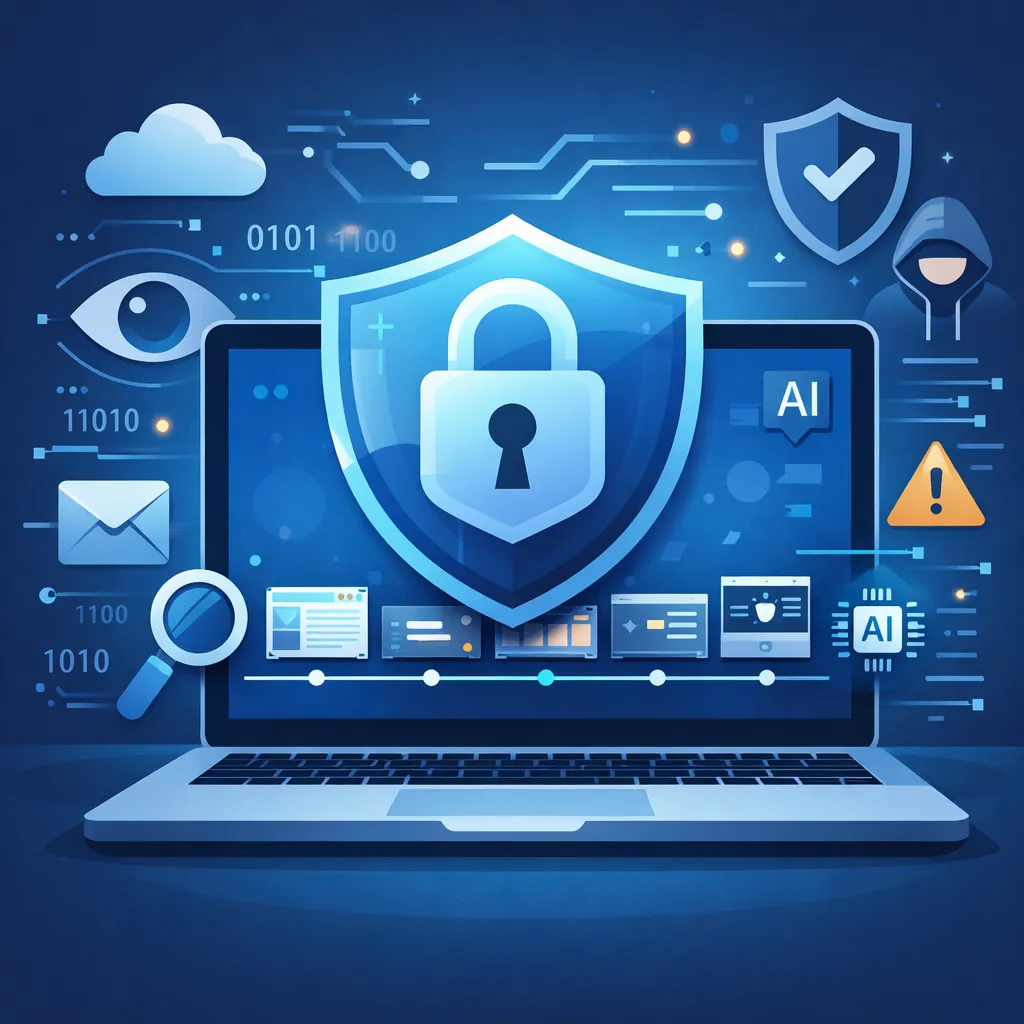
Windows Recall security has become one of the most debated changes to Windows 11 in years. Recall is designed to help you "retrace your steps" by saving snapshots of what you saw on your PC, then letting you search it with natural language. (Microsoft Support)
That's the productivity pitch. The security reality is more complicated: early previews drew fierce criticism, Microsoft delayed and redesigned the feature, and privacy-minded apps started blocking Recall. (Reuters)
If you want the straight story, this guide breaks down what Recall does, what changed, what risks still exist, and the safest settings to use today.
🧠 What Windows Recall Security Is Trying to Do
Recall is meant to give your PC a searchable "memory." You can describe what you remember ("that recipe," "the chart," "the message") and Recall tries to pull up the moment you saw it. (Microsoft Support)
Microsoft positions Recall as on-device: snapshots are stored locally, and search is powered by local OCR and indexing. (Microsoft Support)
In plain English: it's like browser history, but for your whole screen.
📸 How Recall Captures “Snapshots”
Recall takes periodic snapshots of your screen activity and stores them so you can scroll a timeline or search later. In early reporting, Recall was described as taking a screenshot every few seconds (including "every five seconds" in preview-era coverage). (WIRED)
Modern Recall is still snapshot-based, but the story now hinges less on "how often" and more on how it's protected and who can access it. (Microsoft Learn)
🔎 What Recall Indexes (And Why That Matters)
Recall uses OCR (optical character recognition) locally to turn text you see on-screen into searchable data. (Microsoft Support)
That's powerful… and dangerous if mishandled. OCR can capture:
- Private chats you view (even if you later delete them in the app)
- Documents you open briefly
- One-time codes, addresses, invoices, account screens
It's not "keylogging," but it can be close enough in real-world impact if sensitive text appears on screen.
🎯 The Promise vs. the Attack Surface
The promise: "Find anything you saw." (The Official Microsoft Blog)
The attack surface: "A rich pile of high-signal personal and work data, stored on endpoints."
This is why Windows Recall security became a headline. Endpoints (laptops) are the #1 place criminals target with infostealers and session theft. If malware lands on your machine, Recall becomes a "supercharger" for what can be stolen quickly.
🧨 Why Researchers Freaked Out Early
Early preview analysis said Recall data could be extracted too easily, with snapshots and indexed content stored in ways that were not sufficiently protected. That's what triggered the "spyware / stalkerware" comparisons in the public discourse. (WIRED)
Microsoft's response wasn't "nothing to see here." They delayed release, shifted to opt-in behavior, and added layers like Windows Hello gating and stronger encryption. (Reuters)
🧪 TotalRecall and the “Proof” That Scared Everyone
Security strategist Alex Hagenah created a demo tool ("TotalRecall") during the early wave of concern to show how Recall's recorded data could be extracted and reviewed. The point wasn't to hand criminals a blueprint—it was to prove that weak protection would be abused. (WIRED)
The practical takeaway: if Recall's stored data is readable after an attacker gains access on the device, it becomes a high-value target.
🧯 Windows Recall Security Threat Models That Actually Matter
Let's be brutally practical. Here are the real-world situations that define Windows Recall security:
- Infostealer / malware on the same user session
If malicious code runs as you (or can read your profile), it can often steal more than passwords. Recall can increase the "loot." - Shared device / second account access
Modern Recall is designed to prevent other users on the same PC from viewing your snapshots, but endpoint misconfigurations are common in real homes and small businesses. (Microsoft Learn) - Insider risk / BYOD workplace mess
BYOD + local snapshots of corporate data = compliance nightmares if the wrong settings are used. - Domestic safety risk if someone has access to the device
This was one of the most cited ethical concerns in the backlash phase. (Reuters)
🧱 What Microsoft Changed (The Big Windows Recall Security Rebuild)
After the initial backlash, Microsoft made several major shifts:
- Opt-in snapshot saving: users must choose to enable saving snapshots (and admins can control it in managed environments). (Microsoft Learn)
- Windows Hello gating: Recall requires identity confirmation via Windows Hello, with biometric sign-in enabled. (Microsoft Learn)
- "Just-in-time" decryption + stronger encryption: snapshots and associated data are encrypted, with keys protected via TPM and operations happening within a protected environment (VBS Enclave). (Microsoft Learn)
- Admin controls: Microsoft published IT management guidance for Recall (policies and security architecture). (Microsoft Learn)
This is the most important update for Windows Recall security: the "plain text database" era is not the end-state Microsoft is aiming for. (Microsoft Learn)
🧾 Windows Recall Security Table: Risks vs. Fixes
| Risk | What could be exposed | Best mitigation |
|---|---|---|
| Malware in your user session | Snapshots + OCR text that shows what you viewed | Disable snapshots, strengthen endpoint security, keep Defender + updates current |
| Sensitive apps/screens get captured | Chats, invoices, account screens, internal dashboards | Use Recall filters/exclusions and consider browsers/apps that block Recall |
| Shared PC or poor account separation | Privacy leakage via misconfiguration or sloppy permissions | Separate accounts, strong Windows Hello, avoid shared admin accounts |
| BYOD corporate exposure | Customer data / confidential docs appearing in snapshots | Policy: disable Recall on work devices, or enforce strict exclusions and auditing |
🧩 Apps Started Blocking Recall (That’s a Signal)
Privacy-focused apps didn't just complain—they acted. Signal kicked off an early wave of blocking tactics, and later Brave and AdGuard also moved to block Recall by default (or provide strong controls), arguing that background captures can grab sensitive info. (The Verge)
This is a clear market vote: even with improvements, Windows Recall security is still "high-stakes" for certain apps.
⚙️ How to Disable Recall (Fast, Clean, and Current)
The simplest official path is inside Windows settings:
- Open Settings
- Go to Privacy & security
- Open Recall & snapshots
- Toggle off Save snapshots (Tom's Guide)
If you run a business or you're setting up a family PC, disabling snapshots is the no-drama option.
Want help locking down Windows settings without breaking performance? Use your own support pages like Contact or your Helpdesk page.
🧹 How to Delete Existing Recall Data
Turning off snapshots stops new captures, but it doesn't automatically erase what's already stored. In the same Recall & snapshots area, use the delete controls to remove existing snapshots. (Tom's Guide)
For shared devices, deleting stored snapshots is the step people forget—and it's the one that matters most.
🔐 The Encryption Debate (Why “At Rest” Isn’t the Whole Story)
Windows Recall security improvements include encryption, TPM-protected keys, and Windows Hello gated access. (Microsoft Learn)
But here's the uncomfortable truth: if malware runs inside your logged-in session, "encrypted at rest" is only part of the defense. This is not unique to Recall—this is how endpoint compromise works.
Microsoft itself emphasizes that UAC prompts and same-desktop elevation are not a hard security boundary in the way people assume. (Microsoft Learn)
So yes, encryption helps a lot. No, it's not magic.
🏢 Windows Recall Security for Business and BYOD
If you manage endpoints, you should treat Recall like a data-retention system:
- Decide: allowed or banned
- If allowed: define exclusions, retention, and acceptable use
- Train staff: "don't open sensitive customer records on personal machines"
Microsoft's IT guidance ("Manage Recall for Windows clients") is the correct starting point for enterprise controls. (Microsoft Learn)
🧑⚖️ Regulatory Pressure and Privacy Questions
Regulators and privacy watchdogs paid attention early, and the feature's design choices (opt-in, encryption, user control) are clearly shaped by that pressure and public response. (Reuters)
If you operate in regulated sectors (health, finance, legal), assume your compliance team will want Recall disabled unless proven safe for your workflows.
✅ Practical Checklist: Safer Recall or No Recall?
Use this as your decision filter:
- If you share a PC → disable snapshots
- If you handle client/customer data → disable snapshots
- If you use privacy-sensitive messaging → disable snapshots
- If you're a solo user on a hardened device and you like the feature → keep it opt-in only, use exclusions, and audit your security habits
Windows Recall security isn't about "Microsoft evil vs. Microsoft good." It's about whether your device is a safe place to store a searchable timeline of your life.
🚀 Conclusion: Make Recall Worthy of Trust
Recall can be genuinely useful—but it must be held to a higher standard than typical "nice-to-have" features. Microsoft has already moved the right direction with opt-in behavior, Windows Hello gating, and encrypted storage in protected environments. (Microsoft Learn)
Until Windows Recall security feels boring (in a good way), the smartest default for most people is simple: don't save snapshots.
If you want hands-on help tuning Windows privacy and security without breaking your daily workflow, send people to your contact page or your helpdesk.
❓ Windows Recall Security FAQ
❓ What is Windows Recall security really about?
It's about whether a searchable record of your screen activity is protected strongly enough against real endpoint threats. (Microsoft Learn)
❓ Does Recall send my snapshots to Microsoft?
Microsoft's documentation and IT guidance emphasize local storage and local processing for Recall on supported devices. (Microsoft Support)
❓ Is Windows Recall security "fixed" now?
It's improved with opt-in, Windows Hello gating, and encrypted storage, but risk depends on your threat model. (Microsoft Learn)
❓ Can malware steal Recall data?
If malware runs on your PC in your user session, it may be able to access sensitive local data—Recall can increase what's available. (Microsoft Learn)
❓ Is Recall enabled by default?
Microsoft moved Recall toward opt-in snapshot saving for users, with admin controls in managed environments. (Microsoft Learn)
❓ What does Recall use to search snapshots?
Recall uses OCR locally to make snapshots searchable. (Microsoft Support)
❓ Does Windows Hello matter for Windows Recall security?
Yes. Windows Hello authentication is part of the access control and decryption workflow. (Microsoft Learn)
❓ Can other users on my PC see my Recall timeline?
Microsoft says snapshots aren't shared with other users signed into the same device. (Microsoft Learn)
❓ How do I turn Recall off quickly?
Settings → Privacy & security → Recall & snapshots → toggle off "Save snapshots." (Tom's Guide)
❓ How do I delete saved snapshots?
Use the delete controls under Recall & snapshots after turning off saving. (Tom's Guide)
❓ Is this the same as Windows "Activity History / Timeline"?
No—Recall is a newer snapshot + AI search feature tied to Copilot+ PCs and modern Windows AI components. (Microsoft Learn)
❓ Why did Microsoft delay Recall?
Microsoft delayed broader rollout amid security and privacy concerns, moving it into Insider testing first. (Reuters)
❓ What is TotalRecall?
A demo tool referenced in early reporting that illustrated how Recall data could be extracted in weakly protected preview states. (WIRED)
❓ Do privacy apps block Recall?
Some apps (like privacy-focused messaging and browsers) have pushed back or implemented blocks/controls. (The Verge)
❓ Is Windows Recall security worse for BYOD?
Yes, because personal devices may store corporate data in snapshots unless policies disable it. (Microsoft Learn)
❓ Does UAC protect against all Recall abuse?
No—Microsoft notes common misconceptions about UAC and its security boundaries. (Microsoft Learn)
❓ Will Recall work on every Windows 11 PC?
Recall is tied to Copilot+ PCs and related Windows AI requirements/rollouts. (Microsoft Learn)
❓ What's the safest setting for most people?
Leave snapshot saving off unless you have a strong reason and a hardened device setup.
❓ What's the biggest Windows Recall security risk?
Endpoint compromise: if attackers run code on your machine, Recall can make data harvesting faster. (Microsoft Learn)
❓ Should Microsoft have shipped Recall at all?
It can be useful, but only if the default posture is conservative and the controls are genuinely reliable.
Sources & References
- Microsoft Support: Retrace your steps with Recall (Microsoft Support)
- Microsoft Learn: Manage Recall for Windows clients (Microsoft Learn)
- Reuters: Microsoft delays Recall on security concerns (Reuters)
- WIRED: TotalRecall demo and early Recall risks (WIRED)
- The Verge: Recall release and security changes (The Verge)
- Microsoft Learn: UAC misconceptions and boundaries (Microsoft Learn)
 If TikTok is a Threat to My Security, Why Aren’t Google and Meta?The Science of Blood Sugar Practical Advice to Manage Glucose Levels Effectively
Related Posts



About the Author: Bernard Aybout (Virii8)