
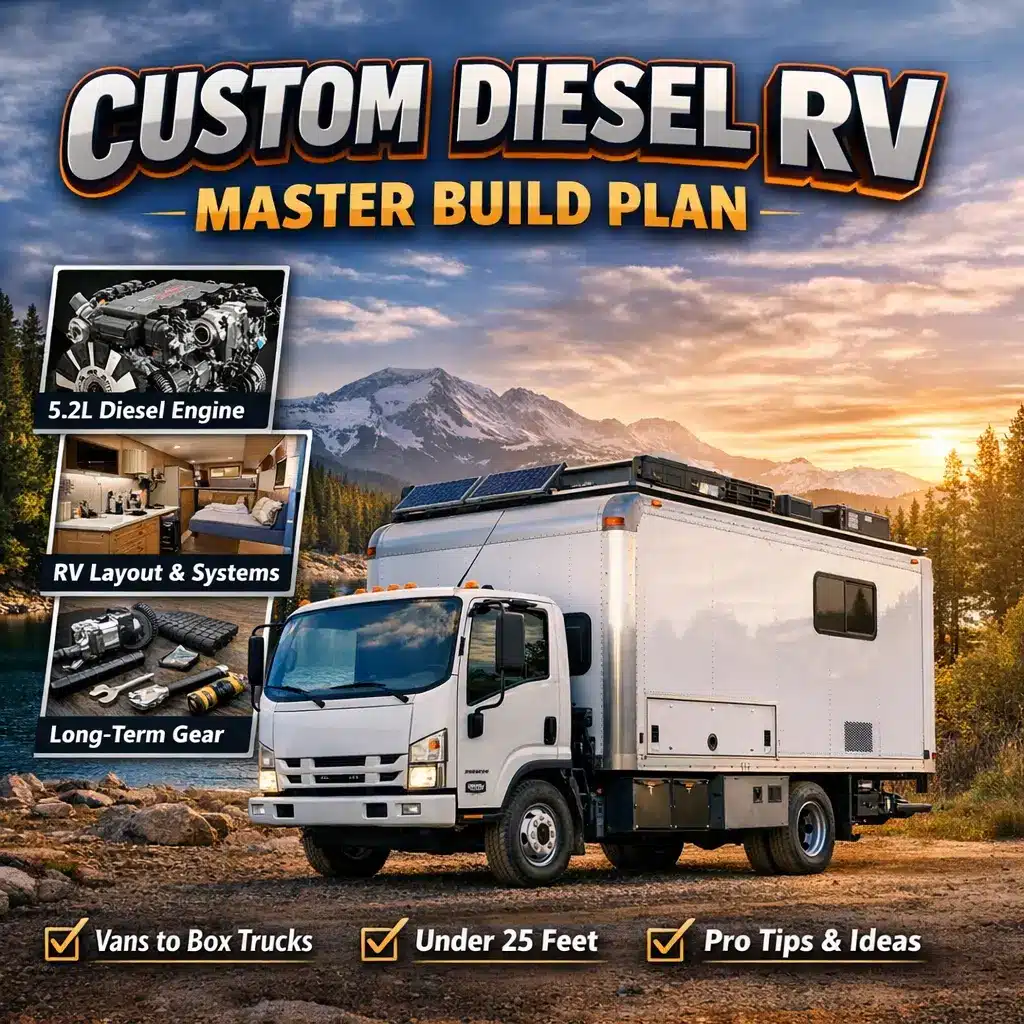
Custom Diesel RV Build: The Ultimate Under-25-Foot Box Truck and Van Conversion Guide
This custom diesel RV article is built from the uploaded master plan and reorganized for publishing. The original technical substance stays intact, the original diagrams stay in place, and the appendix material is folded into the body so readers do not have to bounce between the main plan and back-matter.
If you want one blunt takeaway before diving in, it is this: the best custom diesel RV is not the flashiest one. It is the one you can repair, weigh correctly, winterize, and actually live in without fighting your own systems every week.
What this guide covers: platform choice, electrical architecture, water, tanks, HVAC, kitchen, bath, storage, floor plans, off-grid systems, maintenance, long-term living, budget, vendors, and advanced technical guidance.
🚚 1. VEHICLE PLATFORM SELECTION
Research-verified note: Isuzu’s official N-Series diesel specs list the NPR-HD at 14,500 lbs GVWR and the NPR-XD at 16,000 lbs GVWR, while Isuzu’s company history still highlights its long-running low-cab-forward position in North America. See Isuzu N-Series diesel specs and Isuzu Commercial Truck of America.
🚚 1.1 Why the Isuzu NPR
The Isuzu NPR (and its siblings in the N-Series lineup) is the default recommendation for a custom diesel RV build under 25 feet for several compelling reasons. Isuzu has held the number-one position in low cab forward (LCF) truck sales in North America for decades, which translates directly into parts availability, dealer network density, and mechanic familiarity. The 5.2L Isuzu 4HK1-TC turbodiesel engine is a proven commercial workhorse with a reputation for longevity well past 300,000 miles when maintained on schedule. The low cab forward design gives you a flat, unobstructed cargo area behind the cab with no intrusion from wheel wells or drivetrain tunnels, which is critical for RV layout efficiency. The cab-over configuration also keeps the overall vehicle length short relative to the usable box length — a 16-foot box NPR is roughly 24 feet bumper to bumper, still fitting standard parking spots.
- NPR (standard): 14,001 lb GVWR, the workhorse of the lineup. Available in gas (6.6L V8) and diesel (5.2L turbo). The diesel is the correct choice for an RV build: better fuel economy, more torque at low RPM, and the ability to share fuel with a diesel generator and diesel heater.
- NPR-HD: 14,500 lb GVWR, slightly higher payload capacity. Same cab and engine options. Choose this if your build will be heavy (steel framing, large water tanks, extensive batteries).
- NPR-XD: 16,000 lb GVWR with the 5.2L diesel only. The best choice for a heavily built 18–20 foot box where payload margin matters. The XD designation adds heavier axles and suspension.
- NQR: 17,950 lb GVWR. Steps into CDL territory in some jurisdictions (over 16,001 lb). Only consider if you need a 20–22 foot box with extremely heavy build-out.
- NRR: 19,500 lb GVWR. Firmly requires a CDL in most US states and Canadian provinces. Overkill for most RV builds under 25 feet.
For the recommended 16-foot box build, the NPR or NPR-HD diesel on the 150-inch wheelbase is the sweet spot. For the 20-foot family build, step up to the NPR-XD on the 176-inch wheelbase. Both keep you under CDL requirements while providing ample payload.
🔹 1.2 Isuzu NPR Wheelbase and Body Pairing
| Wheelbase | Body length | Best for | Overall length |
|---|---|---|---|
| 109″ | 10–12’ | Too small for RV | ~18–20’ |
| 132.5″ | 12–14’ | Compact / weekender | ~20–22’ |
| 150″ | 16–18’ | Solo/couple full-time | ~23–25’ |
| 176″ | 18–20’ | Family / extended | ~26–28’ |
Common commercial box bodies come in 96-inch exterior widths, yielding approximately 88–91 inches of finished interior width after the flash-and-batt insulation assembly (2″ spray foam + 4″ mineral wool per side).
🔹 1.3 Large Van Platforms (Under 22 Feet Overall)
For builders who want the driving experience of a van rather than a cab-over truck, the three dominant platforms are:
- Mercedes Sprinter 2500 (170″ WB, high roof): The gold standard for van conversions. ~144″ cargo length, ~70″ interior width, ~76″ interior standing height. Diesel (2.0L turbo-4 or 3.0L turbo-6) provides excellent fuel economy. Well-supported aftermarket with extensive RV conversion parts available. Overall length ~24 feet.
- Ford Transit 350 (148″ WB, high roof): ~148″ cargo length, ~70″ interior width, ~81″ interior height (tallest of the three). Available with the 3.5L EcoBoost V6 (gas) or rare diesel. Widest aftermarket support due to Ford’s dealer network. Overall length ~22 feet.
- Ram ProMaster 3500 (159″ WB, high roof): ~159″ cargo length, ~75″ interior width (widest of the three due to FWD flat floor). Standing height ~76″. Front-wheel drive means a completely flat cargo floor with no drivetrain hump. Overall length ~22 feet.
Van trade-offs versus a box truck: you gain drivability, stealth, fuel economy, and access to regular parking. You lose interior width (70–75″ vs 89″), ceiling height (in some areas), dry bath capability (wet bath only at 70″ width), and service access (everything is tighter). A van is an excellent weekender or extended-trip vehicle but becomes cramped for true full-time living for more than one person.
🔹 1.4 Size Comparison: Van vs Box Truck
| Feature | Van 144″WB | NPR 14’ box | NPR 16’ box | NPR 20’ box |
|---|---|---|---|---|
| Interior length | ~144″ | ~168″ | ~192″ | ~240″ |
| Interior width | ~70″ | ~89″ | ~89″ | ~89″ |
| Bath type | Wet only | Wet only | Dry bath | Dry bath |
| Bed | E/W fixed | E/W or convert | N/S short queen | N/S full queen |
| Garage | Under bed | Under bed | Full rear | Full rear |
| Best for | Solo/couple trips | Solo full-time | Couple full-time | Family full-time |
| Overall length | ~22–24’ | ~20–22’ | ~23–25’ | ~26–28’ |
🛞 1.5 CTIS — Central Tire Inflation System
Install an automated central tire inflation system that allows real-time adjustment of tire pressure from the cab while driving. The system connects to the existing air brake compressor (or a dedicated compressor on non-air-brake chassis) and feeds each tire through rotary unions at the hubs. Benefits include optimizing traction on soft terrain by lowering pressure, extending tire life on pavement at full pressure, and detecting slow leaks early through continuous pressure monitoring. Pair the CTIS with a dashboard display showing live PSI per tire and configurable alerts for pressure drop thresholds.
- New idea: NEW IDEA: Even without full CTIS, install a six-sensor TPMS system covering all truck tires plus the spare. Many aftermarket TPMS units support Bluetooth or ANT+ dashboards and will alert on both low pressure and high temperature, catching developing blowouts before they happen.
🛞 1.6 Suspension Upgrades
- New idea: NEW IDEA: Install Sumo Springs, Timbren bump stops, or aftermarket rear air bags to handle the heavy build-out weight and improve ride quality. A sway bar upgrade on the rear axle reduces body roll during cornering and crosswind events. For the front end, consider upgraded steering stabilizer shocks. These upgrades cost relatively little but dramatically improve handling safety when the truck is loaded to near GVWR.
⛽ 1.7 Auxiliary Diesel Fuel Tank
- New idea: NEW IDEA: Install a secondary diesel fuel tank (50–100 gallons) to extend range between fuel stops. This is especially valuable for remote travel in northern Canada or the western US where diesel stations can be 200+ miles apart. The auxiliary tank feeds the main tank via a transfer pump, and also supplies the diesel generator and diesel cabin heater. Include a fuel polishing system (filter loop) on the auxiliary tank to prevent algae and water accumulation in stored diesel during long stationary periods.
⚡ 2. ELECTRICAL POWER SYSTEM
Research-verified note: Victron’s official Quattro 48/5000 120V manual confirms two AC inputs and the 48V model family used in this guide, and Cummins’ current Onan QD 8000 product page confirms the RV application, variable-speed operation, and 120V diesel model availability. See Victron Quattro manual and Cummins Onan QD 8000.

Figure 2.1 — Electrical system architecture: all sources feed the 48V battery bank through the Victron Quattro
🔹 2.1 48V DC Architecture
The truck’s native electrical system is 12V, but the house system should be built on a 48V DC backbone for significantly lower current draw (and therefore smaller wire gauges and reduced voltage drop) at the same wattage. Install a custom high-output alternator or a DC-DC converter setup that provides 48V DC charging from the engine while driving, delivering approximately 5,000 watts of charge capacity during transit. This allows the battery bank to absorb serious energy on driving days without relying solely on solar or the generator.
- New idea: NEW IDEA: For van builds where a custom 48V alternator is impractical, use a Victron Orion-Tr Smart 12/48 DC-DC charger to step up from the factory alternator to the 48V house bank. Multiple units can be paralleled for higher charge current.
🔋 2.2 Battery Bank

Figure 2.2 — 48V wiring topology: battery to bus bar to distribution, with fuse ratings and grounding
Use a 48V lithium iron phosphate (LiFePO4) battery bank sized for the load profile. LiFePO4 chemistry offers long cycle life (3,000–5,000+ cycles), flat discharge curves, built-in BMS protection, and far better energy density by weight than AGM or lead-acid. Size the bank for at least two full days of off-grid autonomy at normal consumption. Mount the batteries low, near the axle, in a ventilated but thermally managed compartment inside the heated envelope. Cover the battery compartment with a fire-rated Kevlar/aramid blanket as a containment layer in the unlikely event of thermal runaway.
- New idea: NEW IDEA: Battery heating pads: If operating in Canadian winters, install thermostatically controlled silicone heating pads on the battery cells. LiFePO4 cells cannot safely accept charge below 0°C, and heating pads ensure the BMS never locks out charging during cold snaps.
- New idea: NEW IDEA: Battery capacity monitor with historical logging: Track daily charge/discharge cycles, depth of discharge, and capacity fade over time. This data helps predict when cells need balancing or replacement before they fail in the field.
☀️ 2.3 Roof Solar Array
Cover all available roof real estate with rigid monocrystalline solar panels wired to a 48V MPPT charge controller. Rigid panels outperform flexible ones in longevity and thermal performance. Use tilt-capable mounting brackets if roof geometry allows, or accept the flat-mount efficiency loss for simplicity. Run dedicated solar wiring through a weatherproof conduit to the charge controller located inside the service core.
- New idea: NEW IDEA: Portable ground-deploy panels: Carry one or two folding suitcase-style solar panels (200W each) that can be placed on the ground in direct sun while the RV is parked in shade. This captures energy even when the roof array is shaded by trees or awnings.
- New idea: NEW IDEA: Solar panel tilt kit: For extended stationary stays, a manual tilt bracket that angles the roof panels toward the sun increases winter output by 25–40% compared to flat mounting. Simple pin-and-strut design, no motors needed.
🔌 2.4 Inverter / Charger
Install only two inverters: one primary and one backup. Avoid the temptation to stack four or more smaller inverters, which creates unnecessary wiring complexity and debugging nightmares. The recommended primary inverter is a Victron Quattro 48/5000, which is rated for 4,000W continuous at 25°C with 70A house-battery charging, accepts two AC inputs (shore power and generator), provides automatic source switching, and includes PowerControl/PowerAssist so short peak loads come from the battery instead of tripping the generator. Keep the backup inverter identical or a smaller Victron MultiPlus for seamless parts compatibility.
For split-phase 120/240V needs, the Victron MultiPlus-II 2x120V provides 120V on both legs in inverter mode, and true 240V is only available when fed by a split-phase AC source (shore or generator). Design around this limitation rather than fighting it.
⚙️ 2.5 Diesel Generator
- Best overall: Cummins Onan QD 8000 — built-in diesel RV generator with variable-speed operation, enclosed sound control, pure sine wave output. Cummins rates the QD 6000/8000 at 66 dB(A) and the QD 10000/12500 at 68–70 dB(A) at 10 feet at half load.
- Best premium battery-first: Fischer Panda RV4 DC — a 4 kW diesel DC generator designed specifically to charge 12/24/48V battery systems, with variable RPM, a Kubota diesel, radiator cooling, and a compact 270 lb package.
- Best for heavy loads: Step up to the Onan QD 10000 rather than stacking smaller inverters and generator hacks.
Mount the generator in an exterior service compartment, mid-to-rear, with exhaust pointed away and downwind of the living space. Ensure the compartment is properly ventilated and accessible for oil changes, filter swaps, and coolant service without removing interior panels.
- New idea: NEW IDEA: Portable generator inlet: Even with a built-in genset, include a standard 30A exterior inlet that accepts a portable generator. If the built-in unit fails, you can rent or borrow a portable generator and still power the house system.
🔹 2.6 Shore Power & Transfer
Install a 50A shore power inlet with adapters for 30A and 15A service. An automatic transfer switch seamlessly switches between shore power, generator, and inverter without manual intervention or power interruption.
- New idea: NEW IDEA: Motorized shore power cord reel: Mount a motorized reel in the utility bay that stores and deploys the 50A shore power cord. Eliminates the chore of manually coiling heavy cable and prevents kinks and damage.
🔹 2.7 Energy Monitoring Dashboard
- New idea: NEW IDEA: Install a Victron Cerbo GX with a GX Touch display showing real-time battery state of charge, solar input, AC load, DC load, generator status, and estimated remaining autonomy at current consumption. Remote monitoring via the Victron VRM portal allows checking the system from a phone anywhere with connectivity.
🔹 2.8 USB-C PD and 12V Outlets
- New idea: NEW IDEA: Install USB-C Power Delivery outlets (65W+) at the desk, bedside, and kitchen areas for charging laptops and devices directly without brick adapters. Add 12V accessory outlets (cigarette lighter style and Anderson PowerPole) at the desk, garage, and exterior utility bay for 12V tools and devices.
💧 3. WATER SYSTEMS
Research-verified note: CDC guidance supports filtration before UV treatment for better disinfection performance, and DOE explains how drain-water heat recovery can preheat incoming water and improve hot-water efficiency. See CDC home water treatment, CDC emergency water UV guidance, and DOE drain-water heat recovery.

Figure 3.1 — Water system schematic: manifold architecture with every fixture on a labeled shutoff
🚰 3.1 Fresh Water Intake & Filtration
All water entering the RV must pass through a premium three-stage filtration system before reaching any fixture. Stage one: a sediment pre-filter (5 micron) to catch particulates, rust, and debris. Stage two: a carbon block filter to remove chlorine, VOCs, taste, and odor. Stage three: a 0.5 micron or finer absolute filter for bacteria, cysts, and fine sediment. After filtration, the water passes through a UV-LED purifier rated for the system’s flow rate, which neutralizes bacteria, viruses, and protozoa without chemicals.
- New idea: NEW IDEA: TDS meter at the tap: Install an inline total dissolved solids meter on the filtered output line. This gives a quick visual readout of water quality and alerts you when filters are losing effectiveness and need replacement.
- New idea: NEW IDEA: Exterior pre-filter housing: Before water even enters the main system, install a clear-bowl sediment filter on the exterior city water inlet. This catches the worst sediment from campground water before it fouls your primary filters, extending their life significantly.
🚰 3.2 Plumbing Architecture
Build the plumbing system around a centralized manifold with individually labeled shutoff valves for every fixture (kitchen sink, bathroom sink, shower, toilet, outdoor rinse, washing machine, exterior hose bib, etc.). This allows isolation of any single fixture for repair without shutting down the entire water system. Install a pressure regulator at the city-water inlet to protect the system from campground over-pressure. After the pump, install a strainer and an accumulator tank to smooth pulsation and reduce pump cycling.
- PEX-B tubing with crimp rings for all distribution lines (flexible, freeze-tolerant, easy to repair).
- Dedicated low-point drains at every plumbing low spot for complete winterization.
- Heater bypass valves so the water heater can be isolated during winterization without draining it.
- Service access to every valve, filter, pump, and fitting — no buried fittings behind finished walls.
- Absolutely no cross-connections between potable and non-potable lines.
- Anti-scald thermostatic mixing valve on the hot water output to prevent burn injuries.
- No wipes of any kind down any drain, regardless of what the packaging claims.
- New idea: NEW IDEA: Backup water pump: Carry an identical spare pump pre-wired with quick-connect fittings. If the primary pump fails, swap it in under 15 minutes. A pump failure with no backup means no water.
- New idea: NEW IDEA: Water usage tracking: Install a flow meter on the fresh tank output with a cumulative and per-day gallon counter displayed on the monitoring dashboard. Knowing exactly how much water you use per day is critical for planning off-grid stays.
🚨 3.3 Leak Detection & Automatic Shutoff
Install leak sensors under every sink, behind the toilet, below the water heater, under the washing machine area, and inside the utility bay. Wire all sensors to an automatic shutoff solenoid valve on the main supply line. When any sensor detects moisture, the valve closes and an audible alarm sounds. The CDC warns that stagnant plumbing and water stored at mid-range warm temperatures can encourage Legionella and other biofilm bacteria, so the system should also support periodic hot-flush sanitization.
- New idea: NEW IDEA: Flow-rate anomaly detection: Install a smart flow meter on the main line that monitors gallons-per-minute in real time. If it detects sustained flow when no fixture is in use (indicating a hidden leak or a line failure), it triggers the shutoff valve automatically.
🔹 3.4 Infinite Shower Recirculation Loop
Install a shower water recirculation system that captures, filters, and UV-treats shower water in real time, then recirculates it back through the showerhead. This dramatically extends shower time without draining the fresh tank. The system requires a drain capture tray, a coarse particulate filter, a fine filter, a UV sterilizer, a recirculation pump, and a mixing valve to maintain temperature. Commercial products like the Shower loop and similar marine-grade systems exist as reference designs. This is an engineered treatment loop — not a raw-water bypass. The water must be filtered and disinfected on every pass.
CRITICAL: Do not store recirculated lukewarm shower water. The loop should operate in real time during the shower and flush to grey on completion. Standing lukewarm water is a bacterial incubator.
- New idea: NEW IDEA: Greywater heat recovery: Install a drain-water heat recovery coil (GFX or Power-Pipe style) on the shower drain line. Incoming cold water runs through a coil wrapped around the warm drain pipe, pre-heating it before it reaches the water heater. This recovers 30–50% of the heat that would otherwise go straight to the grey tank, reducing propane/electric usage for hot water.
♻️ 3.5 Greywater Reuse (Engineered Treatment Loop)
Using greywater for toilet flushing is a legitimate water conservation strategy, but it is not a casual plumbing shortcut. The EPA treats onsite non-potable reuse as something that must be appropriately treated before use, and California’s greywater regulations require disinfection for toilet flushing applications. The system requires: a settling/pre-filter stage to remove solids and hair, a fine particulate filter, chlorine or UV disinfection, and a dedicated non-potable distribution line to the toilet that is clearly labeled and has no cross-connection to the potable system.
⚙️ 3.6 Atmospheric Water Generator (AWG)
An atmospheric water generator pulls humidity from the air and condenses it into drinkable water. In humid climates (above 50–60% relative humidity), a well-sized AWG can produce several liters per day, supplementing the fresh tank during extended boondocking. In dry climates, output drops significantly. Size the unit for realistic expectations — an AWG is a supplement, not a primary water source. The generated water should still pass through the main filtration and UV system before use.
🌊 3.7 Wild Water Drafting & Desalination
For truly remote or coastal operation, include the ability to draft water from natural sources (rivers, lakes, ocean) using a raw-water intake pump with a floating strainer. For freshwater sources, the intake feeds into a multi-stage treatment system (sediment filter, carbon, UV, and optionally a 0.1 micron hollow-fiber membrane) before entering the fresh tank. For saltwater, a 12V or 48V DC-powered reverse osmosis desalination unit (watermaker) converts seawater to potable water. Marine-grade watermakers from brands like Katadyn, Rainman, or Spectra are designed for exactly this use case. Realistic output for a compact DC unit is 10–25 litres per hour.
🔹 3.8 Hot Water System
Install a dual-fuel tankless or hybrid water heater capable of running on both propane and 120V AC electric. Propane provides rapid heating off-grid; electric provides silent, efficient heating on shore power. Install the anti-scald thermostatic mixing valve downstream and ensure the heater has its own labeled shutoff and bypass for winterization.
🛠️ 3.9 Exterior Water Connections
- City water inlet with built-in regulator and filter housing.
- Garden-hose-compatible exterior spigot (hot and cold) for filling buckets, washing the dog, or general outdoor use.
- Outdoor shower / rinse connection near the entry door.
- Pressure washer quick-connect ports at front, rear, and both sides.
- New idea: NEW IDEA: Tank sanitization port: Install a dedicated port on the fresh tank for introducing a sanitizing solution (dilute bleach or food-grade hydrogen peroxide) for periodic system sanitization without having to disassemble any plumbing.
🚽 4. TANKS & SANITATION
🔹 4.1 Tank Placement & Sizing
Keep all tanks (fresh, grey, black) low, centered near the axle, and inside the heated envelope to prevent freezing. The fresh tank should be the largest (80–100+ gallons for extended boondocking). Grey and black tanks should sit directly under the mid service core: the black tank immediately below the toilet for the straightest possible drop, and the grey tank below the shower and galley. Short drain runs reduce clog potential and simplify winterization.
- New idea: NEW IDEA: Capacitive or ultrasonic tank level sensors: Install these instead of standard probe-type sensors that foul constantly. These provide accurate percentage-based readings on a dashboard display and eliminate the “my sensors are always wrong” problem.
- New idea: NEW IDEA: Clear sight glass on dump valve: Install an inline clear section on the dump plumbing so you can visually confirm when the tank is truly flushed clean before disconnecting.
🔹 4.2 Toilet Options
Three viable paths, each with trade-offs:
- Cinderella incineration toilet: Burns waste to sterile ash using propane or electric heat. No water, no chemicals, no black tank needed. Excellent for off-grid simplicity. Downsides: power consumption during burn cycles, some odor during incineration (vented outside), and high purchase price.
- Composting cartridge toilet: Separates liquids from solids and uses aerobic composting to break down solid waste. No water, no black tank. Requires periodic emptying and management of the composting medium.
- Traditional flush with black tank: Familiar, comfortable, and compatible with dump stations everywhere. Requires water, enzyme treatments, and regular dumping. If going this route, install a bidet seat to improve hygiene and reduce toilet paper consumption.
🔧 4.3 Tank Cleanout & Maintenance
Include tank cleanout access ports, flush valves for the black tank (a built-in rinse nozzle), and an exterior connection for a tank-flushing wand. Use enzyme-based treatments rather than harsh chemicals. Never put wipes of any kind down any drain, regardless of what the packaging claims.
🌡️ 5. HVAC, INSULATION & CLIMATE CONTROL
🧱 5.1 Insulation: Flash-and-Batt Method

The gold standard for a custom box conversion: 2 inches of closed-cell spray foam applied directly to all interior surfaces of the metal shell (walls, ceiling, floor), followed by 4 inches of mineral wool batts fitted into the framing cavities. The spray foam serves as the vapor barrier, air seal, and structural adhesive — it fills every gap, crack, and thermal bridge with zero air infiltration. The mineral wool provides the bulk of the thermal resistance plus excellent sound deadening. Mineral wool is superior to fibreglass in every meaningful way: higher density, better acoustic performance, naturally fire-resistant (rated to over 1,000°C), moisture-resistant, and does not sag or settle over time.
- Total R-value (approximate): R-13 spray foam + R-15 mineral wool = R-28 wall assembly, exceptional for a mobile structure.
- New idea: NEW IDEA: Thermal break strips: Where metal framing penetrates the insulation envelope (steel studs, mounting brackets), install thermal break strips made from rigid foam or nylon to prevent conductive heat loss through the metal.
- New idea: NEW IDEA: Insulated window covers: Custom-fit rigid foam inserts (Reflectix-backed XPS) for every window, held in place with magnets or friction fit. These add R-5 to R-10 at the weakest thermal points in the shell and also provide blackout privacy.
- New idea: NEW IDEA: For van builds: The flash-and-batt method works the same way but at reduced thickness (1″ spray foam + 1.5–2″ mineral wool) due to the tighter wall cavity. Still dramatically better than the common approach of gluing Thinsulate to the bare metal.
🔥 5.2 Heating
Install a diesel-fired forced-air heater (Webasto or Espar/Eberspaecher) that taps the truck’s fuel supply and distributes heat through ducting to all zones. Supplement with PCM (phase-change material) mats installed under a radiant floor surface: these absorb excess heat during the day and release it slowly at night with zero power consumption. For the heated basement, run a dedicated heat duct to the tank and plumbing bay to prevent freezing during cold-weather operation.
- New idea: NEW IDEA: Heated floors: Run PEX hydronic loops under the floor surface connected to a small 12V circulating pump and the diesel heater’s coolant loop. Warm floors dramatically improve comfort perception and eliminate cold spots at floor level.
- New idea: NEW IDEA: Redundant heater: Carry a small portable propane heater (Mr. Buddy or similar, with a CO detector active) as a backup. If the diesel heater fails in a Canadian winter, this keeps you alive while sourcing parts. Never rely on a single heat source in cold climates.
❄️ 5.3 Air Conditioning
- Rear-bumper-mounted mini split: A ductless mini split heat pump installed with the condenser on the rear bumper area and the evaporator head inside. Efficient, quiet, and provides both cooling and supplemental heating.
- 48V rooftop unit: A DC-powered rooftop air conditioner that runs directly from the 48V battery bank without inverter losses. Purpose-built for off-grid operation.
- New idea: NEW IDEA: For van builds: A 12V or 24V rooftop unit (Dometic, Cruise N Comfort, or similar) is the practical choice, as most van builds run 12V or 24V systems rather than 48V. Pair with a high-capacity lithium bank for overnight AC without the generator.
🌬️ 5.4 Ventilation
Proper ventilation prevents moisture buildup, mold growth, cooking odors, and off-gassing from interior materials. Install:
- A powered roof vent / sky dome above the kitchen area with a rain sensor that auto-closes.
- A powered exhaust fan in the bathroom with a humidity sensor for automatic activation.
- A fresh-air intake vent (filtered) on the opposite end of the rig from the exhaust to create cross-ventilation.
- An ERV (Energy Recovery Ventilator) if the budget allows — these exchange stale interior air for fresh outside air while recovering 70–80% of the heating or cooling energy.
- New idea: NEW IDEA: CO2 monitoring: Install a CO2 sensor in the sleeping area. In a tightly sealed, well-insulated RV, CO2 levels can rise quickly overnight. When the sensor crosses a threshold (e.g., 1,000 ppm), it triggers the ventilation fan automatically.
- New idea: NEW IDEA: Dehumidifier: In humid climates, install a compact 12V or 120V dehumidifier to control condensation inside the shell. Condensation on metal surfaces is the number one cause of hidden mold and corrosion in insulated van/truck builds.
🔹 5.5 Air Lock Vestibule
Install a secondary interior sliding glass door just inside the main entry door, creating a small vestibule airlock between outside and inside. When the outer door opens, the inner door stays closed, trapping the temperature differential in the vestibule and preventing the entire climate-controlled interior from exchanging with outside air. Especially valuable in extreme heat, extreme cold, and bug-heavy environments.
🔹 5.6 Air Curtain Bug Defense
Mount a commercial air curtain unit above the main entry door. The moment the door opens, a high-velocity downward fan creates an invisible wall of air across the doorway that flying insects cannot penetrate. Wire it to the door switch so it activates automatically on open and shuts off on close.
- New idea: NEW IDEA: Bug screens for all openings: Install magnetic or Velcro-mounted bug screens on every opening window and the main door. The air curtain handles the door during use, but screens provide passive protection when windows are open for ventilation.
🍳 6. KITCHEN & COOKING
🍳 6.1 Cooktop: Dual-Fuel (Propane + Induction)
Install a cooktop that provides both propane burners and an induction element. Propane works off-grid with zero electrical draw; induction is efficient, fast, and produces no combustion byproducts when on shore power or running the generator. A two-burner propane plus one-burner induction combo covers virtually every cooking scenario. Ensure the propane side has proper LP-gas leak detection in the kitchen zone.
- New idea: NEW IDEA: Removable butcher-block countertop insert: A custom-cut butcher block that drops into the sink or covers the cooktop when not in use, providing additional prep surface in the tiny galley.
🧊 6.2 Refrigeration
Install a 12V compressor refrigerator rather than an absorption (propane/electric) fridge. Compressor fridges are dramatically more efficient, cool faster, work at any angle, and draw directly from the house battery bank. Size it for realistic food storage needs — typically 8–12 cubic feet for full-time living. Consider a separate small chest-style 12V freezer for long-term frozen storage.
- New idea: NEW IDEA: Secondary cooler/drawer: Install a small 12V compressor drawer cooler in the dinette or lounge area for drinks and snacks, keeping the main fridge door closed and reducing energy loss from frequent opening.
🔹 6.3 Pot Filler Faucet
Install a wall-mounted pot filler faucet behind the stove. Carrying heavy pots full of water from the sink to the cooktop is awkward and potentially dangerous in a tight galley. A pot filler lets you fill directly at the stove, then the articulated arm folds flat against the wall when not in use.
🔹 6.4 Pass-Through Outdoor Bar
On the curb side, install a mullion-free awning window that opens outward from the kitchen counter area. When open, the counter extends through the window to create an outdoor serving bar. A fold-down exterior shelf below the window provides the outdoor surface.
🔹 6.5 Through-Floor Trash Chute
Install a sealed through-floor trash chute near the kitchen that drops garbage down a tube into a sealed exterior-mounted trash receptacle below the floor. The chute must have a positive-seal lid on the interior side (spring-loaded or latched) to prevent odors from migrating back up, and the exterior bin must be sealed and animal-proof.
ENGINEERING NOTE: The floor penetration must be properly sealed and insulated to prevent thermal bridging, water intrusion, and rodent entry. A poorly executed version creates more problems than it solves. This belongs in the “get it right or don’t do it” category.
🔹 6.6 Magnetic Walls & Ceiling
Install thin sheet steel behind the decorative wall finish in the kitchen area so that magnetic containers, spice jars, knife strips, hooks, and organizers can be placed anywhere without drilling. This provides infinitely reconfigurable storage that stays put during transit.
- New idea: NEW IDEA: Magnetic spice rack with silicone lids: Wide-mouth magnetic tins with clear silicone lids for spices. They attach to the wall, you can see the contents, and the silicone lid prevents spilling during driving.
🔹 6.7 Compact Washer/Dryer
- New idea: NEW IDEA: Install a compact ventless washer/dryer combo (or a dedicated small washer plus a drying rack in the shower room). Brands like Splendide and Dometic make 120V ventless combos specifically designed for RV installation. For van builds where space is tighter, a manual hand-crank washer (Lavario or similar) plus the shower-room drying rack is the realistic solution.
🛁 7. BATHROOM & HYGIENE
🛁 Psychology behind design: the things we do EVERY day should be GRAND and not crammed. Makes it feel less cluster phobic. Example. Tall ceiling in bathroom, with sky window dome, and roomy. Also, a bathtub is mandatory. Aim for 2 bathrooms for 14 foot and larger trucks..
🛁 B1=toilet, sink, wet bath (main bathroom)
🛏️ B2=toilet, sink, dry bath with standard tub. (master bedroom private bath.)
🚿 7.1 Dry Bath Layout (Box Truck Builds)
If space allows (and it does in the 16-foot and larger layouts), build a dry bath with a separate shower stall and toilet/vanity area. A dry bath keeps the toilet and vanity dry during showers and makes the bathroom usable even immediately after someone showers. The shower stall should be at minimum 24″ x 36″.
For 14-foot box trucks and all van builds, a wet bath (combined shower/toilet room) is the realistic choice. Waterproof the entire room and accept that everything gets wet during showers.
🔹 7.2 Shower as Drying Room
When the shower is not in use, it doubles as a drying room for wet gear, towels, rain jackets, and muddy clothing. Install hooks or a tension rod at the top of the shower enclosure for hanging items, and ensure the bathroom exhaust fan can run independently to pull moisture out of drying items.
- New idea: NEW IDEA: Retractable clothesline: Install a retractable clothesline across the shower stall (or across the interior near a window) for drying lighter items. When not in use, it retracts into a small wall-mounted housing.
🔹 7.3 Quick-Rinse Entry Shower
Install a low-pressure hand-held shower nozzle just inside (or just outside) the main entry door, connected to the hot and cold water supply with a mixing valve. If you come back covered in mud, sand, or dog mess, you can rinse off at the door before tracking it through the entire living space. This also serves as the dog-wash station.
🔹 7.4 Bidet
Regardless of toilet type, install a bidet seat or bidet attachment. Improved hygiene, drastically reduced toilet paper usage, and a genuine quality-of-life improvement for full-time living.
🛏️ 8. BEDROOM & SLEEP
🛏️ 8.1 Fixed Rear Bed
Install a fixed bed (no daily conversion required) in the rear of the rig. In the 16-foot layout, a 60″ x 75″ short queen running front-to-back (north-south) on the curb side. In the 20-foot layout, a full 60″ x 80″ queen. In a van, a full-width east-west bed spanning the rear. The bed platform sits above the garage bay, giving massive storage below.
🔹 8.2 Elevator / Fold-Away Bed (Alternative)
If maximizing floor space is more important than a permanent bed, install an electrically actuated elevator bed that raises to the ceiling during the day and lowers for sleeping. Murphy-style wall beds are also viable. These recover significant floor area but add mechanical complexity and a daily ritual.
🔹 8.3 Liquid-Cooled Mattress
Run a network of small-diameter medical-grade silicone tubes through or under the mattress, connected to a compact water reservoir and a low-noise 12V circulation pump with a thermoelectric (Peltier) cooler. Cool water circulates through the tubes, pulling body heat away from the sleeping surface. This provides active sleep cooling with minimal power draw (30–80 watts). In winter, the same loop can circulate warm water from the diesel heater coolant circuit for heated sleeping without running the cabin heater all night.
- New idea: NEW IDEA: Reading lights: Install individual adjustable LED reading lights on articulated arms at each side of the bed. Warm-white, dimmable, with a touch switch. One partner can read without waking the other.
📦 9. STORAGE & ORGANIZATION
📦 9.1 Rear Garage / Pass-Through Storage
The full-width area below the rear bed serves as a garage and pass-through storage bay accessible from large exterior hatches on both sides. Store hoses, recovery gear, tools, an outdoor table, dirty bins, and generator service items. Include interior lighting, tie-down points, and drainage so the bay can handle wet or muddy equipment.
🔹 9.2 Stair Drawers
Never build hollow stairs. Every step should contain a pull-out drawer for storing shoes, tools, cleaning supplies, or dog gear. Use heavy-duty full-extension drawer slides rated for the weight.
🔹 9.3 Skateboard-Wheel Drawers
For heavy drawers (battery compartments, tool drawers, storage under benches), mount the drawer boxes on skateboard wheels running in aluminum U-channel tracks. Skateboard bearings are cheap, incredibly strong, smooth-rolling, easily replaceable, and widely available.
🔹 9.4 Toe-Kick Step Stools
In the kitchen and at any high cabinetry, build a fold-out step stool into the toe kick at the base of the cabinet. When needed, it pulls out and provides 6–8 inches of height. When stowed, it disappears flush into the kick plate.
🔹 9.5 Through-Floor Laundry Chute
Install a sealed through-floor laundry chute in the bathroom or bedroom area that drops dirty clothes into a sealed bin in the basement or garage bay. Same engineering caution as the trash chute: proper seal, insulation around the penetration, and a latching interior lid.
🔹 9.6 Mechanics Chest for Tools
Secure a professional-grade mechanics tool chest in the garage bay. These chests lock all drawers simultaneously with one latch and keep tools organized and secure during transit. Bolt it to the floor with vibration-isolating mounts.
🔹 9.7 Samsonite-Handle Furniture Hardware
Source used Samsonite hard-shell suitcases from thrift stores and salvaged the telescoping handles, latches, and pull mechanisms. These make excellent custom drawer pulls, cabinet handles, and fold-out hardware. Over-engineered for durability and cost next to nothing secondhand.
🔹 9.8 Multi-Use Transformer Furniture
Every piece of furniture should serve at least two functions. The dinette converts to a work desk or extra sleeping surface. Benches contain storage. The galley counter extends for food prep and retracts for transit. Use marine-grade hardware for all folding and locking mechanisms.
🔹 9.9 Dog Dish Drawer
Build a pull-out drawer at floor level that contains one water bowl and one food bowl in recessed cutouts. When open, the dog eats and drinks. When closed, the drawer locks, preventing spills during driving. Line the drawer with a waterproof tray.
- New idea: NEW IDEA: Hanging shoe organizer on inside of closet door: A simple over-the-door shoe organizer provides dozens of clear pockets perfect for small items, toiletries, cables, and miscellaneous gear.
- New idea: NEW IDEA: Cargo net walls: Install bungee cargo nets on the inside of cabinet doors and on wall sections above the bed. These hold lightweight items (hats, gloves, books, tablets) securely without shelves or bins.
- New idea: NEW IDEA: Under-floor storage pods: In the box truck builds, the space between the chassis rails (below the main floor, above the frame) can house sealed waterproof storage pods for items that don’t need heated storage: recovery straps, wheel chocks, leveling blocks, outdoor chairs.
🧩 Small-Space Mastery — Maximizing Every Cubic Inch
Living full-time in 90–192 square feet of floor space requires a fundamentally different relationship with storage, furniture, and vertical space than a house. In a house, you solve storage problems by buying another shelf. In an RV, every item either earns its space or steals it from something else. This appendix covers the strategies, tricks, and design principles that separate a livable small space from a frustrating one.
🔹 B.1 The Core Philosophy: Everything Earns Its Place
Before designing any storage solution, apply three filters to every item and every cubic inch of the build:
- The One-In-One-Out Rule: Does this item serve at least one essential function? If not, it does not board the truck.
- The Dual-Purpose Test: Can this space serve double duty — storage AND structural, storage AND seating, storage AND work surface? If a volume only does one job, redesign it.
- The 10-Second Access Rule: Can I reach, see, and retrieve this item in under 10 seconds without moving other items? If not, you will stop using it and it becomes dead weight.
The biggest mistake in small-space builds is not lack of storage — it is disorganized storage. A 16-foot box truck with well-designed storage holds more usable gear than a 24-foot RV with deep cabinets full of jumbled piles you never dig through.
🔹 B.2 Vertical Wall Space: Your Biggest Untapped Resource
In a conventional house, walls are decorative. In an RV, every square inch of wall between 18 inches and 78 inches above the floor is premium storage real estate. Most RV builds waste 60–70% of their available wall space.
🔹 Pegboard and French Cleat Systems
Install a French cleat system (interlocking angled strips) or perforated pegboard on at least one major wall section — typically the galley wall, the utility area, or the garage bay wall. French cleats are the professional choice because any shelf, hook, bin, or tool holder can be repositioned in seconds by lifting and re-hanging. The entire wall becomes a modular, reconfigurable storage grid.
- Garage bay: Use a French cleat wall in the garage bay for tools, hose reels, and recovery gear. Each item hangs on its own cleat bracket and can be rearranged as the kit evolves.
- Kitchen backsplash zone: A narrow pegboard strip (4–6 inches tall) mounted between the countertop and upper cabinets holds utensils, scissors, bottle openers, towel hooks, and small tools within arm’s reach without consuming any counter or drawer space.
- Office/desk area: French cleat strips above the desk area hold monitor arms, cable organizers, headphone hooks, pen cups, and small shelves — keeping the desk surface clear for actual work.
🔹 Magnetic Strips and Surfaces
Beyond the magnetic wall concept in Section 6.6, install magnetic knife strips horizontally on the galley wall for knives, metal utensils, and small metal tools. In the bathroom, a magnetic strip holds tweezers, nail clippers, bobby pins, and small metal grooming tools. In the workshop/garage area, magnetic strips hold sockets, bits, and small hardware. These strips cost under $15 each and recover drawer space immediately.
🔹 Vertical Pocket Organizers
Fabric or canvas wall-mounted pocket organizers (the kind sold for nurseries and dorm rooms) are one of the most underrated small-space tools. Mount them:
- Inside closet doors (toiletries, socks, underwear, cables, adapters).
- On the bedroom wall beside the bed (phone, glasses, earplugs, book, flashlight).
- Inside the entry door (keys, wallet, sunglasses, dog leash, mail).
- Inside cabinet doors (spice packets, tea bags, cleaning supplies, first-aid items).
- New idea: TIP: Clear-pocket shoe organizers are the single best dollar-per-storage-slot investment in any RV. One $12 over-the-door organizer provides 20+ clear pockets that each hold a category of small items, visible at a glance, accessible in seconds, and zero wasted space.
🔹 Tension Rods as Dividers and Shelves
Spring-loaded tension rods are one of the simplest and most versatile tools for small-space storage:
- Install vertically inside tall cabinets to create dividers that keep cutting boards, baking sheets, and trays standing upright instead of stacked in a pile you have to dig through.
- Install horizontally across a cabinet opening as a “bar” to hang spray bottles, S-hooks with utensils, or small hanging baskets.
- Install across the inside of a cabinet to create a second “shelf” for lightweight items like spice jars, tea boxes, or supplement bottles — doubling the usable vertical space in that cabinet.
- Install in the shower as a second towel bar or gear-drying rod.
- New idea: TIP: Under-shelf wire baskets: Slide-on wire baskets that clip onto an existing shelf and hang below it, creating an instant second tier of storage. These are $5–10 each and immediately double the capacity of any cabinet shelf. Use them for wraps, bags, packets, and flat items.
📦 Ceiling-Mounted Storage
The ceiling is the most wasted surface in most RV builds. In areas with adequate headroom (typically above the galley, lounge, and bed), install:
- A ceiling-mounted bike-style pulley hoist for heavy items (spare water jugs, tool bags, seasonal gear) that can be raised to the ceiling and lowered when needed.
- Overhead mesh or bungee cargo nets across the ceiling above the bed for lightweight items: hats, gloves, stuffed animals for kids, light jackets.
- Ceiling-mounted track systems (like yacht/marine overhead tracks) for sliding bins that glide out for access and push back for headroom.
- Magnetic ceiling panels in the galley area for hanging lightweight metal items (ladles, whisks, trivets).
- New idea: TIP: Headliner hammock: A flat nylon mesh hammock stretched across the ceiling above the cab-over or bed area. Extremely common in the van-life world. Holds blankets, pillows, books, and lightweight gear completely out of the way while remaining visible and accessible.
🔹 B.3 Container & Bin Strategy: Taming Cabinet Chaos
The number one reason RV cabinets become unusable is loose items rattling around, falling over, and creating a pile you stop digging through. The fix is simple: containerize everything.
🔹 The Bin-Per-Category System
Assign one container, bin, or basket to each category of items. The container goes in the cabinet; individual items go in the container. When you need something from that category, pull the entire bin, find the item, and slide the bin back. This eliminates the “dig through the pile” problem entirely.
- New idea: TIP: Use uniform square or rectangular containers that match your cabinet dimensions — not round containers, not oddly shaped baskets, not leftover household tubs. Square bins with flat sides pack tightly with zero wasted space between them. Measure your cabinet width and depth FIRST, then buy bins that tessellate perfectly.
🔹 Nesting and Stackable Containers
For food storage, cooking bowls, and meal prep containers, use sets that nest inside each other when empty. A set of 6 nesting bowls takes up the space of 1 bowl when stowed. Same principle for measuring cups, colanders, and mixing bowls. Collapsible silicone containers take this further — they flatten to a fraction of their open height.
- New idea: TIP: Collapsible silicone everything: colanders, mixing bowls, measuring cups, funnels, dish tubs, water buckets, trash cans. The RV market and camping market both offer collapsible versions of nearly every kitchen and utility item. A collapsible dish tub that goes from 4 inches flat to 12 inches open saves massive cabinet space.
🔹 Lazy Susans and Turntables
Install a lazy Susan turntable on any deep shelf where items get pushed to the back and forgotten. Corner cabinets are the worst offenders — a $10 turntable makes every item on the shelf accessible with a spin instead of requiring you to empty the front items to reach the back. Use them for condiments, spice jars, supplement bottles, and cleaning supplies.
📦 Vacuum-Seal Storage for Soft Goods
Clothing, bedding, towels, and seasonal gear should be vacuum-sealed in compression bags when not in active rotation. A winter coat that takes up 8 inches of closet depth compresses to 2 inches. Extra blankets compress from a cubic foot to a flat slab. This is not just a packing trick — it is a permanent storage strategy for items that cycle seasonally or are used infrequently.
🔹 B.4 Multi-Use Furniture: Every Piece Does Double Duty
The original Section 9.8 covers the principle. Here is the detailed execution:
🔹 Convertible Dinette / Bed / Desk
The dinette table should convert to at least two other functions:
- Guest bed: Drop one side of the table to cushion level, fill the gap with a filler panel, and the dinette becomes a single or double sleeping surface. This is the classic RV dinette bed and it works if the cushions are quality foam (4+ inches of high-density foam, not the 2-inch contractor-grade garbage most factory RVs use).
- Work desk: A removable table-leg post with a higher mounting point, or an adjustable-height pedestal (Lagun, Springfield, or similar marine pedestal), lets the table serve as a standing or sitting desk. A Lagun swivel mount is the gold standard for RV table legs — it swings, tilts, locks, and completely folds away against the wall.
- Fold-flat: A table that folds completely flush against the wall (using a Lagun mount or a piano-hinge drop-leaf) disappears entirely when you need the floor space for exercise, yoga, dog space, or loading gear.
- New idea: TIP: Lagun swivel table mount: This single piece of hardware transforms a fixed table into a swing-out, tilt-adjustable, fold-flat surface. It is the most recommended table solution in the van-life and RV-conversion community for a reason — it gives you a table exactly when and where you want it and complete absence of table when you don’t.
📦 Ottoman / Storage Cube / Step Stool
A padded storage ottoman serves as: extra seating, a step stool for reaching high cabinets, a footrest, a side table (with a flip-over lid that becomes a flat surface), and a storage container for blankets, books, or seasonal items. One piece, five functions. Build or buy one that matches your interior and has a locking lid so it stays closed during driving.
🔹 Fold-Down / Fold-Up Surfaces
Every surface that is not needed 24/7 should fold away:
- Kitchen: A hinged cutting board that folds up against the wall or drops down over the sink to create extra prep surface.
- Desk: A fold-down shelf or desk that hinges from the wall, supported by a folding bracket or chain. Takes up zero floor space when not in use.
- Outdoor: The outdoor bar window shelf (Section 6.4) folds flat against the exterior. The interior counter can also have a fold-out extension that deploys only when cooking.
- Bathroom: A fold-down changing table or grooming shelf in the bathroom, especially useful for families with young children or for pet grooming.
- New idea: TIP: Wall-mounted fold-down ironing board: Takes up about 3 inches of wall depth when closed, deploys to a full ironing surface. Also serves as an emergency extra surface for food prep, laptop use, or craft work. Mounts in a closet door or narrow wall section.
📦 Bed with Storage Architecture
The bed platform is the single largest furniture item in the RV and should contain the most storage. Beyond the garage bay below:
- Gas-strut-assisted lift-up mattress platform for easy access to the garage from inside the cabin without going outside.
- Side drawers built into the bed base for clothing, accessible from the aisle without lifting the mattress.
- Headboard shelving with small cubbies for phone, glasses, water bottle, book, and reading light.
- Under-mattress sliding trays (like keyboard trays on a desk) that pull out for flat items: laptops, tablets, documents, maps.
- New idea: TIP: Bedside caddy: A fabric organizer that slides between the mattress and the bed frame, hanging down the side with pockets for phone, remote, glasses, book, tissues. Costs $10–15, replaces the need for a nightstand, and saves 18+ inches of aisle space that a nightstand would consume.
📦 B.5 Door Backs and Dead Zones: Hidden Storage Gold
🔹 Cabinet Door Backs
The inside of every cabinet door is unused space. Install:
- Adhesive-mount hooks for pot lids, measuring cups, and small tools.
- Stick-on corkboard or whiteboard strips for notes, grocery lists, and recipe cards.
- Narrow wire racks (spice rack style) for spice jars, bottles, and small containers — turns a flat door into a shallow shelf.
- Clear pocket organizers for cleaning supplies under the kitchen sink (spray bottles stand in the cabinet; rags, gloves, and sponges go in the door pockets).
- Command-strip hooks for hanging oven mitts, dish towels, or reusable bags.
🔹 Entry Door Back
The inside of the main entry door should have a key hook rack, a mail/document slot, a small mirror, and hooks for jackets, dog leash, and reusable shopping bags. This becomes the “landing zone” — the first and last thing you interact with on every entry and exit. Everything you grab on the way out lives here.
🔹 Dead Zones Between Furniture
Gaps between furniture, between the bed and the wall, between the fridge and the cabinet, between the stove and the counter — these thin slotted spaces are perfect for:
- Pull-out narrow tray organizers (6–8 inches wide) for cutting boards, baking sheets, and trays.
- Slide-out spice racks (3–4 inches wide) that fit between the stove and the counter wall.
- Rolling carts (IKEA RÅSKOG or similar) that tuck into a narrow gap and roll out when needed for extra workspace, serving, or ingredient staging.
- Flat-profile storage for folding chairs, folding tables, and yoga mats — items that are thin but tall.
- New idea: TIP: The ‘crack catcher’ trick: Every RV has a gap between the stove/counter and the wall where food, utensils, and crumbs fall into an unreachable void. Install a silicone gap filler strip (sold as stove counter gap covers) to seal these crevices. This is not storage — it is sanity.
🔹 B.6 Closet Optimization: Triple Your Hanging Space
RV closets are typically one rod and a shelf — barely enough for a weekend. For full-time living:
- Double rod: Install a double hanging rod: one at normal height for long items (jackets, dresses) and one halfway down for folded-over pants, shorts, and shirts. This instantly doubles hanging capacity.
- Slim hangers: Use slim velvet hangers instead of thick plastic ones. Velvet hangers are about 1/3 the thickness of standard hangers and prevent clothes from sliding off. Switching hangers alone can increase closet capacity by 30–40%.
- Shelf dividers above: Install narrow shelves or cubby dividers above the rod for folded items, hats, and bags. Most RV closets waste the top 12–18 inches entirely.
- Hanging shelf organizer: Hang a fabric shelf organizer (the kind with 5–6 cubbies stacked vertically) from the rod for folded clothes, sweaters, or shoes. These are space-efficient and keep folded items from toppling.
- Over-rod hooks: Add over-the-rod hooks for belts, scarves, and bags without consuming rod space.
- New idea: TIP: Seasonal rotation: Keep only the current season’s clothing in the closet. Off-season clothing goes into vacuum-sealed bags stored under the bed or in the garage bay. This alone can cut closet demand in half.
🍳 B.7 Kitchen Space Maximizers
- Sink and cooktop covers: A wooden or acrylic cover that fits over the sink creates instant counter space when the sink is not in use. Same for a cover over the cooktop. These are the two highest-impact space multipliers in any tiny kitchen.
- Over-sink drying rack or roll-up mat: A foldable or rollable silicone dish drying mat replaces a bulky dish rack. Lays flat on the counter when needed, rolls up and stores in a drawer when not. Some have built-in drain channels that direct water into the sink.
- Magnetic knife strip: A wall-mounted magnetic knife strip replaces an entire knife block that would consume 6+ inches of counter depth. Same principle for metal utensils, scissors, and bottle openers.
- Under-cabinet everything: Mount the paper towel holder under a cabinet or on the inside of a cabinet door — not on the counter. Same for the dish soap dispenser (wall-mount it).
- S-hooks and hanging rails: S-hooks on a tension rod under a cabinet or along the range hood rail hold mugs, small pots, utensils, and anything with a loop or handle. This is one of the oldest galley tricks and it still works.
- Folding step stool: A folding step stool that stores flat (1–2 inches thick) against a wall or inside a cabinet door is essential for short cooks. Better than the toe-kick stool if multiple people use the kitchen.
- New idea: TIP: Vertical plate rack: Store plates vertically (like records in a crate) instead of stacked horizontally. A simple wooden dowel rack or wire rack lets you pull one plate without unstacking everything. Especially useful for mixed-size plates and bowls.
🛁 B.8 Bathroom Space Strategies
- Recessed shower niches: A recessed niche (built into the wall between studs during construction) provides shelf space for shampoo, soap, and toiletries without any protrusion into the shower or bathroom footprint. This is a zero-cost space upgrade if planned during the framing phase.
- Corner tension shelves: A tension corner shelf unit (floor-to-ceiling spring-loaded pole with attached shelves) fits into the corner of a wet bath and holds toiletries, shampoo, and accessories. Removes without damage for cleaning.
- Wall-mounted fixtures: Mount the toilet paper holder, toothbrush holder, soap dispenser, and towel hooks on the wall — never on the vanity surface. Every item removed from the counter gives back usable prep space.
- Medicine cabinet mirror: A cabinet with a mirrored door above the vanity provides both mirror function and hidden storage for medications, dental care, and grooming items. One piece, two functions.
- New idea: TIP: Over-toilet shelf unit: A narrow shelf unit that stands over the toilet tank (or mounts to the wall above the toilet) provides 2–3 shelves for towels, extra toilet paper, and toiletries in space that would otherwise be empty wall. This is one of the most effective bathroom storage additions in any small space.
🔹 B.9 The Mental Model: Think in Zones, Not Rooms
Stop thinking about an RV as ‘rooms’ and start thinking about it as ‘zones’ with ‘layers.’ Each zone has three layers of storage:
- Layer 1 — Instant access: Items you use multiple times per day. These must be within arm’s reach without opening anything — hooks, magnetic strips, countertop caddies, bedside pockets.
- Layer 2 — Daily access: Items you use daily but not constantly. One action to reach: open a cabinet, pull a bin, open a drawer.
- Layer 3 — Deep storage: Items you use weekly or less. Two actions to reach: open a hatch, pull out a bin, then find the item. Under-bed garage, overhead cabinets, vacuum-sealed bags.
If a Layer 1 item is stored at Layer 3 depth, you will stop using it. If a Layer 3 item occupies Layer 1 space, it is wasting your most precious real estate. Audit your zones regularly and promote/demote items based on actual use, not imagined use.
- New idea: TIP: The 30-day box test: If you are unsure whether you actually use something, put it in a box with a date. If you have not opened the box in 30 days, the contents do not belong in the RV. This is the most effective decluttering tool for full-time small-space living.
🧩 Small-Space Living — Philosophy, Tips & Techniques
Living full-time in 90–200 square feet requires a fundamentally different relationship with space than living in a house. Every cubic inch must earn its place. This section covers the philosophy, proven techniques, and specific product categories that make small-space living not just tolerable but genuinely comfortable. These principles apply to vans, box trucks, truck campers, and any mobile living situation.
📦 B.1 The Core Philosophy: Every Surface is Storage
In a house, you have rooms dedicated to single purposes and closets dedicated to hiding things. In an RV, you have neither. The mindset shift that separates a cramped RV from a comfortable one is this: every surface — walls, ceilings, doors, stair risers, cabinet sides, the undersides of shelves, the backs of doors, the insides of cabinet lids, floor voids, and even the ceiling — is potential storage or functional space. The moment you stop thinking of walls as decoration and start thinking of them as vertical real estate, the build changes.
The three rules of small-space living:
- Rule 1: Everything earns its place. If it doesn’t serve at least two purposes, it probably doesn’t deserve the space it occupies.
- Rule 2: Go vertical before going horizontal. Horizontal counter space is the most precious resource in a small build. Move everything possible to walls, ceilings, doors, and vertical surfaces.
- Rule 3: Visible beats hidden. If you can’t find it in 10 seconds, your organization has failed. Clear containers, labels, and consistent placement beat clever hiding spots every time.
🔹 B.2 Vertical Wall Space Utilization
Walls are the largest underused surface in most RV builds. In a 16-foot box truck with 7-foot ceilings, you have roughly 400 square feet of wall surface. Even dedicating 10% of that to organized storage reclaims the equivalent of a large closet — without consuming a single inch of floor space.
🔹 Pegboard Systems
Install 1/4-inch tempered hardboard pegboard on dedicated wall sections in the kitchen, garage bay, workshop area, or utility zone. Pegboard accepts an infinite variety of hooks, baskets, shelves, and holders that can be rearranged in seconds without tools or drilling. For RV use, the metal pegboard variants (Wall Control brand or similar) are superior because they are magnetic in addition to accepting hooks, and they don’t sag or deteriorate with moisture.
- New idea: TIP: Use pegboard behind the stove (above the pot filler) for hanging pots, pans, lids, and utensils. This is how professional kitchens and food trucks solve the same problem.
- New idea: TIP: Pegboard inside cabinet doors: Mount small pegboard panels on the inside of upper cabinet doors. When the door is open, you have an instant tool/utensil display. When closed, everything is hidden and secured.
🔹 Rail Systems (French Cleat & Track Rails)
A French cleat system is one of the most versatile wall-storage solutions available. Two interlocking 45-degree beveled strips allow shelves, bins, hooks, and tool holders to be hung anywhere along the wall and repositioned at will. The beauty of French cleats in an RV is that they use gravity to lock items in place — during transit, everything stays put because the downward force tightens the joint rather than loosening it.
- Garage bay: Use a continuous French cleat strip along the garage bay walls. Hang tool racks, parts bins, spray-bottle holders, and cord organizers. Rearrange as your needs change.
- Kitchen: IKEA-style kitchen rail systems (or marine-grade equivalents) accept hooks, baskets, paper towel holders, knife racks, and small shelves. Mount a rail along the backsplash and another above the window.
- Desk/office area: A single rail with hooks above the workbench holds headphones, cable organizers, USB hubs, and desk accessories off the work surface.
🔹 Magnetic Surfaces (Expanded)
Beyond the kitchen magnetic wall already in the build plan, consider adding magnetic surfaces in other areas:
- A magnetic strip inside the medicine cabinet door holds tweezers, nail clippers, bobby pins, and small grooming tools that otherwise rattle around in a drawer.
- Magnetic knife strip in the kitchen (already common) but also a magnetic tool holder strip in the garage bay for frequently used wrenches, screwdrivers, and pliers.
- Magnetic spice tins on the wall (already in the plan) — expand to magnetic containers for screws, fuses, spare parts, and small hardware in the garage bay.
🔹 Wall-Mounted Fold-Down Surfaces
Any flat surface that isn’t needed 24/7 should fold against the wall when not in use:
- A wall-mounted fold-down desk (piano hinge + chain or gas strut) provides a full workspace that disappears to 2 inches of wall depth when folded up. Marine-grade versions with positive latches exist specifically for boats and RVs.
- A fold-down kitchen extension shelf that doubles counter space during food prep and folds flush when driving.
- A fold-down changing table / utility shelf in the bathroom area.
- A wall-mounted fold-down ironing board (compact RV versions exist) if you need one, though most full-timers abandon ironing within the first month.
🔹 B.3 Container & Bin Strategy: The Bucket-in-Cupboard Method
One of the simplest and most effective small-space organizing techniques is grouping related items into containers that live inside cabinets and drawers. Instead of loose items scattered across a shelf, each container is a self-contained ‘kit’ that can be pulled out, used, and returned as a unit. This prevents the cascading mess that happens when you dig through a pile of loose items to find one thing.
🔹 The Kit Approach
Organize consumables and tools into purpose-specific kits stored in labeled containers:
- Medical kit: First aid supplies, medications, thermometer, tweezers, bandage scissors — one grab and you have everything.
- Shower caddy kit: Shampoo, conditioner, body wash, razor, toothbrush, toothpaste, deodorant — in a waterproof toiletry bag or caddy that goes to and from the shower.
- Repair kit: Drill bits, screwdriver tips, picture hangers, wood screws, drywall anchors, tape measure, pencil, level — everything for a quick repair in one small bin.
- Cooking spice kit: All seasonings, oils, and cooking staples in one pull-out container. When cooking, pull the whole kit to the counter. When done, slide it back.
- Cleaning kit: Soap, sponge, brush, drying mat in a small caddy under the sink.
- Dog walk kit: Leash, treats, poop bags, spare collar, tick remover, towel — one grab on the way out the door.
- Electrical repair kit: Multimeter, wire strippers, crimps, fuses, electrical tape, heat shrink, spare connectors — everything for an electrical repair without hunting through five drawers.
🔹 Container Selection
Not all containers are equal in an RV environment:
- Use clear or translucent containers wherever possible. Being able to see contents without opening lids saves time and prevents the ‘open every bin looking for the thing’ cycle.
- Square and rectangular containers pack more efficiently than round ones. Round containers waste the corners of rectangular shelves and drawers.
- Stackable containers with interlocking lids maximize vertical space inside tall cabinets.
- Use containers with positive-locking lids (snap-lock or screw-top) for anything that will be stored during driving. Friction-fit lids WILL come off during hard braking or rough roads.
- Silicone collapsible containers are excellent for items that vary in quantity (food storage, laundry) — they compress when empty and expand when full.
- New idea: TIP: Dollar store clear shoe boxes are one of the best RV organizing tools available. They are the perfect size for cabinet shelves, stackable, see-through, and cost almost nothing. Buy 20 of them.
🔹 B.4 Door & Cabinet Interior Space
The inside of every door and cabinet lid is wasted space in most builds. Reclaim it:
- Over-the-door shoe organizers (clear pocket style) on closet doors, pantry doors, and bathroom doors. Each pocket holds small items: toiletries, spices, cables, batteries, first aid supplies, sewing kit, flashlights. This is one of the single highest-impact small-space hacks available.
- Adhesive-backed hooks (Command strips or permanent screw-mount) on the inside of cabinet doors for measuring cups, pot holders, oven mitts, keys, and small tools.
- Narrow wire racks or spice racks mounted on the inside of upper cabinet doors for bottles, jars, and small containers that would otherwise take up shelf depth.
- A corkboard or small whiteboard mounted on the inside of a cabinet door near the entry for notes, shopping lists, campground info, and reminders.
- Magazine/file holders mounted on the inside of cabinet doors for flat items: cutting boards, baking sheets, laptop, tablet, clipboard.
🔹 B.5 Ceiling & Overhead Space
The ceiling is the most forgotten surface in an RV. In a 7-foot-ceiling box truck, the space above 6 feet is rarely used by occupants but can hold a surprising amount of lightweight storage.
- Ceiling nets: Overhead cargo nets (elastic mesh nets stretched between hooks on the ceiling) for lightweight items: hats, gloves, scarves, stuffed animals, towels, throw blankets. These are standard in sailboat cabins and work perfectly in an RV.
- Overhead bins: Slide-out overhead bins (like aircraft overhead compartments) above the bed, above the dinette, and above the galley. Build them as shallow as practical (8–12 inches deep) to avoid head-bump territory.
- Pot racks: A ceiling-mounted pot rack (hanging rail with S-hooks) above the galley island or stove area for pots, pans, and large utensils. Only viable if ceiling height allows — minimum 6’8″ ceiling recommended to avoid constant head contact.
- Direct ceiling mounts: Mount lightweight items directly to the ceiling with clips, hooks, or elastic cord: reading lights, portable fans, plant hangers for the biosphere system, a retractable clothesline.
- New idea: TIP: Hammock-style ceiling storage: A small gear hammock (the kind sold for camping tents) stretched across a corner of the ceiling holds lightweight bulk items — toilet paper, paper towels, stuffed animals, extra pillows, off-season clothing in compression bags.
🔹 B.6 Multi-Use & Convertible Furniture (Expanded)
The transformer furniture concept from Section 9.8 deserves a deeper treatment. In a small space, furniture that serves only one purpose is a luxury you usually cannot afford. The best RV furniture does two or three jobs:
🔹 Proven Multi-Use Furniture Concepts
- Dinette/bed/storage bench: The top lifts and slides to become a desk or dining table. Underneath is a storage cavity. At night, the seat folds flat and the backrest cushions fill the gap to create a single or double bed. Three functions: seating, dining, sleeping.
- Drop-leaf wall table: A wall-mounted drop-leaf table on a piano hinge provides a full eating or working surface. When not needed, it folds flat against the wall (less than 2 inches). Use a folding leg or a chain/cable for support. This reclaims 4–6 square feet of floor space when folded.
- Storage ottomans / bench seats: The classic ottomans and benches with hinged tops that open to reveal deep storage inside. Use these for the dinette seating, the entry bench, and the bed platform edge. Every seating surface should have storage inside it.
- Countertop extenders: A cutting board that fits over the sink when you need more prep surface, and removes to use the sink. A cooktop cover that becomes a flat counter when burners are off. A washer/dryer lid that becomes a folding surface.
- Rolling cart / island: A sturdy shelf or table on locking casters that can serve as a kitchen island, a desk, a bedside table, or an outdoor serving cart depending on where you roll it. Locking casters prevent movement during driving.
- Lift-up bed platform: A bed platform on gas struts that lifts to reveal the full garage/storage bay below. The bed does not convert — it stays a bed — but it provides access to the largest storage volume in the rig without any daily teardown.
🔹 Fold-Away and Retractable Items
Anything that sticks out into the living space when not actively in use should fold, retract, collapse, or stow:
- Folding dining chairs: Fold flat against the wall between meals. Available in marine hardware catalogs.
- Wall-mounted folding laundry shelf: The kind used in laundromats — spring-loaded, wall-mounted, folds up when released. Mounts in the shower room or above the washer.
- Retractable clotheslines: Retractable across the shower stall (already in the plan). Add a second one near a window or in the garage bay for outdoor gear.
- Collapsible everything: Ironing boards, drying racks, shoe racks, laptop stands, and tablet holders all exist in folding/collapsible versions. Before buying any accessory, ask: ‘Does this come in a version that folds flat?’
🔹 B.7 Nesting & Stackable Gear
Choose gear that nests, stacks, or collapses rather than gear that maintains a fixed footprint:
- Cookware: Nesting pots and pans (the handles detach or fold) take up 1/3 the space of conventional cookware. Sea to Summit, Stanley, and GSI Outdoors all make camping-grade nesting sets.
- Silicone collapsibles: Collapsible silicone bowls, measuring cups, colanders, and storage containers compress to a fraction of their open size. Buy the whole set.
- Nesting bowls: Nesting mixing bowls with lids that double as prep bowls, serving bowls, and storage containers.
- Minimal knife set: A single high-quality chef’s knife, a paring knife, kitchen shears, and a serrated bread knife cover 95% of cooking tasks. You do not need a 12-piece knife block.
- Dish drying: Folding or collapsible dish drying rack that stows flat when not in use. Over-the-sink roll-up drying racks are excellent — they create drying space and extra counter space simultaneously.
- Drinkware and food storage: Stackable mugs, nesting glasses, and square/rectangular food storage containers (round containers waste corner space).
🔹 B.8 Dead Space Recovery
Every RV build has ‘dead space’ — voids between structures, gaps behind appliances, spaces between cabinet tops and the ceiling, and cavities under/behind furniture. Identify and reclaim every one:
- Above cabinets: The space between the top of upper cabinets and the ceiling. Fill it with a continuous shelf, closed bins, or a cargo net. This is often 6–12 inches of wasted vertical space.
- Between appliances: The gap between the fridge/oven/washer and the wall. Custom slim pullout shelves (3–6 inches wide) fit in these gaps and hold spices, oils, aluminum foil, cleaning supplies, or canned goods.
- Inside stairs: Already covered (stair drawers) — but also consider the vertical face of each step as a small door to a narrow compartment behind it.
- Corner dead zones: The triangular space at the end of an L-shaped counter is often dead. Install a lazy Susan, a pull-out corner tray, or a custom diagonal shelf.
- Under the bed edge: Install a slim pull-out tray below the bed frame edge for shoes, books, tablets, or a laptop.
- Side-of-furniture surfaces: Mount a shallow basket, shelf, or magazine rack on the exposed side of the fridge, cabinet, or bookshelf. Side surfaces are free real estate.
- Under-seat sliding trays: Shallow sliding trays under bench seats that pull out for access and slide back flush.
- New idea: TIP: Map your dead space before building the interior. Walk through the bare shell with a measuring tape and physically identify every cavity, gap, and void that could hold storage. Draw it on the floor plan. You will be shocked how much volume is available that a standard build would waste.
🍳 B.9 Small Kitchen Maximization
- Under-shelf baskets: Install a narrow under-shelf wire basket (the kind that clips onto an existing shelf) to double the usable layers in every cabinet. These create an instant second shelf in the dead air space between the items on the shelf and the shelf above.
- Tension rod dividers: Tension rods inside cabinets create dividers for baking sheets, cutting boards, and trays — stored vertically instead of stacked flat. Vertical storage means you can grab one item without unstacking everything.
- Shelf risers: Open shelf risers (stackable cabinet shelves) let you store plates on the bottom and mugs on a raised platform above — using the full height of the cabinet instead of just the bottom half.
- Over-the-sink everything: Over-the-sink cutting board (already in the plan) — expand this to an over-the-sink colander, over-the-sink drying rack, and over-the-sink prep bowl holder. The sink, when not actively in use as a sink, is wasted counter space.
- Countertop zero policy: Store knives on a magnetic wall strip, not in a block. Store spices on the magnetic wall or inside a cabinet door rack, not on the counter. Store paper towels on a wall mount, not a standing holder. Move every countertop item to a wall, hook, or rail.
- New idea: TIP: The ‘one in, one out’ rule: For every new item that enters the RV, one item of similar size must leave. This is the only sustainable way to prevent gradual accumulation of stuff in a small space. Enforce it ruthlessly.
🔹 B.10 Clothing & Personal Items in Small Spaces
- Vacuum bags: Vacuum compression bags reduce seasonal clothing, extra bedding, and bulky jackets to 1/3 of their uncompressed volume. Store compressed bags in the under-bed garage or overhead bins.
- Packing cubes: Packing cubes (the kind designed for travel suitcases) work perfectly in RV drawers and closets. Each cube holds one category: underwear, socks, shirts, pants. They prevent the ‘everything mixed together in a pile’ problem.
- Capsule wardrobe: A capsule wardrobe of 20–30 versatile pieces that mix and match covers every situation from hiking to dinner out. Full-time RV living is not the time for a 100-item wardrobe.
- Cascading hangers / S-hooks: S-hooks on the closet rod double hanging capacity by creating a second tier. Cascading hangers (multiple hooks on one hanger) work similarly.
- Door-mounted shoe storage: A small over-the-door shoe organizer (already in the plan) replaces a shoe rack on the floor. Floor space is more valuable than door space.
🔹 B.11 Psychological Tricks That Make Small Spaces Feel Larger
The physical square footage doesn’t change, but the perceived size can be dramatically influenced by design choices:
- Light-colored walls, ceiling, and flooring reflect more light and make spaces feel open. Dark colors absorb light and make small spaces feel smaller. Save dark accents for trim and details, not large surfaces.
- Mirrors on cabinet doors, behind the dinette, or at the end of a hallway create visual depth and the illusion of doubled space. A full-length mirror on a closet door serves double duty.
- Skylights and dome vents (already in the plan) are the single most impactful trick for making a metal box feel like a home. Natural overhead light eliminates the cave feeling.
- Consistent flooring material throughout (no transitions between zones) makes the floor plane feel continuous and larger. Transitions and thresholds visually chop the space into smaller pieces.
- Minimize visual clutter. Closed storage (doors on cabinets) reads as cleaner than open shelving with visible stuff. Keep the visual field calm and the space feels bigger.
- The curved shower curtain rod (from Section 7.0) is a perfect example: zero floor space gained, but the perceived roominess at shoulder height is dramatic. Look for similar tricks everywhere.
- Rounded corners on countertops and furniture eliminate bruise-causing sharp edges AND make the space feel softer and more open. In a tight galley, this matters more than it sounds.
🧩 B.12 Small-Space Quick Reference Checklist
Before finalizing any design decision, run it through this checklist:
- Can this item serve more than one purpose?
- Can this be mounted on a wall, door, or ceiling instead of sitting on a counter or floor?
- Does this come in a folding, collapsible, or nesting version?
- Is there dead space nearby (above cabinets, between appliances, under stairs) that could hold this?
- Can this be stored in a labeled container as part of a kit?
- Is this item used daily? Weekly? Monthly? Rarely? (Rare-use items go in the hardest-to-reach spots.)
- If I add this, what am I willing to remove to make room?
- Would a clear container, label, or consistent placement make this easier to find?
- Am I using the vertical space here, or just the horizontal?
- Is there a marine, van-life, or tiny-home product that solves this better than the household version?
The best-organized RVs are not the ones with the most clever gadgets. They are the ones where every single item has a specific, labeled, secured home — and goes back there every time.
🧩 Small-Space Mastery — Making Every Cubic Inch Work
Living full-time in under 200 square feet demands a completely different relationship with space than a house or apartment. In a home, you organize for convenience. In an RV, you organize for survival. Every surface, every wall, every door back, every ceiling plane, and every gap between structural members is potential storage or functional space. The builders who get this right don’t just have more room — they have a vehicle that feels twice its size. The ones who get it wrong end up with a beautiful interior that’s functionally suffocating within a month of real living.
🧩 B.1 The Three Rules of Small-Space Design
- Rule 1 — Nothing gets a free ride: If it does one thing, it better be the most important thing. Otherwise, it should do two or three things. A dinette that’s only a dinette is burning premium real estate. A dinette that’s also a desk, a guest bed, and has 40 gallons of storage underneath is earning its floor space.
- Rule 2 — Think in cubic feet, not square feet: Horizontal space fills up immediately. Vertical space is almost always underused. Walls, door backs, ceiling areas, and the vertical faces of cabinets are all usable storage surfaces that most builders ignore because they’re thinking in floor-plan mode instead of volume mode.
- Rule 3 — Design for 80% capacity, not 100%: Every drawer, cabinet, and storage zone should be 80% full when you move in. If it’s 100% full on day one, you have zero room for the things real life adds. If it’s 50% full, you overbuilt storage and underbuilt living space. The 80% target gives you breathing room without waste.
🔹 B.2 Vertical Wall Space — The Most Wasted Resource in RV Builds
Most RV builders mount upper cabinets and call it done. That leaves enormous amounts of usable wall area completely untouched. Here’s how to use it all:
🔹 Pegboard and French Cleat Systems
Install a French cleat wall system (angled interlocking wood strips) on at least one major wall section — typically the galley wall, the utility wall, or the garage bay wall. French cleats let you hang shelves, tool holders, bins, hooks, and accessories at any height, and rearrange them in seconds without drilling new holes. The entire wall becomes a modular, reconfigurable storage surface. For lighter items, metal pegboard (not the hardware-store Masonite type — use steel or aluminum) provides similar flexibility with smaller hooks and holders.
- New idea: TIP: French cleat + magnetic wall combo: Install sheet steel behind the French cleat strips. Now you have both mechanical hanging (cleats) and magnetic attachment (tins, knife strips, small tools) on the same wall. Two systems, one wall, infinite configurations.
🔹 Wall-Mounted Pocket Organizers
Fabric or mesh pocket organizers mounted on walls, the side of cabinets, or inside wardrobe doors provide dozens of small storage slots for items that would otherwise rattle around in drawers: toiletries, cables, adapters, medications, pens, flashlights, batteries, spice packets, dog treats. These cost almost nothing and turn dead vertical space into organized, visible storage where you can find things instantly.
🔹 Tension Rods and Rail Systems
Install stainless steel rail systems (IKEA KUNGSFORS style or marine equivalents) on the galley backsplash and bathroom walls. Hooks hang from the rail for utensils, mugs, towels, cleaning supplies — anything with a handle or loop. Tension rods inside cabinets create vertical dividers for cutting boards, baking sheets, lids, and plates that would otherwise stack into an avalanche. A tension rod under the sink holds spray bottles by their triggers, freeing up the entire cabinet floor.
- New idea: TIP: Spring-loaded tension rods inside upper cabinets as shelf dividers. They prevent stacks from shifting during driving and let you create mini-zones within a single shelf: spices on the left, cups in the middle, snacks on the right, all held in place.
📦 Ceiling Storage
The ceiling is the most overlooked storage surface in an RV. Options include: overhead cargo nets (bungee mesh stretched across a ceiling section for lightweight items like hats, gloves, stuffed animals, or paperback books), ceiling-mounted storage hammocks above the bed area, and shallow ceiling-mounted bins or cubbies for items you rarely access. In the garage bay, ceiling-mounted hooks or rails can hold bikes, folding chairs, or long items like fishing rods and recovery boards that don’t fit anywhere else.
- New idea: TIP: Overhead ceiling track with sliding bins: Install a pair of aluminum T-tracks on the ceiling and hang shallow bins from them on rollers. The bins slide forward for access, then push back out of the way. Think garage ceiling storage, scaled down for an RV.
🔹 B.3 Container Discipline — Bins, Baskets, and Buckets Inside Everything
Open shelves and deep cabinets without internal organization become junk piles within a week of real living. The solution is container discipline: every cabinet, drawer, and shelf should contain smaller containers that group related items together, prevent shifting during driving, and make it possible to pull out one bin to find what you need instead of excavating through a pile.
- Use square containers, not round: Square or rectangular bins that fill cabinet volumes completely — no wasted corners. Round containers waste 21% of a rectangular shelf’s area. In a tiny space, that matters.
- Clear or translucent bins where possible: Clear bins mean you can see contents without opening every one. In a dark cabinet under the sink or in the garage bay, this saves real time.
- One bin per category: One bin for first aid, one for electrical tools, one for plumbing spares, one for cleaning supplies, one for cooking spices, one for baking ingredients. When you need the first aid kit at 2 AM, you grab the red bin. Done.
- Label everything: Label every bin on the front and the top. Front labels help when bins are on shelves. Top labels help when bins are stacked or in drawers.
- Use pull-out bins in deep cabinets: Deep shelves become black holes when items are stacked. Install pull-out shelf inserts (basically shallow drawers inside the cabinet) or use bins with handles that slide out. The back of a deep cabinet should be as accessible as the front.
- New idea: TIP: Nesting container sets: Buy stackable containers that nest inside each other when empty. When you consume food supplies and bins empty out, they collapse into each other instead of taking up the same volume empty as they did full. This is especially important for long-trip food storage.
- New idea: TIP: Vacuum-seal bags for soft goods: Clothing, bedding, towels, and seasonal items can be vacuum-sealed into flat packs that take up a fraction of their normal volume. A hand-pump vacuum bag system (no electric pump needed) can compress a winter jacket from 6 inches thick to 1 inch. Store these flat under the mattress, in dead spaces behind furniture, or in the under-floor storage pods.
🔹 B.4 Multi-Use Furniture — The Deep Dive
Section 9.8 introduced the concept of transformer furniture. Here is the expanded philosophy and specific implementation ideas:
📦 Every Seat is Storage
No bench, dinette seat, or lounge should be solid. Every seating surface should lift on gas-assist hinges to reveal a storage cavity underneath. The cavity should be lined, sealed against dust, and sized for specific items: the dinette bench holds the portable solar panels and extension cords. The lounge bench holds board games, books, and extra bedding. The bed platform holds tools and recovery gear in the rear garage. Assign each cavity a purpose and label it.
🔹 Tables That Disappear
The dinette table should do at least two of the following: fold flat against the wall (wall-mounted folding table with piano hinge and gas strut), drop to seat level to form a bed platform (standard RV dinette conversion), slide on a rail to extend or retract its length, or remove entirely and store in a slot against a wall or under the bed. A Lagun table mount is the premium answer — it swivels, tilts, adjusts height, and locks in any position. Marine hardware stores sell these, and they are the single best table investment for a small RV.
- New idea: TIP: Lagun-style swivel table mount: One mount, infinite positions. Swing it over the lounge for coffee. Center it for dinner. Push it against the wall for floor space. Remove the tabletop entirely for a dance party. About $200–300 installed. Worth every penny.
🔹 Fold-Down and Fold-Out Surfaces
Every wall can host a fold-down surface:
- Bathroom: A fold-down shelf in the bathroom for toiletries during use, folds flat when not needed.
- Kitchen: A fold-down cutting board / prep surface that extends the counter when cooking and tucks away for transit.
- Office / desk: A fold-down desk surface mounted to the wall with a gas strut. Laptop, notebook, and coffee fit on it. When done, fold it up — the wall is clear.
- Laundry area: A fold-down shelf or ironing board that serves double duty.
- Exterior: A fold-out work table from the side of the rig for outdoor cooking, repairs, or general workspace.
- New idea: TIP: Fold-down surfaces with integrated power: Install a USB-C outlet and a small LED light on the underside of the fold-down desk. When the desk deploys, power and light are already there. No cords to manage.
🔹 Beds That Earn Their Space
A fixed bed is the recommendation for full-time living, but the space underneath must work hard:
- Gas-strut lift platform: Lift the entire mattress platform on gas-assist struts (like a car trunk) for full access to the garage bay below. No crawling, no removing cushions.
- Side-access drawers: Build drawers into the sides of the bed platform that pull out into the aisle. These hold clothing, linens, and personal items without lifting the mattress.
- Headboard shelf: The headboard wall can contain a shallow shelf for phones, glasses, books, and water bottles. Build it 4–6 inches deep, the full width of the bed, with a small lip to prevent items from falling during driving.
- Fold-down nightstands: Night stands that fold flat against the wall when not needed, or that double as small shelves during the day.
📦 B.5 Door-Back and Panel-Back Storage
Every door — cabinet, closet, bathroom, entry — has a back surface that is almost always wasted. Reclaim it:
- Cabinet doors: Shallow wire racks, pocket organizers, or hook strips on the back of every cabinet door. Measuring cups, spice packets, cleaning supplies, pot lids, and cutting boards all live here.
- Closet door: Full-length mirror on one side. Over-the-door shoe organizer (clear pockets) on the other. The pockets hold toiletries, cables, chargers, medications, and small tools.
- Bathroom door: Hooks for towels, a small mirror, a toothbrush holder. Every square inch of a small bathroom is premium real estate.
- Entry door: Key hooks, a small mail/document pocket, a flashlight holder, and a pre-departure checklist.
- New idea: TIP: Magnetic knife strip on the back of a cabinet door: Keeps knives secure, accessible, and out of the drawer where they dull against other utensils and are a safety hazard during sudden stops.
🔹 B.6 Nesting, Stacking, and Collapsible Gear
In a small space, the volume of your possessions when NOT in use matters as much as their function when in use. Prioritize items that collapse, nest, or stack flat:
- Nesting cookware and bowls: Mixing bowls, measuring cups, colanders, and storage containers that nest inside each other. A set of 5 nesting bowls takes the space of 1.
- Collapsible silicone kitchen tools: Silicone collapsible colanders, kettles, dish tubs, and dog bowls that flatten to 1–2 inches when stowed. These look gimmicky but are genuinely useful in a tiny galley.
- Collapsible bins and baskets: Folding laundry basket, folding trash can, folding step stool (in addition to the toe-kick stool), folding drying rack. When not in use, they store flat in a 2-inch gap.
- Stackable dishes and cups: Stackable mugs or cups with flat bottoms (not tapered). Plates that stack neatly. Avoid oddly shaped dishes that waste cabinet volume.
- Folding outdoor furniture: Folding outdoor chairs, a roll-up outdoor table, and a collapsible outdoor kitchen setup that all store in the garage bay without consuming usable living space.
- New idea: TIP: Magnetic cup holders on the wall: Instead of stacking mugs in a cabinet, hang them from magnetic hooks or a wall-mounted mug rail. Frees up an entire cabinet shelf and looks great.
🔹 B.7 Dead Space Reclamation — Finding Hidden Volume
Every RV has dead space that builders either ignore or don’t realize exists. Finding and using it is the difference between ‘we have no room’ and ‘everything has a place.’
- Wheel well voids: The triangular voids above and below wheel wells inside the box body. These can be boxed in with access doors and used for long-term storage of items that don’t need frequent access: spare parts, seasonal clothing, emergency rations.
- Cab-to-box gap: The gap between the back of the cab and the front wall of the box body (if not a pass-through). This narrow space can hold flat items: folding tables, solar panels, window shades, brooms.
- Above-cabinet gap: The gap between the top of the upper cabinets and the ceiling. Install a continuous shelf or a series of cubbies for lightweight items you rarely access: holiday decorations, extra blankets, document storage boxes.
- Under-floor between chassis rails: The space between the chassis rails (below the main floor, above the frame) that isn’t occupied by tanks, batteries, or plumbing. Sealed waterproof pods in these bays hold outdoor gear.
- Below the entry step: The space below the bottom step (if you have entry stairs). A shallow drawer here holds shoes, dog leash, keys, or a doormat.
- Between-appliance gaps: The narrow slot between the fridge and the wall, between the stove and the counter edge, or between cabinets. Slide-out spice racks, vertical tray dividers, or slim pull-out pantry shelves fit here perfectly.
- New idea: TIP: Custom gap fillers: Measure every gap wider than 1.5 inches in the finished build. For each gap, either build a slim pull-out insert (spice rack, tray holder, cutting board slot) or fill it with a fitted foam block to prevent items from falling into unreachable crevices. Gaps either work for you or against you — there is no neutral.
🔹 B.8 Visual Space — Making It Feel Bigger Than It Is
Physical storage is half the battle. Psychological space is the other half. A cramped RV that feels open is more livable than a slightly larger one that feels claustrophobic:
- Light colors: Light-colored walls, ceiling, and cabinetry reflect more light and make the space feel larger. Dark wood and dark walls absorb light and shrink the perceived space. Save dark accents for small touches, not major surfaces.
- Mirrors: Mirrors on cabinet doors, on the bathroom wall, and at the end of narrow hallways create depth illusion. A full-length mirror on the closet door doubles the apparent width of the aisle.
- Minimize visual clutter: Visual clutter is the enemy of perceived space. Closed cabinets with clean faces, hidden appliances, and a policy of ‘everything has a home and goes back to it’ make the same space feel dramatically more open than open shelving with visible stuff everywhere.
- Natural light from above: Your sky dome / panoramic skylight is already on the list, but it bears repeating here: natural overhead light transforms a box into a room. Overhead windows do more for perceived spaciousness than any other single feature.
- Curved lines: Use curved lines where possible — curved shower curtain rod (already noted), rounded cabinet corners, arched doorways. Hard right angles feel institutional. Gentle curves feel residential.
- Continuous flooring: Match the same flooring throughout the entire living space (no transitions between rooms). Consistent flooring makes the eye read the space as one continuous room rather than a series of tiny compartments.
- New idea: TIP: LED strip lighting under upper cabinets and toe kicks: Indirect up-lighting and down-lighting eliminates harsh shadows that make small spaces feel smaller. The light bounces off walls and ceilings, making the space glow rather than casting pools of darkness in corners. This is the single cheapest way to make a small RV feel twice as expensive and twice as large.
📦 B.9 Small-Space Storage Quick Reference
A rapid-fire list of specific products and techniques that experienced small-space dwellers swear by:
- Command hooks (3M removable adhesive) for lightweight items on walls that can’t be drilled.
- Magnetic strips for knives, spice tins, and small metal tools on walls and door backs.
- Over-the-door shoe organizers repurposed for toiletries, snacks, cables, adapters, batteries.
- Tension rod under sink for hanging spray bottles by their triggers.
- Lazy Susan turntables inside deep corner cabinets so nothing gets lost in the back.
- Stackable shelf risers inside cabinets to double the number of usable shelf levels.
- Hanging fruit basket (3-tier wire) in the galley for produce that doesn’t need refrigeration.
- Bungee cord net on the inside of cabinet doors to hold lids, cutting boards, and flat items.
- Drawer dividers (adjustable bamboo or spring-loaded) in every kitchen and bathroom drawer.
- Vacuum-seal bags for off-season clothing and bedding to reduce volume by 60–75%.
- S-hooks on rail systems for mugs, utensils, keys, hats, and dog leashes.
- Slim rolling cart (narrow utility cart on casters) for the gap between fridge and wall.
- Clip-on shelf for the rim of any table — holds a drink, phone, or remote without taking table space.
- Retractable clothesline in the shower for drying clothes without a separate drying rack.
- Suction-cup shelves and hooks in the shower/wet bath for toiletries (no drilling, removable).
- Fridge bins / fridge organizer trays so the refrigerator interior is organized, not a game of Tetris.
- Cable management clips and Velcro ties behind every workstation so cords don’t become visual noise.
📡 10. SMART HOME & TECHNOLOGY
📶 10.1 Connectivity: 5G + Satellite Auto-Switching
Install a high-performance mobile router connected to a 5G SIM card with external MIMO antennas on the roof. Pair with a satellite internet terminal (Starlink) as the fallback. The router should support automatic WAN failover: when 5G is strong, it uses cellular; when cellular drops, it switches to satellite. Add a Wi-Fi 6 access point and a wired Ethernet backbone (Cat6a) for high-bandwidth devices. Include a Wi-Fi range extender for outdoor coverage under the awning.
- New idea: NEW IDEA: Cellular signal booster: Install a weBoost or similar with an exterior directional antenna. In marginal signal areas, this turns an unusable 1-bar connection into a workable 3-4 bar signal.
- New idea: NEW IDEA: Dual SIM / dual carrier: Use a router that supports two SIM cards from different carriers (e.g., Rogers and Bell in Canada, or T-Mobile and Verizon in the US). The router auto-selects whichever carrier has better signal at the current location.
🔹 10.2 Hidden Motorized TV
Install the main TV inside a wall cabinet with an electric lift mechanism. At the press of a button, the TV rises from the cabinet into viewing position; when done, it sinks back and the cabinet closes flush. For the bedroom area, a smaller ceiling-mounted drop-down TV on a motorized arm provides viewing from bed.
🔹 10.3 TV Mount Appliance Arm
Repurpose a heavy-duty articulated TV wall mount as a swing-out shelf for a coffee machine, blender, or any small appliance. The arm swings out from the wall when needed and folds flat when stowed. Add a locking pin to secure the arm during transit.
🔹 10.4 Windshield Movie Theatre
For indoor movie nights, mount a motorized roll-down projector screen inside the windshield area. A short-throw projector mounted on the dashboard or ceiling projects onto the screen. For outdoor movie nights, mount the projector facing outward and use the flat side of the vehicle or a portable screen under the awning.
🔹 10.5 Invisible Sound System (Transducers)
Instead of conventional speakers, install surface transducers (exciters) bonded to walls, ceiling panels, or countertops. These turn the surface itself into a speaker, producing sound from seemingly nowhere. Pair with a compact Class-D amplifier hidden in the utility bay.
🔹 10.6 Night Vision Lighting
Install ambient red LED strips along bathroom baseboards, the hallway floor, and the entry step. Red light preserves night-adapted vision. Wire these to motion sensors that activate only when the main cabin lights are already off.
- New idea: NEW IDEA: Dimmable zone lighting: Install independently dimmable LED zones (kitchen, lounge, bath, bedroom) controlled from a central panel or a phone app. Each zone can be set from full brightness to near-zero, with presets like “cooking,” “movie,” “sleeping.”
- New idea: NEW IDEA: Exterior LED work lights: Install waterproof LED flood lights on each side of the rig, aimed downward, for nighttime setup, hookup, and exterior work. Controlled from inside or from an exterior switch at the utility bay.
🛡️ 11. SAFETY & SECURITY
🔥 11.1 Fire, Gas & CO Detection
Non-negotiable life-safety equipment:
- Interconnected smoke alarms in the kitchen, lounge, and bedroom areas.
- Carbon monoxide (CO) detector near the sleeping area and near the generator bay.
- LP-gas (propane) leak detector installed low near the stove, propane lines, and propane appliances.
- At least two fire extinguishers: one in the kitchen and one in the bedroom / rear area.
- A fire blanket within arm’s reach of the cooktop for grease fires.
- New idea: NEW IDEA: Stove-top fire suppression: A small automatic fire suppression canister mounted inside the range hood that activates at a specific temperature and dumps fire-retardant on the cooktop. Commercial versions exist for restaurant hoods and can be adapted to RV scale.
🔋 11.2 Battery Fire Containment
Cover the lithium battery compartment with a fire-rated Kevlar/aramid blanket designed to contain and suppress lithium battery thermal runaway events. Ensure the battery compartment has external ventilation routing gases to the outside.
🔹 11.3 Emergency Egress
Maintain two clear, unobstructed escape routes at all times: the primary entry door and a secondary exit (rear window or emergency exit hatch). Do not store items that block these routes. The secondary exit must be operable from the inside without tools.
- New idea: NEW IDEA: Escape window hammer + seatbelt cutter: Mount a window-breaker / seatbelt-cutter tool at the driver’s seat and at the secondary exit.
🔹 11.4 Security Cameras & Monitoring
Install a 360-degree exterior camera system (four small weatherproof cameras) recording to a local NVR with loop storage. The cameras serve triple duty: security surveillance when parked, dashcam while in transit, and backup camera for parking and reversing.
- New idea: NEW IDEA: Perimeter motion alerts: Configure the camera system to push motion-detection alerts to your phone when the RV is parked and unoccupied.
🔹 11.5 Door & Entry Security
- New idea: NEW IDEA: Deadbolt and security latch on entry door: RV entry doors are notoriously easy to defeat. Upgrade to a residential-grade deadbolt and add a secondary security bar or chain latch on the interior.
- New idea: NEW IDEA: Drawer and cabinet latches: Every drawer and cabinet must have a positive-locking latch that prevents opening during driving. Unsecured doors flying open during braking are one of the most common RV interior damage events.
🔹 11.6 First Aid & Emergency Kit
- New idea: NEW IDEA: A comprehensive first aid kit stored in an accessible, labeled location. Include trauma supplies (tourniquet, pressure bandages, chest seals) in addition to standard bandages and medications. In remote areas, professional medical help may be hours away. Also stock a portable fire escape ladder if the RV has a loft or elevated sleeping area.
🔹 11.7 Communication
- New idea: NEW IDEA: Ham radio / GMRS radio: Install a mobile ham radio (dual-band VHF/UHF) and/or a GMRS radio for emergency communication in areas with zero cellular or satellite coverage. A magnetic-mount antenna on the roof provides excellent range. For Canadian wilderness travel, this can be the difference between getting help and waiting days.
🛠️ 12. EXTERIOR & OUTDOOR FEATURES
🔹 12.1 Built-In Pressure Washer
Install a compact electric pressure washer (1,500 PSI) permanently mounted in the garage bay, with quick-connect hose ports plumbed to outlets at the front, rear, and both sides of the rig. Include a retractable hose reel for clean stowage.
🔹 12.2 Integrated Central Vacuum
Mount a strong outdoor-rated shop vac (or a dedicated central vacuum motor) in the garage bay with a retractable hose inside the cabin. Central vacuum ports at strategic points let you plug in and vacuum the entire interior with powerful suction while the motor noise stays outside the living space.
🔹 12.3 Powered Awning
Install a powered retractable awning on the curb side covering the entry and outdoor bar area. Electric operation with wind-speed auto-retract prevents damage from unexpected gusts.
- New idea: NEW IDEA: Awning lighting: Integrate a waterproof dimmable LED strip along the underside of the awning for outdoor evening lighting.
- New idea: NEW IDEA: Awning screen room: A snap-on mesh screen enclosure that attaches to the awning, creating a bug-free outdoor living room. Rolls up and stores in a compact bag when not in use.
🛠️ 12.4 Exterior Utility Bay
Consolidate all exterior hookups into one or two accessible utility bays:
- Shore power inlet (50A and 30A adapters).
- City water inlet with built-in regulator and filter housing.
- Black and grey tank dump valves with clear sight glass.
- Outdoor shower / rinse connection (hot and cold).
- Compressed air outlet for inflating tires, cleaning, and running pneumatic tools.
- Exterior 120V AC outlet and 12V DC outlet.
- Portable generator 30A inlet (backup).
- New idea: NEW IDEA: Roof access ladder: A fixed or folding ladder on the rear of the rig for accessing roof solar panels, sky dome, and roof-mounted equipment for cleaning and maintenance.
- New idea: NEW IDEA: Exterior fold-out work table: A hinged aluminum table that folds down from the side of the rig for outdoor cooking, repairs, or general workspace. Folds flush against the body for transit.
🔹 12.5 Leveling System
- New idea: NEW IDEA: Install hydraulic or electric auto-leveling jacks at all four corners (for box truck builds) or manual stabilizer jacks for van builds. A level rig means the fridge works properly, water drains correctly, you sleep without rolling, and the entry step is at a consistent height. Hydraulic auto-leveling is a one-button operation and worth the cost for full-time use.
🔹 12.6 Electric Entry Steps
- New idea: NEW IDEA: Install motorized fold-out entry steps that deploy when the door opens and retract when it closes. Box trucks (especially the NPR) sit high, and a tall fixed step with no intermediate is a daily annoyance and a safety hazard for shorter users or in icy conditions. Power steps with integrated LED lighting solve both problems.
🛠️ 12.7 Exterior Paint / Wrap
- New idea: NEW IDEA: A full exterior wrap or quality paint job protects the box body from UV degradation and corrosion, and also reduces the visual “box truck” profile. Wrap is replaceable; paint is more durable. For stealth, a simple solid-color wrap that matches the cab color is effective.
🌿 13. COMFORT & LIVABILITY
🔹 13.1 Sky Roof Window / Dome Vent
Install at least one panoramic skylight or dome vent in the main living area. Natural light from above transforms the feel of a small space. Use an insulated, double-pane acrylic dome with a built-in screen and blackout shade.
🔹 13.2 Biosphere: Indoor Growing System
Install a compact indoor hydroponic or soil-based growing system for fresh herbs and greens: mint, lettuce, kale, basil, microgreens, and other quick-growing edibles. A small recirculating hydroponic system uses minimal water and produces fresh food year-round.
- New idea: NEW IDEA: Sprouting station: A simple jar-based sprouting station for alfalfa, mung bean, broccoli, and radish sprouts requires zero soil, minimal water, no electricity, and produces nutrient-dense food in 3–5 days.
📦 13.3 PCM Radiant Floor Heat Storage
Install phase-change material (PCM) mats beneath the floor surface. PCM materials absorb heat during the warm part of the day and release it slowly as the temperature drops at night, providing passive thermal regulation with zero ongoing power consumption.
🔹 13.4 Non-Slip Flooring
- New idea: NEW IDEA: Use commercial-grade non-slip vinyl plank or rubber flooring throughout. The floor will get wet from entry traffic, spills, and shower splash. Hardwood or smooth tile is a slip hazard in a moving vehicle. Luxury vinyl plank (LVP) with a textured surface provides the best combination of durability, easy cleaning, water resistance, and traction.
🔹 13.5 Grab Handles
- New idea: NEW IDEA: Install marine-grade stainless steel grab handles at the entry door, inside the bathroom, above the bed, and anywhere someone might need to steady themselves during vehicle movement or slippery conditions. These cost almost nothing and prevent injuries.
🔹 13.6 Sound Deadening
- New idea: NEW IDEA: Apply butyl-rubber sound deadening (Dynamat, Noico, or similar) to the interior of the wheel wells, cab floor, and any large flat metal panels. This dramatically reduces road noise and tire rumble transmitted into the cabin. Combined with the mineral wool insulation, the result is a noticeably quieter ride.
🔹 13.7 Blackout Curtains
- New idea: NEW IDEA: Install blackout curtains or roller shades on all windows, plus a cab privacy curtain that separates the driving area from the living area. Essential for sleeping in daylight, stealth parking, and preventing the greenhouse effect on hot days when combined with the insulated window covers.
🗺️ 14. FLOOR PLANS & LAYOUTS
🔹 14.1 Layout Philosophy (All Sizes)
Regardless of vehicle size, the same core principles apply:
- All the stuff that breaks lives together. Group water, power, and drain systems in one serviceable core.
- Short plumbing runs, short drain runs, fewer hidden joints.
- Two clear escape routes, with nothing blocking the secondary exit.
- Entry door near the kitchen/bathroom, not the bedroom. Dirt stays contained.
- Service access via removable panels, not by dismantling furniture.
- Label everything: every shutoff, breaker, fuse, and manifold port.
🔹 14.2 Large Van Layout (Sprinter/Transit 144″ WB)

Figure 14.1 — Large van floor plan: wet bath, east-west bed, under-bed garage
Zone allocation inside ~144″ cargo length at ~70″ width:
- Front dinette/work zone (36″): Face-to-face benches behind swivel cab seats. Table between them converts to guest bed platform. Minimum viable daytime living space.
- Mid galley + wet bath (48″): Curb side: galley counter with sink, 2-burner cooktop, undercounter fridge, drawers. Street side: wet bath (combined shower/toilet/sink, fully waterproofed). Between them: narrow utility stack containing pump, manifold, water heater access, and electrical panel.
- Rear bedroom (60″): Full-width east-west fixed bed spanning the van width (~54″ deep x 70″ wide). Under-bed garage accessible from rear barn doors. Battery bank, inverter, and additional storage below. This is where the van’s rear doors become the garage hatch.
Van-specific notes: The slider door on the curb side lands at the galley/bath zone, serving as the primary entry. Wet bath is the only realistic option at 70″ width. The galley is necessarily compact — one-person cooking only. The dinette area does double duty as office, dining, and guest sleep.
🔹 14.3 NPR 14’ Box Layout (Compact Full-Timer)
Zone allocation inside ~168″ at ~89″ width:
- Front lounge/work zone (42″): Bench/desk street side, compact fridge and pantry curb side. Swivel cab seats face rear to extend the lounge.
- Mid service core (54″): Street side: wet bath (the 14-foot box is too tight for a true dry bath, but the wider 89″ width makes the wet bath more comfortable than in a van). Curb side: entry/mud zone + compact galley. Utility chase between them.
- Rear bed/garage (72″): Fixed short queen (60×75) running north-south on curb side, 18″ aisle on street side, full-width garage below.
The 14-foot box is where compromises start breeding. You gain significant width over a van but lose length. The wet bath is the main sacrifice compared to the 16-foot layout. Still a substantial upgrade from any van build for full-time living due to the 89″ interior width.
🔹 14.4 NPR 16’ Box Layout (Recommended for Solo/Couple)

Figure 14.2 — NPR 16’ floor plan: the recommended build for full-time solo or couple living
This is the recommended build. Zone allocation inside ~192″ at ~89″ width:
- Front lounge/work zone (54″): Bench/desk street side, short bench + fridge/pantry tower curb side.
- Mid service core (63″): Street side: DRY bath module (24×36 shower + toilet + vanity + plumbing stack). Curb side: 28″ entry/mud zone + 35″ galley. Single utility chase between bath and galley with all shutoffs, manifolds, pump, heater, and electrical panel accessible via removable panels.
- Rear bed/garage zone (75″): 60×75 short queen running N/S on curb side, 18″ aisle + wardrobe on street side, full-width rear garage below the bed platform with pass-through hatches on both sides.
This layout hits the sweet spot: dry bath, fixed bed, real garage, full service core, and a usable daytime living space — all in under 25 feet overall.
🔹 14.4a Side Section — Tank & System Placement

Figure 14.3 — Side section showing vertical placement of tanks, batteries, generator, and insulation envelope
Fresh tank centered near rear axle for weight balance. Grey tank under galley. Black tank directly under toilet for the straightest drop. Battery bank low and forward. Generator in exterior compartment mid-to-rear. All within the heated envelope (2″ spray foam + 4″ mineral wool). Solar array spanning full roof.
🔹 14.5 NPR 20’ Box Layout (Family Build)

Figure 14.4 — NPR 20’ family layout: adds bunk zone and upgrades to full queen bed
Zone allocation inside ~240″ at ~89″ width:
- Front L-shaped lounge (54″): Larger lounge that converts to guest/child sleeping. Full pantry tower + 12V compressor fridge.
- Bunk zone (48″): Two 30×72 bunks on street side with privacy curtains and individual reading lights. Family wardrobe + storage on curb side. Stair drawers accessing upper bunk.
- Mid service core (63″): Dry bath module (enlarged to 28×36 shower). Full galley with more counter space. Entry/mud zone. Same utility chase principles as the 16-foot layout.
- Master bedroom/garage (75″): Full queen bed (60×80, not short queen). 24″ aisle with closet. Overhead cabinets. TV lift in wall. Full-width rear garage below.
The 20-foot box on the NPR-XD 176″ wheelbase is the family layout. It adds a bunk zone and upgrades the bed to a full queen. Overall length is approximately 27–28 feet with the cab — slightly over the “under 25” target, but the NPR-XD handles the weight and the extra length is justified by the livability gains for a family of four.
🔹 14.6 System Placement Rules (All Layouts)
- Fresh tank: low, near axle, inside heated envelope.
- Grey tank: directly below shower + galley.
- Black tank: directly below toilet for the straightest drop.
- Pump, filtration, manifolds, water heater: one full-height utility chase.
- Batteries and inverter: same service core area, separate sealed and ventilated compartment.
- Generator: exterior compartment, mid-to-rear, exhaust away and downwind.
- Entry door: at the kitchen/mud zone, not the bedroom.
🔹 14.7 What to Avoid (All Layouts)
- Rear kitchen: Pushes weight, plumbing, and cabinetry to the tail.
- Corner bed: Annoying to make, awkward to enter/exit, wastes floor area.
- Multiple slides: More seals, more motors, more leak potential. Zero or one slide maximum.
- Scattered systems: If the pump is under one bench, the heater behind a wall, the inverter under the bed, and the dump plumbing under a sealed floor, you have built a future argument with yourself.
- Generator in an impossible coffin compartment: If you can’t change the oil without removing interior panels, relocate the generator.
- Tanks scattered front and rear: Consolidate. Short runs, easy access, simpler winterizing.
🔧 15. MAINTENANCE & SERVICEABILITY
Serviceability is not an afterthought — it is a core design requirement equal to aesthetics and functionality. Every system in this build should be repairable by one person, in a parking lot, with common tools.
- Every valve, filter, pump, and fitting must be accessible without removing furniture or finished panels.
- Use removable access panels (screwed, not glued or stapled) at every service point.
- Label every shutoff valve, circuit breaker, fuse, and manifold port.
- Document every wire run, plumbing route, and system location in a physical binder kept in the vehicle.
- Stock critical spare parts on board: pump rebuild kit, fuses, common hose fittings, fan belts, filters, light bulbs, and a complete set of replacement leak sensors.
- No buried fittings behind finished walls. If you can’t see it, you can’t fix it.
- Use standardized fittings and connectors wherever possible — avoid proprietary parts that are hard to source on the road.
- New idea: NEW IDEA: Pre-departure checklist laminated card: Create a laminated checklist mounted near the driver’s seat covering everything to verify before driving: slides retracted, awning stowed, shore power disconnected, antenna lowered, jacks up, steps retracted, all exterior hatches latched, all interior drawers/cabinets latched, fridge on 12V mode, windows closed. Forgetting even one of these can cause expensive damage.
- New idea: NEW IDEA: Weight log: Maintain a running weight log of the build. Weigh the completed rig at a truck scale (front axle, rear axle, and gross). Know your payload margin. Overloading is the most common and most dangerous mistake in custom RV builds.
- New idea: NEW IDEA: Anti-vibration mounting for all appliances: Use rubber isolator mounts under the fridge, inverter, generator, and any vibration-sensitive equipment. Road vibration destroys rigid mounts over time.
🏕️ 16. OFF-GRID & REMOTE CAPABILITY
🔹 16.1 Recovery Gear
- New idea: NEW IDEA: Stock a kinetic recovery rope, a set of traction boards (Maxtrax or similar), a hi-lift jack, rated shackles, and a 12V portable air compressor. If you drive off-grid, you will eventually need to self-recover or assist someone else.
🔹 16.2 Navigation & Maps
- New idea: NEW IDEA: Pre-download offline maps for your entire travel region. Cellular and satellite coverage both have dead zones. A dedicated GPS unit (Garmin Overlander or similar) with pre-loaded topographic maps and truck-specific routing (bridge heights, weight limits) is cheap insurance.
🔹 16.3 Tool Kit
- New idea: NEW IDEA: Beyond the mechanics chest, carry a comprehensive roadside tool kit: jumper cables or a lithium jump starter, a tire plug kit, a 12V air compressor, duct tape, zip ties in multiple sizes, JB Weld, a multimeter, spare fuses for every circuit, spare hose clamps, a basic socket set, screwdrivers, pliers, wire strippers, and a headlamp. This kit lives in the cab, not the garage, so it’s accessible even if the garage is jammed.
🔹 16.4 Propane System
If running propane appliances (cooktop, water heater, backup heater), install a properly sized propane system with:
- A dual-bottle setup with an automatic changeover regulator (one bottle empties, the system switches to the second without interruption).
- A ventilated propane compartment with exterior access only (propane is heavier than air and must not accumulate inside the living space).
- LP-gas leak detector installed low in the kitchen and near all propane appliance connections.
- A manual master shutoff accessible from both inside and outside the rig.
- Flexible stainless-braided propane lines rated for mobile use (not rigid copper, which cracks from vibration).
📦 17. LONG-TERM FOOD STORAGE
The following foods, when stored properly in airtight containers with moisture absorbers in a cool, dry environment, have effectively indefinite shelf lives.
🔹 17.1 Staples with Indefinite Shelf Life
- Salt: Pure salt does not expire. Keep it dry and sealed.
- Sugar (white granulated): Stores indefinitely in airtight containers. May harden but remains safe.
- Honey: The only food proven to last thousands of years. May crystallize; gently warming restores liquid form. Must be pure, unprocessed honey.
- Pure maple syrup: Stores indefinitely if unopened. Once opened, refrigerate or freeze to prevent mold.
- White rice: Stores 25–30+ years in sealed Mylar bags with oxygen absorbers. Do not store brown rice long-term (oils go rancid).
- Durum wheat pasta: Stores 20–30 years in vacuum-sealed bags with moisture absorbers. Must be completely dry.
- Dry beans (pinto, black, kidney, lentils): Store indefinitely if kept bone-dry and sealed. Cooking time increases with age.
- Rolled oats: Store 20–30 years in sealed, oxygen-free containers.
- Cornstarch: Indefinite shelf life in a cool, dry, airtight container.
- Powdered milk: Stores 20–25 years sealed, cool, and dry. Nonfat lasts longer than whole milk powder.
- Distilled white vinegar: Virtually indefinite. Self-preserving due to acidity.
- Hard liquor / spirits (40%+ ABV): Does not expire. Keep sealed. Wine and beer do not qualify.
🔹 17.2 Long-Life Canned Goods
- Canned meat (chicken, tuna, spam, corned beef): Commercially canned meats are safe well beyond the printed date if cans remain intact and properly stored.
- Canned fruits and vegetables: Safe indefinitely if undamaged, best quality within 2–5 years.
📦 17.3 Storage Best Practices
- Store all dry goods in food-grade Mylar bags with oxygen absorbers inside sealed 5-gallon buckets or rigid airtight containers.
- Keep storage temperature below 70°F (21°C) whenever possible.
- Rotate stock using FIFO (first in, first out). Date-label everything.
- Include a manual can opener, not just an electric one.
- Keep a printed inventory list of all stored food with quantities and pack dates.
- New idea: NEW IDEA: Freeze-dried meals: Commercially freeze-dried meals (Mountain House, Peak Refuel, etc.) store for 25–30 years, weigh almost nothing, and rehydrate with hot water. An excellent lightweight complement to shelf-stable staples.
- New idea: NEW IDEA: Bouillon and seasoning packets: Stock bouillon cubes, seasoning packets, hot sauce, soy sauce, and dried spice blends. These turn plain rice, beans, and pasta into actual meals with flavor.
- New idea: NEW IDEA: Pemmican or jerky: High-calorie, shelf-stable protein that lasts months to years without refrigeration. Excellent emergency ration.
- New idea: NEW IDEA: Coconut oil: Stores 2+ years unrefrigerated in a sealed jar. Works as cooking fat, skin moisturizer, and fire starter.
🔧 Operations, Legal, Maintenance & Living Guide
Research-verified note: Ontario’s published OHIP guidance still centers on the 153-days-in-12-months rule, with additional conditions for longer absences. See Ontario OHIP residency guidance and OHIP coverage while outside Canada.
🛣️ C.1 Driving a Box Truck — What Nobody Tells You
An Isuzu NPR with a 16–20 foot box is a fundamentally different driving experience from any car, SUV, or pickup truck you have ever driven. The sooner you internalize this, the fewer expensive mistakes you will make. The build plan is useless if you destroy the vehicle or its contents because you drove it like a Honda Civic.
🔹 Height Awareness
Your number one enemy is overhead clearance. A box truck RV is typically 10–12 feet tall. Gas station canopies, drive-throughs, parking garages, tree branches, motel porticos, and bridge underpasses can all be lower than your roof. One moment of inattention equals a destroyed A/C unit, ripped-off solar panels, or a peeled-back roof.
- Mandatory: Write your vehicle height on a card and tape it to the dashboard where you see it constantly.
- Also post your height: On the sun visor, inside the entry door, and on the rear of the box.
- Use a GPS with truck routing (Garmin Overlander, CoPilot Truck): Low clearance warnings are your new religion. Never assume — always verify.
- New idea: TIP: Install a height indicator stick on the front bumper — a flexible fiberglass rod cut to your roof height. If the rod hits something, you stop before the roof does. Commercial trucks use these routinely.
🔹 Width and Turning
The box body is wider than the cab. Your mirrors are your lifeline — adjust them before you move the truck, and use them constantly. The turning radius of an NPR is better than most box trucks (the short cab-over nose helps), but the rear wheels track inside the turn. On tight corners, the rear of the box will cut the inside corner and hit curbs, posts, bollards, or parked cars.
- Right turns: Swing wide on every right turn. The sharper the turn, the more you swing.
- Left turns: Stay in the far-right position of the left-turn lane so the box clears oncoming traffic.
- Mirrors: Your side mirrors should show the full length of the box body. Add convex spot mirrors to see the blind zone immediately beside and below the mirrors.
🔹 Backing Up
Backing a box truck is the skill that takes the longest to develop. You cannot see directly behind you — you rely entirely on mirrors and your backup camera. Go slow. Use a spotter whenever possible. When backing into a campsite or parking spot, get out and look first. Walk the space. Identify obstacles. Then back in with someone guiding you on the blind side.
- New idea: TIP: Practice in an empty parking lot before you ever take the rig on the road. Set up cones and practice backing between them until it feels natural. An hour of practice here saves thousands in body damage later.
🔹 Wind and Highway Driving
A box truck is a sail. Crosswinds, passing semi-trucks, and bridge gusts will push the rig sideways without warning. Grip the wheel firmly, anticipate gusts at bridge abutments and highway overpasses, and reduce speed in strong wind conditions. If conditions are genuinely dangerous (sustained 40+ mph crosswind), park and wait. Pride is cheaper than a rollover.
- Slow down on windy days — 5–10 mph below the speed limit is not paranoia, it is physics.
- Empty trucks are more vulnerable than loaded ones. If you are driving without the full build weight, the box catches more wind with less ballast.
🔹 Fuel Stations and Parking
Not all fuel stations can accommodate a box truck. Pull-through lanes at truck stops (Pilot, Flying J, Love’s) are your friend. Regular gas station pump islands often have canopy overhangs too low for a box truck, and the turning radius to exit is too tight. Plan fuel stops in advance using truck-specific apps.
- Use GasBuddy or Trucker Path apps to find truck-friendly fuel stops with diesel pumps accessible by larger vehicles.
- Carry a fuel card that works at major truck stop chains — the pumps are designed for commercial vehicles.
🔹 Parking Strategy (1–3 Spots)
A 16-foot box NPR is roughly 24 feet total. That fits into two standard parking spots end-to-end, or one truck/RV spot. A 20-foot box at 27–28 feet fits in two to three spots. Strategies for everyday parking:
- Plan ahead: Scout parking lots on Google Maps satellite view before you arrive. Look for pull-through spots, end-of-row spots, or overflow areas where you can park without blocking traffic.
- Big-box stores: Big-box stores (Walmart, Home Depot, Costco) usually have oversized spots at the far end of the lot.
- Back in, pull out: Back in whenever possible. It is easier and safer to pull forward out of a tight spot than to back out blind.
- Know the rules: Many cities have overnight parking restrictions. Research local bylaws before parking. iOverlander and FreeRoam apps list free and legal overnight spots.
- New idea: TIP: Stealth parking is about behavior as much as appearance. Arrive late, leave early, keep lights low, don’t deploy the awning, and don’t leave chairs and grills outside. The goal is to look parked, not camped.
🕶️ C.2 Stealth Design — Not Looking Like an RV
If you want to park in cities, urban areas, and non-campground locations without attracting attention, the RV should look like a work truck or delivery vehicle from the outside. The moment it looks like a camper — awning visible, curtains in windows, roof-mounted gear — you become a target for parking enforcement, theft, and neighborhood complaints.
🛠️ Exterior Stealth Principles
- Solid-color wrap: Match the box color to the cab color with a single solid-color wrap or paint. White-on-white, gray-on-gray, or dark blue are the most anonymous. Avoid graphics, stripes, or anything that says ‘custom.’
- Minimal or tinted windows: Use commercial-style windows (small, tinted, or reflective) rather than large residential RV windows. Tinted windows let light in but prevent people from seeing inside. Reflective film works even better.
- Low-profile roof equipment: Roof-mounted solar panels are visible from above but not from street level in most parking situations. Keep panels low-profile and dark-colored (black frames, dark cells). Avoid shiny aluminum frames.
- No visible RV door: Choose a recessed or flush-mount entry door rather than a protruding RV-style door with a fold-out step. If the step is visible, it screams ‘someone lives in here.’
- Hidden utility connections: Hide the shore power inlet, city water inlet, and dump valve connections behind a panel or within a compartment that looks like a standard truck access door.
- Retractable awning (stowed): A retractable awning is great at a campsite but a dead giveaway in a parking lot. Only deploy it when you are in an appropriate location.
- Fake business branding (optional): Consider adding a fake company name or logo wrap. A plain box truck with ‘Smith Logistics’ or a generic business name looks like it belongs in any commercial area. This is legal as long as you are not impersonating a specific real business or emergency vehicle.
🔹 Behavioral Stealth
- Arrive after dark, leave before or during morning business hours.
- Keep interior lights dim or use blackout curtains so no light leaks from windows at night.
- Do not cook smelly food with windows open in stealth locations — the smell announces habitation.
- Park near other commercial vehicles when possible. A box truck among box trucks is invisible.
- Rotate stealth locations. Do not park in the same spot every night.
- Have a plausible story ready if asked: ‘I’m making an early delivery’ works better than ‘I live in here.’
🔹 Sizing for Parking
The 16-foot box on the NPR (24 feet total) fits in most parking scenarios that a large pickup truck or van can handle. It is the stealth sweet spot — big enough to live in, small enough to park without drama. The 20-foot box (27–28 feet) starts to become conspicuous in standard parking lots and is better suited to truck stops, campgrounds, and designated RV parking.
- New idea: TIP: A 16-foot box truck is the largest vehicle that still ‘reads’ as a normal commercial truck in most urban settings. Going beyond 20 feet tips the visual impression toward ‘moving van’ and increases parking difficulty exponentially.
⚖️ C.3 Full-Timer Legal & Administrative Guide
🔹 Domicile State/Province Selection
If you are a full-time RVer with no fixed home, you still need a legal domicile for vehicle registration, driver’s license, voting, taxes, and insurance. In the US, the three most popular domicile states for full-timers are:
- South Dakota: No state income tax. Very easy to establish residency (one night in a campground). Low vehicle registration fees. Strong full-timer community with established services.
- Texas: No state income tax. Easy residency establishment. Good vehicle registration and insurance options. Larger state with more service providers.
- Florida: No state income tax. Good insurance market. Higher vehicle registration fees than SD/TX. Hurricane risk if you claim a physical address.
For Canadians, the domicile question is more complex because provincial health insurance typically requires physical presence for a minimum number of days per year (usually 183 days). Maintaining provincial health coverage while traveling full-time requires careful planning around residency requirements. Ontario, for example, requires you to be physically present in the province for at least 153 days in any 12-month period to maintain OHIP eligibility.
🔹 Mail Forwarding
You need a physical street address (not a PO Box) for driver’s license, registration, banking, and insurance. Full-timer mail forwarding services provide a real street address and forward your mail to wherever you are. The major US services are Escapees RV Club (Livingston, TX), Americas Mailbox (Box Elder, SD), and My Dakota Address (Sioux Falls, SD). They receive your mail, scan the envelopes, and forward on your schedule.
- New idea: TIP: Set up mail forwarding BEFORE you go full-time. Changing your address after you are on the road is ten times harder. Banks, insurance companies, and government agencies all want a consistent address history.
🔹 Vehicle Registration & Insurance
Register the vehicle in your domicile state/province. For a custom box truck conversion, insurance can be complicated because it does not fit neatly into ‘commercial truck’ or ‘RV’ categories. National General, Good Sam, and Progressive all offer RV conversion policies, but you may need to provide documentation of the conversion (photos, receipts, build list) to get proper coverage. Make sure your policy covers the full replacement value of the conversion, not just the base truck value.
- If the truck is titled as a commercial vehicle, some jurisdictions require a DOT number and commercial insurance even if you are using it as a personal RV. Research your domicile state’s titling rules for converted vehicles before you register.
🔹 Health Insurance
For US full-timers, health insurance options include ACA marketplace plans (tied to your domicile state), health sharing ministries (not true insurance but widely used by full-timers), and for those over 65, Medicare. For Canadian full-timers, maintaining provincial health coverage requires meeting residency day requirements. Supplemental travel health insurance is essential for any time spent outside your home province or country.
🔹 Border Crossing (US/Canada)
If you travel between the US and Canada in a box truck RV, be prepared for additional scrutiny at the border. A converted box truck does not look like a typical RV, and border agents may ask detailed questions about the vehicle’s purpose, contents, and your travel plans. Carry documentation of the conversion (title, registration, insurance, photos of the interior) and be prepared to show that it is a personal recreational vehicle, not a commercial transport.
🔧 C.4 Seasonal & Scheduled Maintenance Calendar
🔹 Monthly
- Check tire pressure on all tires including spare (use TPMS readings or manual gauge).
- Inspect roof sealant (Dicor) around all penetrations for cracks or separation.
- Run the generator under load for at least 30 minutes to prevent fuel system issues from sitting idle.
- Check all fluid levels: engine oil, coolant, power steering, brake fluid, windshield washer.
- Inspect leak sensors — test one by placing a wet paper towel on it to confirm the alarm triggers.
- Clean A/C filter and check roof vent fan screens for debris.
🔹 Quarterly (Every 3 Months)
- Sanitize the fresh water system (dilute bleach or hydrogen peroxide flush, then rinse).
- Replace or clean the exterior pre-filter sediment cartridge.
- Inspect all propane connections with soapy water (bubble test for leaks).
- Lubricate all hinges, locks, slides, drawer slides, and mechanical latches.
- Check battery bank health: voltage, cell balance, BMS status, capacity test if available.
- Inspect the diesel heater combustion chamber and exhaust for soot buildup.
- Test all smoke, CO, and LP-gas detectors.
🔹 Semi-Annually (Every 6 Months)
- Replace the main 3-stage water filter cartridges (or sooner based on TDS meter readings).
- Inspect the UV purifier lamp and replace if output has dropped below effective dose.
- Check the shore power cord, plug, and inlet for heat damage, corrosion, or loose connections.
- Inspect all exterior seals: windows, doors, hatches, roof penetrations. Reseal as needed.
- Rotate tires if the truck configuration allows (consult Isuzu service manual for pattern).
- Inspect brake pads/shoes, brake lines, and brake fluid condition.
- Clean and inspect the solar panels for damage, delamination, or connection corrosion.
🔹 Annually
- Full engine service per Isuzu NPR maintenance schedule: oil + filter, fuel filter, air filter, coolant check, belt inspection, DEF system check if equipped.
- Generator full service: oil change, air filter, spark arrester cleaning (Onan QD series service intervals are typically every 150–500 hours depending on component).
- Inspect the undercarriage: frame, suspension mounts, spring hangers, shock absorbers, exhaust system, and tank mounts for rust, cracks, or loosened hardware.
- Reseal the entire roof with Dicor lap sealant. Even if last year’s application looks fine, preventive resealing is cheaper than leak repair.
- Drain and flush the water heater. Inspect the anode rod (if tank-type) and replace if depleted.
- Deep-clean the black and grey tanks with a dedicated tank cleaning product and extended flush.
- Inspect all fire extinguishers: check pressure gauge, verify inspection tag is current, confirm accessibility.
🔹 De-Winterization Procedure
When transitioning from winter storage or cold-weather antifreeze mode back to normal operation:
- Close all low-point drains.
- Reinstall any removed water filter cartridges or bypass the filters for flushing.
- Fill the fresh tank and run the pump. Open every hot and cold faucet (kitchen, bath, shower, outdoor) one at a time until water runs clear with no pink antifreeze tint.
- Flush the water heater separately until clear.
- Reinstall all filter cartridges.
- Run a sanitization cycle (1/4 cup household bleach per 15 gallons of tank capacity, fill system, let sit 4+ hours, then flush every fixture until the chlorine smell is gone).
- Inspect every fitting, valve, and connection for freeze damage (cracked fittings, bulged hoses, leaking unions). Pressure-test the system before trusting it.
- Check that the water heater bypass valve is returned to normal operating position.
- New idea: TIP: Do the de-winterization at a location with a water source and a drain. You will flush 30–50+ gallons through the system. Do not do this at a dry campsite.
🚑 C.5 Emergency Procedures
🔹 Diesel Heater Failure in Extreme Cold
If the Webasto/Espar diesel heater fails at -20°C or below, this is a life-safety emergency, not an inconvenience:
- Step 1: Deploy the backup propane heater (Mr. Buddy) immediately. Ensure the CO detector is active.
- Step 2: Close all unnecessary vents to conserve heat. Keep one vent cracked for combustion air and CO safety.
- Step 3: Run the engine with the cab heater on high if propane supply is limited. Crack a window for CO safety.
- Step 4: Move to a location with shore power or a heated building as soon as safely possible. Do not wait for morning.
- Step 5: If no heat source is available, drive to the nearest occupied building — Tim Hortons, gas station, fire station, hospital.
⚡ Total Electrical Failure
- Step 1: Check the main battery disconnect and main fuse first. 80% of ‘total failures’ are a tripped breaker or blown fuse.
- Step 2: If batteries show zero voltage, the BMS may have locked out. Disconnect and reconnect the battery bank to reset the BMS.
- Step 3: If the inverter is dead, connect critical loads directly to 12V DC via the DC-DC converter bypass.
- Step 4: If all else fails, use the portable generator inlet to power the AC panel from an external source.
🔹 Water System Freeze
If you discover frozen pipes or fittings:
- Do NOT force frozen valves open. Do NOT apply direct flame. Use a hair dryer or heat gun on LOW to gently thaw the frozen section.
- Once thawed, check every fitting and connection for cracks. PEX-B is freeze-tolerant but fittings and valves are not.
- Run the diesel heater duct to the plumbing bay and increase the bay temperature before attempting to use the water system.
- If a fitting has cracked, isolate it using the manifold shutoff and use the spare fitting/hose kit to repair.
🔹 Medical Emergency in Remote Areas
- Activate satellite communicator (inReach, SPOT, or similar) if no cell service.
- Administer first aid from the trauma kit (tourniquet, pressure bandages, chest seals for serious injuries).
- If the patient can be safely moved, drive toward the nearest hospital — do not wait for rescue in a true emergency.
- Keep a laminated card with the nearest hospitals for your current travel region, updated as you move.
- New idea: TIP: Carry an inReach Mini or similar satellite messenger at all times. It provides two-way texting and SOS capability anywhere on Earth, regardless of cell coverage. $15/month for the basic plan. Cheap insurance for remote travel.
💻 C.6 Remote Work Setup — Working From the RV
Working full-time from an RV is not just about having Wi-Fi. It requires deliberate workspace design, power budgeting, and noise management to be sustainable long-term.
🔹 Workspace Ergonomics
- Desk height: 28–30 inches from floor to desk surface. Standard office desk height.
- Monitor height: Top of the screen at or slightly below eye level. Use a laptop stand or portable monitor arm to achieve this — working hunched over a laptop on a dinette table destroys your neck and back within weeks.
- Seating: A proper chair is worth the space it consumes. If a full office chair doesn’t fit, use a supportive seat cushion on the dinette bench and a lumbar roll. Swivel cab seats that face rearward into the living space are the best compromise for many builds.
- Keyboard/mouse: Use a split keyboard and external mouse. The laptop keyboard forces a hunched posture. An external setup lets you position the screen at eye level while typing at desk level.
🔹 Video Calls
- Background: Use a neutral, non-cluttered wall as your background. The back of a cabinet or a solid-color curtain works. Avoid windows behind you (backlight makes you a silhouette).
- Lighting: An LED panel or ring light pointed at your face (not the camera) eliminates the dim, cave-like look of RV interiors. A small USB-powered light costs $15.
- Noise: An RV is full of ambient noise: fans, pump, fridge compressor, traffic, campground neighbors. Use a headset with active noise cancellation for calls. Mute when not speaking.
💰 Power Budget for a Work Day
A typical 8-hour remote work day consumes approximately:
- Laptop (USB-C PD charging): 40–65W × 8h = 320–520 Wh
- External monitor (if used): 20–40W × 8h = 160–320 Wh
- Router + Starlink: 40–100W × 24h = 960–2,400 Wh (always on)
- Lighting: 10–20W × 8h = 80–160 Wh
- Total work-specific load: ~500–1,000 Wh/day on top of normal house loads.
This is well within a properly sized solar + battery system’s daily capacity, but it means your work setup should run from DC (USB-C PD) wherever possible rather than through the inverter to reduce conversion losses.
🐾 C.7 Traveling With Pets — Dedicated Pet Systems
A dog or cat changes the RV build in ways that go far beyond the dog dish drawer. Pets have safety, comfort, and health needs that must be designed into the rig, not bolted on afterward.
🔹 Temperature Monitoring When Pets Are Alone
This is a life-or-death issue. An RV interior can reach lethal temperatures in under 30 minutes on a sunny day, even in mild weather. If you ever leave a pet inside the RV while you run errands:
- Temperature alarm: Install a cellular-connected temperature sensor (Temp Stick, SensorPush with gateway, or Victron temperature probe via Cerbo GX + VRM) that sends real-time alerts to your phone if the interior temperature exceeds a threshold (e.g., 80°F / 27°C).
- A/C on battery: The A/C must be capable of running on battery power while you are away. Budget the power consumption into your battery bank sizing. A 48V rooftop unit running for 2 hours while you grocery shop draws 1,000–2,000 Wh.
- Ventilation failsafe: The roof vent fan (MaxxFan) should be set to exhaust mode and running whenever a pet is inside without A/C. Even in cool weather, a sealed RV heats up.
- Visible notice: Post a sign on the entry door: ‘Pet(s) inside — A/C is running — Owner will return by [time].’ This prevents well-meaning bystanders from breaking your window.
🔹 Pet-Safe Interior
- Use zero-VOC paints and finishes. Dogs and cats are more sensitive to off-gassing than humans.
- Avoid toxic wood treatments (certain stains and sealers are toxic if chewed or licked). Use pet-safe, food-grade finishes on any surface a pet can reach.
- Secure all cleaning chemicals, medications, and toxic substances in latched cabinets. Pets are curious and persistent.
- LVP flooring (already recommended) is ideal for pets: waterproof, scratch-resistant, easy to clean after muddy paws.
🔹 Pet Restraint During Driving
An unsecured pet in a moving vehicle is a projectile in a sudden stop. A 50-pound dog at 30 mph becomes a 1,500-pound force in a collision. Options:
- Harness: Crash-tested pet harness attached to a seatbelt anchor (Sleepypod Clickit, Kurgo Impact).
- Crate: A secured crate or kennel bolted or strapped to the floor of the living area, sized so the pet can stand, turn around, and lie down.
- Barrier: A barrier between the cab and the living area that prevents the pet from reaching the driver, combined with a secured resting area in the living space.
🔹 Pet Emergency Kit
- Copies of vaccination records, microchip number, and vet contact information.
- A basic pet first aid kit: gauze, adhesive tape, hydrogen peroxide (to induce vomiting on vet advice only), tweezers for ticks, antibiotic ointment, Benadryl (with vet-approved dosage written down).
- Extra leash, collar with ID tags, and a recent photo of the pet in case of separation.
- Contact information for emergency vet clinics in your current travel region (update as you move).
⚖️ C.8 Weight Distribution & Center of Gravity
Proper weight distribution is the difference between a stable, predictable rig and one that sways dangerously, overloads an axle, or tips over in a crosswind. This is not optional knowledge — it is safety-critical.
- Heavy low, centered: Place heavy items (batteries, water tanks, generator, tools) as low as possible and as close to the axle centerline as practical. Every pound above floor level raises the center of gravity and increases rollover risk.
- Left-right balance: Distribute weight equally left-to-right. If the battery bank is on the street side, the fresh water tank should counterbalance on the curb side. Weigh each side independently to verify.
- Front-rear balance: Keep the center of gravity as far forward as practical (toward the cab). A rear-heavy rig is more prone to trailer sway-like behavior and can unload the front axle, reducing steering authority.
- Nothing heavy on top: Never mount heavy items on the roof if they can go lower. A rooftop A/C unit is unavoidable, but adding a heavy roof rack loaded with gear raises the CG significantly. Solar panels are light enough to be acceptable.
🔹 How to Weigh Your Rig
Use a CAT Scale (found at most truck stops in North America). The process:
- Step 1: Pull onto the scale with the front axle on the first platform and the rear axle on the second. Record both individual axle weights and the gross vehicle weight.
- Step 2: Compare your front axle weight to the Front GAWR (Gross Axle Weight Rating) on the door sticker. Compare your rear axle weight to the Rear GAWR. Compare the gross to the GVWR.
- Step 3: No single measurement should exceed its rating. If the rear axle is over GAWR but the gross is under GVWR, the rig is overloaded on that axle even if the total is ‘legal.’
- Step 4: For side-to-side balance, weigh one side at a time by putting the left wheels on the scale and the right wheels off (or vice versa). Some CAT Scale locations can accommodate this.
- New idea: TIP: Weigh the rig at every major build phase: after framing, after mechanical rough-in, after interior build-out, and after final loading. Catching a weight problem early is vastly cheaper than discovering it after the interior is finished.
🗑️ C.9 Waste & Trash Management for Boondocking
When you are off-grid for days or weeks with no trash pickup, garbage management becomes a real logistical problem. The goal is to minimize volume, contain odors, and plan disposal stops.
- Reduce before it enters: Remove excess packaging before it enters the RV. Unbox purchases in the parking lot and leave the cardboard in the store’s recycling bin.
- Compost food scraps: Compost food scraps if you have a small composting bin. Even a simple sealed container that you empty at a proper composting facility reduces the volume and odor of your trash significantly.
- Separate recyclables: Separate recyclables (cans, bottles, paper) and dispose of them at recycling stations when available. Many grocery stores have bottle return machines.
- Seal and contain: Use a trash can with a tight-sealing lid inside the RV. When the bag is full, tie it off, spray the exterior with a mild disinfectant, and move it to the sealed exterior trash bin (accessed via the through-floor chute or exterior hatch).
- Planned disposal: Transfer full exterior trash bags to a dump station trash receptacle, campground dumpster, or gas station trash can on your regular fuel/water stops. Never leave trash at a boondocking site.
- Bear country protocol: In bear country, all trash, food, and scented items must be stored in bear-proof containers or inside the sealed vehicle. Do not leave trash in an exterior bin overnight in bear territory.
🛁 C.10 Updated Floor Plan: NPR 20′ with Two Bathrooms

Figure C.1 — NPR 20′ two-bathroom family layout with B1 main wet bath and B2 master private bath with soaking tub
This layout modifies the 20-foot family build to incorporate the two-bathroom philosophy from Section 7.0. The key change is replacing the single mid-core bathroom with a split arrangement:
- B1 — Main bathroom: Located in the mid service core near the entry door. Wet bath (combined shower/toilet/sink). This is the everyday quick-use bathroom — hand washing, quick showers, and guests.
- B2 — Master private bath: Located adjacent to the master bedroom in the rear zone. Dry bath with toilet, sink, and a compact Japanese soaking tub (ofuro, 36″ × 24″ × 24″ deep). Tall ceiling with sky dome overhead for natural light and openness. This is the luxury daily-ritual space.
The bunk zone, galley, and lounge remain largely unchanged from the original 20′ layout. The main trade-off is that the rear zone grows by approximately 12 inches to accommodate B2, which slightly reduces the bunk zone or requires the full 20-foot body length to be utilized aggressively.
- New idea: TIP: The two-bathroom layout is most practical in the 20-foot box. In the 16-foot box, B2 would need to shrink to a toilet-and-sink powder room without its own tub/shower, which still provides privacy but loses the soaking tub. In a 14-foot box, two bathrooms are not realistic.
🔹 18. THE “DON’T GET CUTE” LIST
These items from the original brainstorm are flagged as requiring exceptional engineering care or should be approached with healthy skepticism. They’re not bad ideas — but they’re bad if done halfway:
- Through-floor trash chute: Requires proper thermal seal, waterproofing, rodent-proof construction, and a positive-locking interior lid. A bad implementation creates a cold air leak, a water entry point, and a pest highway.
- Through-floor laundry chute: Same concerns as the trash chute. Double the number of floor penetrations means double the opportunities for failure.
- Direct raw greywater flush loop: Must be a properly engineered treatment system with filtration and disinfection. Tee-ing raw greywater into the toilet supply without treatment creates a health hazard and violates plumbing codes in every jurisdiction.
- Lukewarm stored shower recirculation water: Never store recirculated water. The recirculation loop must operate in real time during the shower only. Standing lukewarm water grows bacteria rapidly.
- Buried fittings behind finished walls: Every fitting, valve, and joint must be accessible. No exceptions. If you can’t see it, you can’t find the leak.
- Four or more inverters: One well-designed inverter/charger (plus one backup) is the correct architecture. Stacking multiple smaller inverters creates wiring complexity, synchronization issues, and debugging nightmares.
- Multiple slides: Every slide adds seals, motors, structural complexity, and leak potential. Zero or one maximum.
📅 19. BUILD TIMELINE & PHASE SEQUENCE

Figure 19.1 — Recommended build sequence: 8 phases from chassis prep to commissioning
🔹 19.1 Phase Overview
The build sequence below is optimized for a 16’ NPR box conversion. The critical principle: all rough-in (electrical, plumbing, HVAC ducting) must be completed and tested before any interior finish work begins. Closing walls over untested systems is how you build future demolition projects.
- Phase 1 — Chassis Prep (2–3 weeks): Strip box interior, rust treat and seal all metal, install CTIS/TPMS, suspension upgrades, auxiliary fuel tank, cut exterior utility hatches, install leveling jacks. This is the dirtiest phase — grinding, cutting, welding.
- Phase 2 — Insulation & Framing (3–4 weeks): Flash 2″ closed-cell spray foam on all metal surfaces, frame walls and ceiling with steel or aluminum studs, install thermal break strips, fit 4″ mineral wool batts, install subfloor with radiant floor prep and PCM mats. Spray foam requires professional application and 24–48 hour cure time.
- Phase 3 — Electrical Rough-In (3–4 weeks): Mount battery bank, install 48V bus bars and fusing, wire Victron Quattro, mount solar panels and MPPT controller, install DC-DC charger from alternator, run ALL wire before walls close. Label every wire at both ends. Photograph everything before covering.
- Phase 4 — Plumbing Rough-In (2–3 weeks): Install all tanks (fresh, grey, black), run PEX-B distribution lines, install manifolds with labeled shutoffs, mount water heater and pump, run all drain lines and low-point drains, install leak sensors and auto-shutoff valve. Pressure test the entire system at 80 PSI for 24 hours before proceeding.
- Phase 5 — HVAC & Mechanical (2 weeks): Install diesel heater and ducting to all zones, mount A/C unit, install ventilation fans and ERV, mount generator and run exhaust, install propane system if applicable, connect hydronic floor loops.
- Phase 6 — Interior Build-Out (4–6 weeks): Wall paneling and ceiling finish, cabinetry and countertops, bathroom build (shower stall, toilet, vanity), flooring (non-slip LVP), bed platform and garage framing, all furniture and hardware. This is the longest phase and the most visible.
- Phase 7 — Systems & Finish (2–3 weeks): Install all fixtures (sinks, faucets, showerhead), appliance installation and testing, lighting and USB outlets, networking equipment (5G router, Starlink, Wi-Fi), cameras and security, sound system transducers. Label every shutoff valve, breaker, and fuse.
- Phase 8 — Test & Commission (1–2 weeks): Full water system pressure test, electrical load test on all circuits, generator and shore power test, check every joint for leaks, weigh rig at a truck scale (front axle, rear axle, gross), shakedown trip of 3–5 days, compile punch list, fix everything before declaring complete.
Total estimated time: 6–9 months part-time (weekends and evenings) or 3–5 months full-time. This assumes one to two builders with moderate fabrication skills and access to basic tools plus a welder.
- New idea: NEW IDEA: Weigh the rig at every major phase. Weight problems compound — catching them early is vastly cheaper than discovering you’re 2,000 lb over GVWR after the interior is finished.
- New idea: NEW IDEA: Photograph every wire run, pipe run, and hidden connection before closing walls. Store photos in a dedicated build album organized by phase and system. This documentation is priceless when troubleshooting years later.
💰 20. BUDGET & COST ESTIMATES
💰 20.1 Budget Philosophy
These estimates are based on 2025–2026 North American pricing for a 16’ NPR box build. Prices vary significantly by region, supplier, and whether you’re buying new or used components. The estimates below represent a quality build using proven commercial-grade components — not the cheapest possible, but not gold-plated either. The goal is reliability and longevity, not winning a budget contest.
🔹 20.2 Major Cost Categories
| Category | Low Est. | Mid Est. | High Est. |
|---|---|---|---|
| Chassis (used NPR diesel, 50–100K mi) | $25,000 | $35,000 | $50,000 |
| Box body (new/refurb 16’ x 96″) | $3,000 | $5,000 | $8,000 |
| Insulation (spray foam + mineral wool) | $2,500 | $4,000 | $6,000 |
| Electrical (batteries + solar + inverter + wiring) | $8,000 | $14,000 | $22,000 |
| Plumbing (tanks + pump + filter + heater + PEX) | $2,000 | $4,000 | $7,000 |
| HVAC (diesel heater + A/C + ventilation) | $2,000 | $4,000 | $7,000 |
| Generator (Onan QD 8000 installed) | $6,000 | $8,000 | $12,000 |
| Interior build-out (cabinets, counters, flooring, bath) | $5,000 | $10,000 | $18,000 |
| Appliances (fridge, cooktop, washer, toilet) | $3,000 | $5,000 | $9,000 |
| Technology (router, Starlink, cameras, TV, sound) | $1,500 | $3,000 | $6,000 |
| Exterior (awning, steps, wrap, leveling, pressure washer) | $2,000 | $5,000 | $10,000 |
| Safety (alarms, extinguishers, cameras, first aid) | $500 | $1,000 | $2,000 |
| Misc (hardware, fasteners, sealant, wire, fittings, tools) | $2,000 | $4,000 | $6,000 |
| TOTAL ESTIMATED | $62,500 | $102,000 | $163,000 |
The “mid estimate” column represents the realistic target for a well-built rig using quality components without excessive luxury. The “low” column is achievable by sourcing used components, doing all labor yourself, and making some compromises (e.g., smaller battery bank, no generator, manual instead of powered systems). The “high” column includes premium components throughout, professional installation of complex systems, and full luxury features.
🔹 20.3 Where to Save and Where Not To
- Save on: Interior finish materials (reclaimed wood, secondhand hardware), non-structural cabinetry (build your own from Baltic birch plywood), decorative items, furniture fabric, window treatments.
- Never cheap out on: Batteries (buy name brand LiFePO4 with proven BMS), inverter/charger (Victron is the standard for a reason), water filtration (your health), wiring (use marine-grade tinned copper), safety equipment (smoke/CO/LP detectors, fire extinguishers), and the chassis itself.
- New idea: NEW IDEA: Contingency budget: Add 15–20% to your mid estimate for surprises. Every build has them. If you budget $102K, set aside $115–120K. Running out of money mid-build is the number one reason custom RVs sit unfinished in driveways for years.
📋 21. PARTS LIST & VENDOR RECOMMENDATIONS
⚡ 21.1 Electrical System
| Component | Recommended | Est. Price | Vendor |
|---|---|---|---|
| Battery bank (48V) | SOK 48V 100Ah x4 or EG4 48V server rack | $4,000–$8,000 | SOK, EG4, Signature Solar |
| Inverter/charger | Victron Quattro 48/5000 | $3,000–$3,500 | Victron dealers, Amazon |
| Solar panels | Rich Solar 200W rigid mono x4–6 | $800–$1,500 | Rich Solar, Renogy |
| MPPT controller | Victron SmartSolar 150/60 or 150/100 | $400–$700 | Victron dealers |
| DC-DC charger (alt.) | Victron Orion-Tr Smart 12|48-6A x2–3 | $500–$900 | Victron dealers |
| Monitor/display | Victron Cerbo GX + GX Touch 50 | $500–$700 | Victron dealers |
| Bus bars + fusing | Victron Lynx Distributor or Blue Sea | $200–$500 | Blue Sea, Victron |
| Wire (battery interconnects) | 2/0 AWG marine-grade tinned copper | $300–$600 | WindyNation, Ancor |
| Shore power inlet | Marinco 50A inlet + 30A adapter | $150–$300 | Marinco, Amazon |
| Transfer switch | Built into Quattro (auto-switching) | Included | — |
🚰 21.2 Plumbing System
| Component | Recommended | Est. Price | Vendor |
|---|---|---|---|
| Fresh tank (80–100 gal) | Custom poly or Ronco/Class A Customs | $300–$800 | Class A Customs, Amazon |
| Water pump | SHURFLO 4008 or Remco 5.3 GPM | $100–$250 | Amazon, RV supply |
| 3-stage filter + UV | Clearsource Ultra + Acuva Eco 1.5 | $400–$800 | Clearsource, Acuva |
| PEX-B tubing | 3/8″ and 1/2″ PEX-B with crimp rings | $100–$200 | Home Depot, Lowes |
| Manifold + shutoffs | Apollo 3/4″ PEX manifold, 8-port | $80–$150 | Home Depot, Amazon |
| Water heater | Girard GSWH-2 tankless or Suburban 6 gal | $400–$900 | RV supply, PPL, Amazon |
| Leak sensors + shutoff | Govee WiFi sensors + 12V solenoid valve | $100–$250 | Amazon, Govee |
| Accumulator tank | SHURflo 182-200 or equivalent | $30–$60 | Amazon, RV supply |
🌡️ 21.3 HVAC & Climate
| Component | Recommended | Est. Price | Vendor |
|---|---|---|---|
| Diesel heater | Webasto Air Top 2000 STC or Espar D2 | $1,000–$2,500 | Webasto, Heatso |
| A/C (rooftop or mini split) | Dometic RTX 2000 (48V) or MrCool mini split | $1,500–$4,000 | Dometic, Home Depot |
| Roof vent/fan | Maxxair MaxxFan Deluxe (rain sensor) | $200–$350 | Amazon, RV supply |
| Spray foam (2″) | Professional closed-cell application | $2,000–$4,000 | Local spray foam contractor |
| Mineral wool (4″) | Rockwool ComfortBatt R-15 | $400–$600 | Home Depot, Lowes |
⚙️ 21.4 Generator & Propane
| Component | Recommended | Est. Price | Vendor |
|---|---|---|---|
| Diesel generator | Cummins Onan QD 8000 | $6,000–$10,000 | Cummins dealers |
| Alt: DC generator | Fischer Panda RV4 DC | $10,000–$15,000 | Fischer Panda dealers |
| Propane system (dual bottle) | Manchester 20 lb tanks + auto-changeover reg | $200–$400 | RV supply, propane dealer |
🔹 21.5 Key Vendor Directory
- Victron Energy: victronenergy.com — Inverters, chargers, solar controllers, monitoring. The ecosystem standard for serious off-grid builds.
- Signature Solar: signaturesolar.com — Batteries, inverters, solar panels. US-based, competitive pricing on EG4 and SOK products.
- Blue Sea Systems: bluesea.com — Marine-grade fuse blocks, bus bars, switches, and electrical distribution. Built for vibration and harsh environments.
- Class A Customs: classacustoms.com — RV-specific water tanks, holding tanks, and fittings. Custom sizes available.
- Clearsource: clearsourcewater.com — RV water filtration systems. Premium multi-stage units.
- Maxxair: maxxair.com — Roof vents and fans with rain sensors and remote control.
- Heatso: heatso.com — Webasto and Espar diesel heaters, kits, and parts.
- PPL Motorhomes: pplmotorhomes.com — Huge RV parts inventory, new and used. Good source for hard-to-find items.
- Home Depot / Lowes: General building materials, PEX tubing, insulation, plywood, hardware, flooring.
- Amazon: Convenience source for smaller components, but verify seller reputation for critical items like batteries and inverters.
🔹 NEW – Oak wood is strong, light and has a nice polished finish.
🔹 NEW – Vinyl flooring is best for RV because it is flexible and water resistant.
Place the sewer hose beside black water drain, instead of with other belongings. Make a custom holder for it so as to not contaminate equipment.
🚛 Truck Camper Suggested custom Build
I’m treating this as “near-max build, not weekend camping.” That changes the answer a lot: once you nearly max an Eagle Cap 1165, the truck recommendation gets brutally conservative.
Since you said anticipate I will almost max this out, my answer changes from “big pickup” to commercial-chassis mindset.
My recommended Eagle Cap 1165 off-grid build:
Roof solar: aim for 600W on the roof if your dealer can order the 200W-panel configuration some 2026 units show; Adventurer’s own 2026 launch coverage says the camper is solar-ready and offers an optional 300W factory package, while dealer build sheets show 200W panels and note you can add two more for three total. That means the platform is definitely expandable, but the exact factory ceiling seems to depend on how the unit is ordered.
Battery bank: fill the factory battery compartment with the largest lithium batteries that truly fit the two-battery bay. Adventurer says the 1165’s compartment is sized for two Group 31 AGMs or two similar-size lithiums, and dealer sheets confirm a dual battery compartment with disconnect plus a 45-amp converter that supports lead-acid or lithium. My practical target would be roughly 400–600Ah total if you stay within the stock bay; if you want to go beyond that, you are into custom battery placement territory.
Inverter/charger: install a 3,000W pure sine inverter/charger and treat it as the heart of the system. The camper has a 30-amp shore cord and that factory 45-amp converter, so a real inverter/charger upgrade makes sense if you want the camper to feel residential off-grid instead of “RV-ish.” I would not build this around all-night battery A/C from the stock two-battery compartment; that’s where people start spending serious money to fight physics.
Truck charging: add a 50A–100A DC-DC charger from the truck. On a rig this heavy, alternator charging should be treated as a useful supplement, not your primary energy plan. This is one of those upgrades that pays off every travel day and quietly saves the battery system from dumb charging behavior.
Generator: take the built-in Onan 2.5 LPG / QG 2500 LPG option as backup power, not as your main lifestyle power source. Dealer listings show that generator option on 2026 1165 units, and Cummins lists the QG 2500i LP at about 113 lb and around 1.3 lb/hour of propane at half load. Since Adventurer says the 1165 carries two 30-lb propane tanks, long generator runtimes will eat into the same propane supply you also want for heat, hot water, and cooking. In other words: good safety net, lousy daily habit.
Here’s the important weight reality. Adventurer lists the 1165 at 4,917 lb base dry, and Truck Camper Magazine’s 2026 launch coverage says a fully optioned unit is closer to 5,500 lb dry; one photographed optioned unit weighed 5,470 lb on Adventurer’s scale. Truck Camper Magazine’s buyers guide shows the 1165 at 6,157 lb wet using its standardized formula, and that formula explicitly adds fresh water, hot water, propane, battery weight, and 500 lb for stuff to the manufacturer’s base dry figure. So an optioned 1165 around 5,470 lb dry implies a standardized loaded figure of roughly 6,710 lb before you start getting clever with extra aftermarket gear. That is already into “stop pretending this is normal pickup-truck cargo” territory.
Because of that, the truck I would actually put under an almost-maxed Eagle Cap 1165 is a Ram 5500 Chassis Cab 4×4 with a flatbed or purpose-built camper bed. Ram’s 2026 chassis-cab page lists up to 11,530 lb max diesel payload, and Ram’s chassis-cab materials repeatedly frame the truck as an upfit-ready platform. That is the kind of margin this camper deserves when you add passengers, tie-downs, recovery gear, food, tools, hitch hardware, and your inevitable “one more upgrade.”
Why not just use a pickup? Because the numbers get ugly fast. Ford’s official 2025 F-450 pickup page shows a 4×4 crew cab payload of 5,319 lb, and even the best-case F-450 pickup figure on that page is 6,482 lb. Both are too tight for a near-max 1165, especially when Adventurer itself says the 1165 can be a challenging match for a one-ton dually unless payload, axle, tire, and center-of-gravity limits all work out. Ram’s 3500 max gas payload is a big 7,590 lb on paper, but Ram also shows a 2026 Ram 3500 Laramie Crew Cab example at 5,530 lb payload. Translation: yes, some stripped 3500s can post heroic brochure numbers, but real crew-cab comfort builds drop fast, and this camper is already enormous before your stuff shows up.
So my blunt recommendation is this:
Best realistic build:
Eagle Cap 1165 + 600W roof solar target + biggest lithiums that fit the stock dual-battery bay + 3,000W inverter/charger + 50A–100A DC-DC charger + built-in Onan 2500 LPG as backup + Ram 5500 Chassis Cab 4×4 camper-hauler bed. The Eagle Cap gives you the condo. The 5500 gives you the payload margin so the condo doesn’t become a rolling liability.
What I would not do is buy an Eagle Cap 1165 with the intention of “almost maxing it out” and then try to make a pickup solve that with suspension band-aids and optimism. That’s how people end up spending luxury money to engineer a headache.
- New idea: NEW IDEA: Buy batteries and inverters from authorized dealers with warranty support. Amazon third-party sellers often void manufacturer warranties, and you do not want to be debugging a dead Quattro with no warranty 1,500 miles from home.
🔹 End Note
This is a living document. Update as the build progresses.
All original ideas preserved. New additions marked with ★.
📘 Expanded Technical Guidance
🛞 A.1 CTIS & Tire Management — Technical Deep Dive
A true cab-adjustable CTIS on a heavy truck is a specialty system, not a casual bolt-on. Commercial automatic inflation systems work by taking filtered, regulated air from the vehicle air supply, routing it through the axle, and feeding the tire through a rotary union. That architecture is proven, but it is much more complex than a basic TPMS.
The “lower pressure on soft terrain” concept is valid only within the tire manufacturer’s load/inflation tables and speed limitations. Commercial tire data books tie allowable load directly to cold inflation pressure. In plain English: airing down is not a highway setting. It is a controlled off-pavement strategy that must respect the tire, wheel, and axle limits.
Configure alerts for slow loss, rapid loss, AND high temperature — not just low pressure. Temperature is often the warning sign that a tire, brake, or wheel-end problem is brewing. Aftermarket RV/truck TPMS systems such as TST and TireMinder support multi-wheel monitoring with programmable pressure and temperature alarms.
Practical recommendation: Full CTIS is premium and specialty-grade; TPMS is mandatory. If the truck is an expedition-style build that will routinely change terrain and pressure strategy, CTIS is worth serious consideration. If not, a robust TPMS plus a good onboard air system gets you most of the practical benefit without the rotary-union headache.
🛞 A.2 Suspension Upgrades — Weight Discipline Warning
Helper springs, airbags, sway bars, and steering stabilizers do NOT increase GVWR or GAWR. Timbren states this directly, and NHTSA’s definition of GVWR is still the manufacturer’s maximum loaded vehicle weight. These upgrades can help the truck carry its existing load more gracefully; they do not legally or physically turn an overloaded truck into a properly rated one.
The correct way to frame these parts: they can improve composure, reduce sag, reduce body roll, and make steering feel less busy, especially under a heavy camper or service body. They are not a substitute for proper spring rates, proper axle selection, proper wheels/tires, or correct loading.
After the build is complete, the truck MUST be weighed by axle, and the tire pressures set from the actual tire maker’s load/inflation tables. That matters more than buying shiny suspension parts.
⛽ A.3 Auxiliary Diesel Fuel Tank — Weight & Architecture
Diesel density data puts a gallon of diesel at roughly 6.8 to 7.3 lb/gal, so 50 to 100 gallons adds roughly 340 to 730 pounds of fuel alone, before the tank, brackets, pump, guards, and plumbing. That is real weight, and it has to live somewhere on the truck.
Use a proper transfer-pump-based system, not an improvised gravity-feed setup. Transfer Flow explicitly says its systems are designed to be safe and legal, and its auxiliary tanks are baffled to control fuel slosh.
Design reserve logic: The safest design lets the auxiliary tank support house systems (generator, cabin heater) without creating a stupid scenario where you strand the truck because the ‘house’ consumed the ‘go home’ fuel.
Fuel polishing system: Chevron’s diesel technical review notes that free water encourages corrosion and provides the medium for microbiological growth. A recirculating filter/water-separation loop is not paranoia — it is good tank hygiene for a truck that may sit for long periods.
🔹 A.4 Solar Harvest Strategy — Comprehensive Guide
For a long-term RV build, rigid panels are the smarter default because heat hurts PV efficiency, and rigid framed modules generally outlast flexible panels by a wide margin — one comparison puts flexible panels around 5–15 years versus 25–40 years for rigid panels.
🔹 Power System Functional Sections
- Section 1: Base generation — the permanent roof array. Produces power every day with zero setup.
- Section 2: Supplemental generation — portable ground-deploy array. Helps when the RV is parked in shade, winter sun is weak, or roof is partly shaded.
- Section 3: Charge-control zones — if the roof is compromised by vents/A/C/shade, split into multiple MPPT zones with controllers on a common battery bank. Victron’s VE.Smart networking can synchronize multiple SmartSolar chargers.
- Section 4: Main house battery bank — one common 48V house bank. Build redundancy with modular battery units on a common bus, not a maze of semi-separate sub-systems.
- Section 5: High-draw AC section — inverter-fed world: air conditioner, induction cooktop, microwave, coffee maker, tools, outlets, entertainment. These loads push you toward 48V.
- Section 6: Native DC section — lighting, fans, water pump, routers, USB charging, DC fridge, control electronics. The more loads you keep native-DC, the less inverter overhead you carry.
- Section 7: Critical-reserve section — fridge, water pump, heating controls, communication gear, lights, battery monitor. This stays alive even when you shut down luxuries.
- Section 8: Chassis / starter system — keep engine-start logically separate from the house bank. The house system should never leave you unable to start the rig.
🔹 Capacity Planning: Charge Side
📦 Capacity Planning: Storage Side
Battery energy (Wh) = nominal voltage × amp-hours. Examples: 48V × 100Ah = 4,800 Wh. 48V × 200Ah = 9,600 Wh. 48V × 300Ah = 14,400 Wh. Don’t design the rig around draining the pack to the floor every day. Leave reserve: day-use capacity, overnight reserve, and emergency reserve you try not to touch.
🔹 Capacity Planning: Use Side
Daily use (Wh) = watts × hours per day. Sort loads into three piles:
- Always-on loads: Things that nibble all day: fridge, network gear, standby electronics, fans, lighting, monitoring.
- Intermittent loads: Things that spike but don’t run long: microwave, coffee maker, blender, hair dryer, power tools.
- Heavy sustained loads: Things that can bully your entire power system: air conditioning, electric heating, electric water heating, long induction cooking sessions. This category is where RV dream builds go to die.
🔌 A.5 Inverter Strategy — Technical Details
The Victron Quattro 48/5000 accepts two independent AC inputs, automatically switches to the active source, includes integrated transfer functionality, and supports PowerControl/PowerAssist. The exact continuous watt rating depends on the regional variant: the North American 120/240V Quattro 48/5000/70 lists about 4.25 kW continuous at 25°C with 70A charging.
Backup inverter reality: Unless you deliberately design the bypassing, isolation, and source routing, the second inverter is really a cold spare, not an instant hot-redundant system. Those are not the same thing, and pretending they are is how people end up with expensive half-redundancy.
Portable generator inlet catch: The Quattro has TWO AC inputs, not three. If you want shore + built-in genset + portable backup, you must decide how the third source is selected safely. Do not create a backfeed circus.
💧 A.6 Water Systems — Multi-Barrier Treatment Philosophy
The three-stage filtration + UV concept only works well if the water is made clear BEFORE UV treatment. CDC guidance says UV can kill bacteria, viruses, and protozoa, but efficacy depends on dose and exposure time, and suspended particles can shield microorganisms.
TDS meters are a trend and taste/mineral indicator, not a pathogen detector. EPA treats TDS primarily under secondary drinking-water standards, which are about aesthetic issues rather than microbiological safety.
Anti-scald warning: avoid creating long runs of deliberately warm mixed water in the plumbing. OSHA guidance warns that warm/tepid water systems upstream are not preferred because those temperatures are friendly to Legionella. Localized tempering is preferable.
🔹 Water System Operating Modes
The plumbing should have clearly documented operating states. On a rig this ambitious, documentation is part of the plumbing:
- City-water mode: Standard filtered supply from campground connection.
- Tank/pump mode: Filtered supply from onboard fresh tank via pump.
- Winterization mode: Low-point drains open, heater bypassed, antifreeze or air blowout.
- Sanitization mode: Dilute bleach or hydrogen peroxide circulated through entire system.
- Shower recirculation mode:
- Non-potable reuse mode: Treated greywater to dedicated non-potable toilet line. Isolated subsystem.
Add maintenance labeling and intervals right in the utility bay: filter type, micron rating, install date, last sanitization date, UV service interval, pump model, spare-pump part number, and winterization procedure.
🚽 A.7 Tanks & Sanitation — Technical Corrections
Tank sensor correction: Standard RV sensors commonly read in crude thirds and go inaccurate when probes get dirty. External systems like Garnet’s SeeLeveL mount outside the tank, avoid internal fouling, and report percentage-based levels.
Toilet terminology correction: Many RV toilets sold as “composting” are really separation/urine-diverting toilets. Thetford says explicitly that composting does not happen in the toilet itself. Nature’s Head describes its unit as urine-diverting and waterless. The maintenance description should be honest about this distinction.
Cinderella Travel correction: For RV use, the relevant models are the Cinderella Travel line (propane or diesel-based), with the gas version using propane plus 12V control power. Distinguish ‘RV version’ from ‘house/cabin version.’
Black tank operating rule: Never leave the black-tank valve open during use. Thetford warns that doing so lets liquids run off while solids stay behind, creating the classic waste pyramid. A healthy black tank wants water, accumulation, and a proper dump.
🔹 Recommended Tank-Rinse Workflow
1. Dump black tank. 2. Rinse black until clear through sight glass. 3. Dump grey to help flush the sewer hose. 4. Cap and store sewer gear in its isolated compartment. This is the cleanest operating sequence.
🔹 A.8 Biosphere — Complete Indoor Growing Guide
Seven system categories for growing food in mobile and stationary living spaces, ranked by practicality:
🔹 1. Seed Sprouters
For alfalfa, broccoli, lentils, mung beans, radish, clover. The Easy Sprout stands about 7 inches tall, holds about 1 liter, and includes a vented travel lid for mobile use. Best for: travel trailer, fifth wheel, full-time RV, backup household food system. Compact, low-power, low-mess.
🔹 2. Microgreens Trays
One of the smartest systems for both homes and RVs. Microgreens can be grown in shallow trays, on windowsills or with supplemental light, and are typically harvested in 7–21 days. Best crops: broccoli, radish, pea shoots, sunflower, mustard.
🔹 3. Self-Watering Soil Planters
Underrated workhorses. A water reservoir below the growing medium wicks moisture upward. Excellent for herbs, much more forgiving than fussy hydroponic rigs. Best crops: basil, thyme, mint, chives, green onions. Weakness: slower growth than hydroponics, soil can get messy in a moving RV.
🔹 4. Countertop Pod Gardens
The “plug-it-in-and-stop-overthinking-it” category:
- Click & Grow Smart Garden 3: 3 pods, 8W, 1.2L tank, ~30 cm × 12 cm footprint.
- Click & Grow Smart Garden 9: 9 pods, 13W, 4L tank, ~60 cm × 18 cm footprint.
- AeroGarden Harvest: 6 pods, 20W LED, ~10.5″ × 6.25″ × 17.4″.
- LetPot LPH-Lite: 12 pods, 24W light, 5.5L tank, 16″ max grow height.
- iDOO 12-pod: ~5L tank, 12 pods.
Best for: houses, apartments, fifth wheels, larger full-time RVs. Weakness: still need power, stable placement, and careful water management while driving.
🔹 5. Passive Hydroponics / Kratky Method
The ‘cheap and clever’ option. A passive hydroponic system without pumps or aeration. Best crops: lettuce, basil, bok choy. Weakness: not great for frequent movement unless you love cleaning spills. Best for stationary homes and mostly-stationary RV setups.
🔹 6. Vertical Smart Gardens and Towers
Output goes up and practicality often goes down for mobile life:
- Just Vertical EVE: 12 plants, <8″ deep and 18″ wide, automatic watering.
- Rise Personal Garden: 12 plants, 18″H × 22″W × 10″D, 30W light.
- Gardyn Home 4: 30 plants in 2 sq ft, 5-gallon reservoir.
Best for houses first, some fifth wheels second. In a travel trailer, these go from ‘smart garden’ to ‘indoor water feature with bad intentions.’
🔹 7. Mushroom Kits
Deserve more respect. North Spore’s indoor kits fruit at typical household temperatures and can produce multiple flushes. Best types: oyster, lion’s mane. This is more ‘crop event’ than ‘continuous herb garden.’
🔹 Best Picks by Living Setup
- House: Rise Personal Garden or Click & Grow 9 + microgreens tray.
- Travel trailer: Easy Sprout + Click & Grow 3. Not glamorous. Very sane.
- Fifth wheel: Click & Grow 9 or Just Vertical EVE + microgreens.
- Full-time RV: Easy Sprout + microgreens + one small pod garden. For a bigger rig parked long-term: EVE or Rise Personal Garden.
🔹 Smartest Crop Choices
- Sprouters: alfalfa, broccoli, lentils, mung beans, clover.
- Microgreens: radish, broccoli, pea, sunflower, mustard.
- Pod gardens: basil, parsley, cilantro, thyme, lettuce.
- Self-watering planters: basil, mint, thyme, chives, green onions.
- Mushroom kits: oyster and lion’s mane (beginner-friendly).
🔹 Growing Tips for Mobile Living
- Choose shallow and boring over tall and exciting. A 7-inch sprouter is easier to secure than a tall tower with a serious reservoir.
- Grow what you will actually eat every week. Herbs, sprouts, and microgreens beat fantasy tomatoes for most people.
- Avoid open reservoirs and deep-water systems in mobile setups. Motion and spills make them a worse travel choice.
- Put effort into food density, not plant count. Microgreens and sprouts give faster edible return per square inch.
- For RV power budgets, small LED systems matter. An 8W Click & Grow 3 is much easier to live with than a larger unit.
- Keep one no-power grow method in reserve. Sprouters and mushroom kits are your insurance when power or setup time is limited.
🛁 A.9 Bathroom Design Detail: Shower Curtain Rod Trick
Install the shower curtain rod bent in a half-circle style, curving outward from the wall. This creates the appearance and sensation of significantly more upper-body room in the shower without consuming any additional floor space. In a compact wet bath where the toilet, sink, and shower share a small room, this simple $20 hardware choice makes the difference between feeling trapped and feeling comfortable. The curved rod pushes the curtain away from your body at shoulder height, preventing the ‘clingy wet curtain’ problem that makes small showers miserable.
📘 Technical Clarifications and Clean Rewrites
Research-verified note: Timbren explicitly states that helper springs do not increase GVWR, which matches the weight-discipline position used throughout this article. See Timbren on GVWR and helper springs.
These are the polished, paste-ready summary rewrites for major systems, plus specific technical details that were referenced in the expanded notes but missing from the main body.
✍️ D.1 Clean Rewrite: Tire & Inflation Management
Install a real-time tire pressure management system rather than treating tire inflation as a manual chore. A full central tire inflation system can be used on the truck if the chassis and air system support it, allowing tire pressures to be monitored and adjusted from the cab. In a proper CTIS architecture, filtered and regulated air is routed from the vehicle air supply or a dedicated compressor through the axle and rotary unions to each tire, with continuous monitoring and configurable alerts for pressure loss. The system is most useful when the vehicle genuinely needs different operating pressures for different terrain conditions, but any pressure changes must remain within the tire manufacturer’s load/inflation tables and speed limits. Low-pressure off-pavement settings are not highway settings. Even if a full CTIS is not installed, a six-sensor TPMS covering all truck tires plus the spare should be treated as mandatory. Use a system that displays live pressure and temperature and provides fast-leak, low-pressure, and high-temperature alarms.
✍️ D.2 Clean Rewrite: Suspension Upgrades
Upgrade the suspension as a control and ride-quality measure, not as a fake payload upgrade. Sumo Springs, Timbren bump stops, rear airbags, a heavier rear sway bar, and a steering stabilizer can all help a heavily built truck feel more composed by reducing sag, body roll, steering vibration, and excessive correction effort. These parts are useful when the truck is carrying a substantial permanent load, but they do not increase the manufacturer’s GVWR or axle ratings. The correct process is to complete the build, weigh the truck by axle, confirm compliance with GVWR and GAWR, and then tune tire pressure and suspension setup around the actual loaded weights.
✍️ D.3 Clean Rewrite: Auxiliary Diesel Fuel Tank
Install an auxiliary diesel tank in the 50–100 gallon range if long-range travel is a real requirement, but treat it as a major weight item, not free capacity. Depending on fuel density and tank size, the fuel alone adds hundreds of pounds before counting the tank, pump, and mounting hardware, so tank placement and axle loading must be planned carefully. Use a baffled, pump-transfer-based auxiliary system rather than any gravity-feed shortcut, and design the plumbing so the auxiliary tank can support the main tank and house diesel loads such as the generator and cabin heater without risking vehicle stranding. Add a fuel-polishing and water-separation loop to the auxiliary tank so stored diesel can be circulated, filtered, and dewatered during long stationary periods, reducing the risk of water accumulation, corrosion, and microbial contamination.
✍️ D.4 Clean Rewrite: Solar Harvest Strategy
Cover as much usable roof area as possible with rigid monocrystalline solar panels tied into a 48V MPPT-based house system. Rigid panels are the better long-term choice for a full-time or high-use RV because they generally handle heat and weather better and typically last much longer than flexible panels — one comparison puts flexible panels around 5–15 years versus 25–40 years for rigid panels. Keep the roof array simple and permanent for baseline daily charging, using UV-rated solar cable and a sealed roof entry into a centralized service core that houses the MPPT controllers, busbars, shunt, battery bank, and inverter. A 48V architecture becomes increasingly attractive as inverter size grows because it sharply reduces current, cable losses, and heat compared with 12V systems. Where roof layout is compromised by vents, A/C units, or partial shade, divide the array into separate solar zones with multiple MPPT controllers charging a common battery bank rather than forcing mismatched panels into one compromised string. For parked use, carry one or two portable folding solar panels or solar blankets so the RV can remain in shade while portable panels are placed in direct sun and angled for better harvest. If the rig often sits stationary for extended periods, especially in winter, add a simple manual tilt bracket to the roof array to improve low-sun performance; otherwise accept the flat-mount efficiency loss in exchange for simplicity and durability. Internally, break the power system into functional sections: base generation, portable supplemental generation, a common 48V house battery core, a high-draw AC inverter section, a native DC house section, and a protected critical-load section for essentials like refrigeration, water pumping, heat controls, and communications. Size the whole system from an energy audit first, using realistic daily generation and consumption numbers rather than panel nameplate fantasy.
✍️ D.5 Clean Rewrite: Inverter & Generator Strategy
Install only two inverter/chargers: one primary and one backup. Avoid stacking four or more smaller inverters, which adds unnecessary wiring complexity, configuration risk, and troubleshooting headaches. The preferred primary unit is a Victron Quattro 48/5000-class inverter/charger because the Quattro family accepts two independent AC inputs, automatically switches to the active source, includes integrated transfer functionality, and supports PowerControl and PowerAssist so short peak loads can be supported from the battery instead of overloading shore power or a generator. Use an identical second Quattro if full parts compatibility and easiest service are the priority, or use a smaller Victron MultiPlus as a degraded-mode backup if it only needs to keep essential loads alive. Treat the backup as either a true cold spare or deliberately engineer the switching needed for real failover; do not assume that simply installing two inverter/chargers creates automatic redundancy.
IMPORTANT: The Quattro has two AC inputs, not three. If you want shore power + built-in genset + portable backup generator, you must decide how the third source is selected safely through a manual selector or alternate input arrangement — not an improvised three-source backfeed.
Use a dedicated diesel generator, not an all-in-one “generator with built-in inverter” shortcut. The standard AC-generator architecture should be diesel genset producing AC, Victron inverter/charger managing AC distribution and battery charging, and the battery bank providing silent operation between generator runs. For a battery-first design, a dedicated DC generator such as the Fischer Panda RV4 DC is a different but valid architecture: it charges the battery bank directly at 12V, 24V, or 48V, and the inverter then powers the AC loads.
Mount the generator in an exterior service compartment with proper ventilation, exhaust routing away from the living area, and enough access for oil changes, filter service, and cooling-system maintenance without dismantling interior cabinetry. Include a portable generator inlet as a contingency feature.
✍️ D.6 Clean Rewrite: Water System Architecture
Design the RV’s water system as a layered, serviceable, contamination-aware architecture rather than a collection of disconnected plumbing features. All incoming water should first pass through an exterior sacrificial sediment pre-filter at the city-water inlet, then through a premium three-stage main filtration train inside the service core: a sediment stage for particulates, a carbon stage for chlorine, taste, odor, and organics, and a fine absolute polishing stage before final UV treatment. The UV unit must be rated for the actual flow rate and only be used on adequately clear water so the disinfection dose is effective. An inline TDS meter at the filtered output is useful for trending source-water changes and filter performance, but it must not be treated as a microbiological safety indicator.
Build the distribution system around a centralized manifold with individually labeled shutoff valves for every fixture and appliance. Use a pressure regulator at the city-water inlet, a strainer before the pump, and an accumulator tank after the pump to reduce pulsation and cycling. Standardize on PEX-B with crimp-ring fittings for repairability, include low-point drains and water-heater bypass valves for winterization, and ensure that every filter, valve, pump, union, and service fitting remains accessible without opening finished walls. Maintain absolute separation between potable and non-potable plumbing. Use anti-scald protection, but avoid creating long runs of intentionally lukewarm mixed water in the system. Carry an identical spare water pump pre-fitted for rapid swap, and install a flow meter on the fresh-water output so real daily water use can be monitored and logged.
Add leak detection as a first-class system, not an afterthought. Place leak sensors under sinks, near the toilet, around the water heater, pump bay, utility bay, washing-machine space, and other concealed low points, and tie them to an automatic shutoff solenoid and alarm. Add real-time flow anomaly detection on the main line so the system can shut itself down if sustained flow is detected when no fixture should be running.
Treat the shower recirculation loop as an advanced engineered treatment subsystem that operates in real time only — never stored warm after use. Pair the shower drain with a drain-water heat-recovery device (DOE references confirm that drain-water heat recovery can capture waste heat and preheat incoming cold water, reducing heater energy demand).
Define and label system modes: city-water mode, tank-and-pump mode, winterization mode, sanitization mode, shower-recirculation mode, and non-potable reuse mode. On a rig like this, documentation is part of the plumbing.
🚽 D.7 Clean Rewrite: Tanks & Sanitation
Design the fresh, grey, and black tanks as low-mounted, centrally located loads positioned as close to the axle zone as practical and kept inside the heated or enclosed underbelly envelope wherever possible. Use external capacitive or ultrasonic-style tank monitoring instead of standard internal probe sensors wherever possible — systems like Garnet’s SeeLeveL mount outside the tank, avoid internal fouling, and provide percentage-based readings.
For the toilet, there are three viable paths. An incineration toilet (Cinderella Travel line for RV use, propane + 12V control) eliminates flush water and black-tank storage. A composting or separation-style toilet is another strong off-grid option — but it should be described honestly: most RV units in this category are urine-diverting waterless separation toilets rather than true full composters, meaning composting does not happen inside the toilet itself (Thetford and Nature’s Head both describe their units this way). The traditional flush toilet with black tank remains the most universally supported path.
Include proper tank-cleanout and maintenance features from the start. Never put wipes of any kind down the toilet. Never leave the black-tank dump valve open during normal use — doing so encourages the classic waste pyramid where liquids drain off while solids accumulate.
Provide dedicated sewer-hose storage directly beside the dump valves in a sealed, rinseable, drainable compartment completely separate from clean equipment.
🔹 D.8 Biosphere: Main System Categories & Setup Rankings
The seven main Biosphere system categories for growing food in mobile and stationary living spaces are: 1) Seed sprouters, 2) Microgreens trays, 3) Self-watering soil planters, 4) Countertop pod gardens, 5) Passive hydroponics / Kratky method, 6) Vertical smart gardens and towers, 7) Mushroom kits. (Full product details for each category are in Appendix A.8.)
🔹 Best Picks by Living Setup
- House: Rise Personal Garden or Click & Grow 9 + microgreens tray.
- Travel trailer: Easy Sprout + Click & Grow 3. Not glamorous. Very sane.
- Fifth wheel: Click & Grow 9 or Just Vertical EVE + microgreens.
- Full-time RV: Easy Sprout + microgreens + one small pod garden. For bigger rig parked long-term: EVE or Rise Personal Garden.
The most practical stack overall: sprouter + microgreens tray + one small hydroponic garden. Least ridiculous, easiest to maintain, hardest to regret.
🪵 D.9 Materials: Recovered Missing Details
- New idea: Avoid MDF and particle board entirely in the build. They absorb moisture, swell, and disintegrate in a mobile environment where humidity and temperature cycle constantly. Every piece of sheet goods should be true plywood or solid wood.
- New idea: Use stainless steel fasteners throughout the entire build. Standard zinc-plated screws will rust in a mobile environment with moisture cycling. The cost difference per screw is pennies; the corrosion resistance is priceless.
- New idea: 3M 5200 marine sealant for permanent bonds (nearly impossible to remove once cured). Sikaflex 291 for semi-permanent bonds that may need future service. NEVER use silicone caulk on anything structural — it has zero structural strength and prevents paint adhesion on everything it touches.
- New idea: Thread-locking compound (Loctite Blue 242) on every bolt and screw that is subject to vibration. This includes cabinet mounting screws, appliance brackets, and especially battery tie-downs. Road vibration loosens everything over time.
- New idea: Butyl tape (not silicone) for window and hatch seals. Butyl tape is the industry standard for RV window installation because it remains pliable for decades and creates a reliable waterproof seal without adhesion failure.
❓ FAQs
❓ What is the best chassis for a custom diesel RV under 25 feet?
For this guide, the sweet spot is the Isuzu NPR or NPR-HD diesel in a 16-foot configuration because it balances payload, serviceability, and parking length.
❓ Is a box truck better than a van for full-time living?
Usually yes. A box truck gives you more interior width, better system packaging, and easier service access. A van wins on stealth and drivability.
❓ Why does this custom diesel RV guide favor 48V power?
A 48V backbone reduces current, lowers cable size, cuts voltage drop, and makes large inverters and air-conditioning loads more practical.
❓ Do suspension upgrades increase GVWR?
No. Helper springs, airbags, and similar upgrades can improve ride control, but they do not change the manufacturer’s GVWR or axle ratings.
❓ Can LiFePO4 batteries charge below freezing?
No. LiFePO4 batteries should not be charged below freezing unless the system warms the cells first or uses integrated heating and BMS protection.
❓ Is a diesel generator still worth it in a battery-first RV?
Yes, as a backup and heavy-load tool. It should support the battery system, not replace a well-designed battery, solar, and alternator-charging plan.
❓ What is the best RV plumbing layout?
A central manifold with labeled shutoffs, short runs, accessible fittings, and no buried service points is the best layout for repairability.
❓ Does UV water treatment work by itself?
It works best when the water is already filtered and clear. Pre-filtration matters because particles can shield microorganisms from UV exposure.
❓ Should a shower recirculation loop store water after use?
No. The recirculation loop should run in real time and purge to grey afterward. Stored lukewarm water is a contamination risk.
❓ Is a dry bath realistic in a 16-foot box truck?
Yes. That is one of the biggest advantages of the 16-foot box layout over most van conversions.
❓ What layout does this guide recommend for a solo or couple build?
The recommended layout is the 16-foot NPR box with a front lounge, mid service core, rear fixed bed, and full garage below.
❓ How much does a serious custom diesel RV build cost?
This guide pegs a realistic mid-range build around six figures once you include the chassis, power system, plumbing, climate control, finishes, and contingencies.
❓ What should never be buried behind finished walls?
Any plumbing fitting, shutoff, electrical connection, or component you may need to inspect or replace later.
❓ Is stealth parking easier with a box truck or a factory RV?
A plain box truck is usually easier to blend in than a factory RV, especially if the exterior looks commercial and the behavior stays low-profile.
❓ What is the biggest mistake in a custom diesel RV build?
Scattering systems everywhere. When water, power, tanks, and service points are spread across the rig, maintenance becomes a future nightmare.
Final word: A smart custom diesel RV is not about gimmicks. It is about weight discipline, service access, redundancy, and honest layout planning. If you want help turning this into a publish-ready post or a cleaner implementation roadmap, use the Helpdesk Support page, reach out through Contact, or support MiltonMarketing through Donate to Us.
🔗 Sources & References
- Isuzu N-Series diesel specs
- Isuzu Commercial Truck of America
- Victron Quattro 120V manual
- Cummins Onan QD 8000
- CDC home water treatment systems
- CDC emergency water UV guidance
- DOE drain-water heat recovery
- Timbren on helper springs and GVWR
- Ontario OHIP residency guidance
- Ontario OHIP coverage while outside Canada
