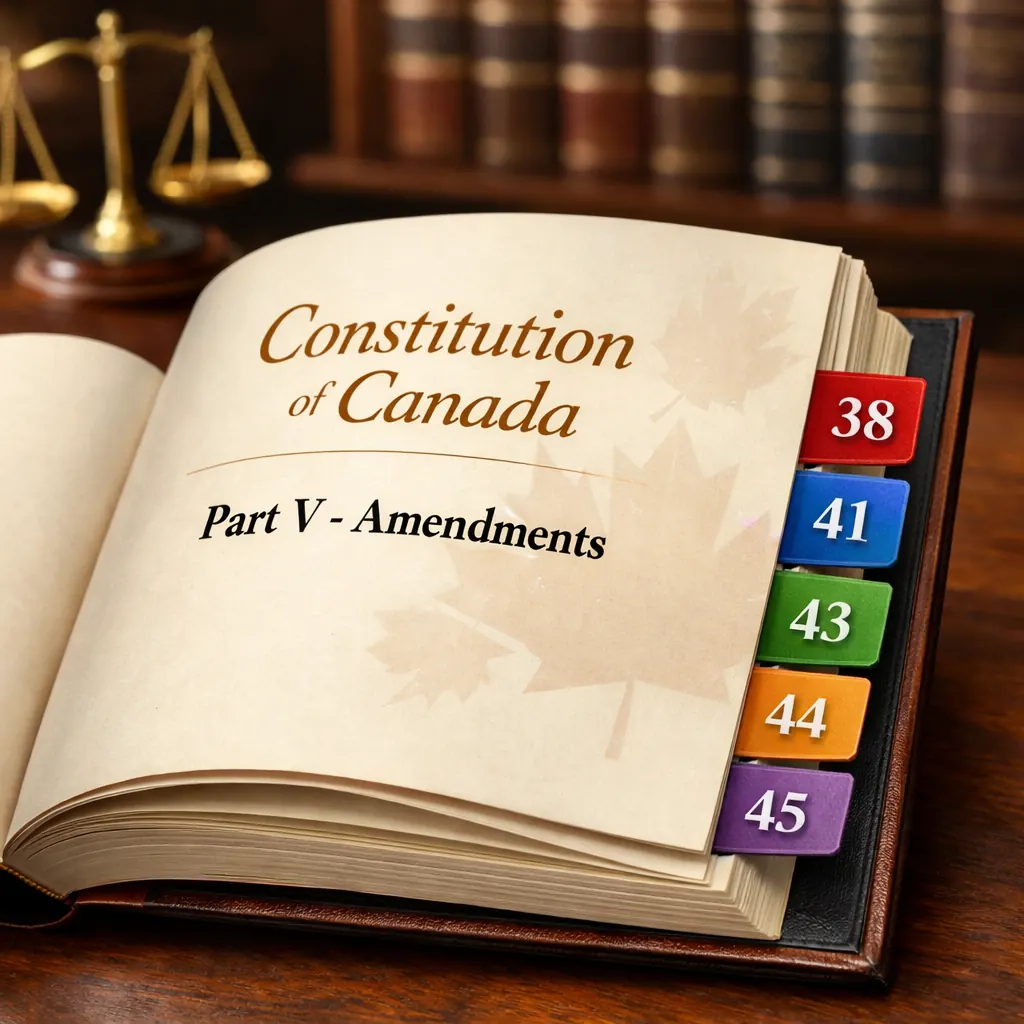
FAQ: Question: In which Part of the Constitution Act, 1982, sets out the amendment procedure?
FAQ
Approx read time: 11.6 min.
Part V Amending Procedure: 7/50 Rule Explained for Canada
In which Part of the Constitution Act, 1982, sets out the amendment procedure?
a) Part I
b) Part II
c) Part IV
d) Part V
If you're staring at a multiple-choice question asking which Part of the Constitution Act, 1982 sets out the amendment procedure, it's testing one thing: whether you know where Canada "hides the rules for changing the rules." The Part V amending procedure is the core answer—and it's also where exam questions love to ambush you with the different formulas.
The correct answer is d) Part V. Part V (sections 38 to 49) lays out the procedures for amending the Constitution of Canada. (Laws and Regulations Canada)
🧭 What this exam question is really testing (and why it matters)
This question is not about political history. It's about structure and process.
On an exam, you're expected to know:
- Where the rules live (Part V).
- Which formula applies to which change.
- What approvals are required (Parliament, provinces, or both).
Once you lock those in, these questions get a lot less scary and a lot more mechanical.
✅ The correct answer: Part V (and why the others are wrong)
Correct: d) Part V — Procedure for Amending the Constitution of Canada. (Laws and Regulations Canada)
Here's why the other options are traps:
- Part I = Canadian Charter of Rights and Freedoms (rights protections, not amendment rules).
- Part II = Rights of the Aboriginal Peoples of Canada (section 35 framework, not formulas).
- Part IV = Constitutional Conference… and it's repealed (so definitely not your amendment "how-to" section). (Laws and Regulations Canada)
Think of Part V as the "settings menu" for the Constitution. Parts I and II are big features. Part IV is an old menu item that got deleted.
🧩 Map of Part V: sections 38–49 in plain English
The Part V amending procedure is not one rule. It's a toolkit.
Part V includes:
- The general amending rule (7/50)
- A unanimity rule for the most sensitive changes
- A regional/bilateral rule for amendments that apply to only some provinces
- Unilateral amendment powers (federal and provincial, for limited areas)
- Extra "process" rules (who initiates, Senate delay rules, proclamations)
All of this is spelled out in the official consolidated text on the Department of Justice site. (Laws and Regulations Canada)
🧮 The “7/50 rule” in the Part V amending procedure (section 38)
The famous 7/50 rule lives in section 38(1).
In plain language: most big constitutional amendments need:
- Approval by House of Commons + Senate, and
- Approval by at least 7 provinces (two-thirds of provinces), representing at least 50% of Canada's provincial population (by the most recent census). (Laws and Regulations Canada)
The Government of Canada summarizes this as the general amending procedure (the "7/50 formula"). (Canada)
🔍 What “7/50” really means in practice
- Canada has 10 provinces.
- Two-thirds of 10 = 7 provinces minimum.
- Those 7 provinces must add up to at least half the provincial population.
So it's not "any 7 provinces no matter what." Population matters.
🧾 What automatically falls under 7/50 (section 42)
Section 42 is basically a sign that says: "If you try to change these topics, you must use section 38's 7/50 procedure."
Section 42(1) lists examples like:
- Proportionate representation in the House of Commons
- Senate powers and how Senators are selected
- Provincial representation in the Senate and residency rules
- Parts of Supreme Court-related changes (but composition is unanimity—more on that later)
- Extension of provinces into territories
- Creating new provinces (Laws and Regulations Canada)
Exam takeaway: Section 42 = "these topics are definitely 7/50."
🧯 Opting out and “dissent” inside the 7/50 framework (section 38(2)–(4))
Here's where exam questions get sneaky.
Section 38 has extra rules when an amendment would reduce a province's powers or rights.
If an amendment "derogates" from provincial legislative powers or provincial rights, then:
- It needs majority support in the required legislatures, and
- A province can pass a resolution of dissent, and the amendment won't apply to that province (unless the province later revokes dissent). (Laws and Regulations Canada)
So yes—under certain types of 7/50 amendments, you can get an amendment that applies across most of Canada but not in a dissenting province.
That's not "chaos." It's a deliberate federalism pressure valve.
💰 Compensation rule (section 40): education and culture get special treatment
Section 40 adds another exam-friendly detail:
If a 7/50 amendment transfers provincial powers over education or other cultural matters to Parliament, Canada must provide reasonable compensation to any province that the amendment does not apply to. (Laws and Regulations Canada)
This is basically Ottawa being told: "If you're taking a core provincial file, and a province opts out, you may have to pay up."
🤝 Unanimity formula in the Part V amending procedure (section 41)
Section 41 is the "all hands on deck" formula.
These amendments require approval by:
- House of Commons + Senate, and
- All 10 provinces. (Laws and Regulations Canada)
Section 41 covers major constitutional pillars, including:
- The office of the Queen, Governor General, and Lieutenant Governors
- A province's minimum representation rule (Commons seats not less than its Senate seats)
- Use of English/French (subject to section 43 in some provincial cases)
- Composition of the Supreme Court of Canada
- Any change to Part V itself (Laws and Regulations Canada)
This is also why Senate abolition/reform talk often runs into a constitutional brick wall. The Supreme Court has discussed how Part V provides the "blueprint" for constitutional change. (Supreme Court of Canada Decisions)
🗺️ Bilateral / regional amendments (section 43)
Section 43 is the "some provinces, not all provinces" formula.
It applies when a constitutional provision affects:
- One province, or
- A group of provinces, but not everyone.
Approval required:
- House of Commons + Senate, and
- Only the province(s) affected. (Laws and Regulations Canada)
Section 43 explicitly includes:
- Boundary changes between provinces
- Language provisions within a province (Laws and Regulations Canada)
Exam trick: If the amendment is clearly limited to a province (or a couple provinces), your brain should automatically whisper: "This smells like section 43."
🏛️ Federal unilateral amendments (section 44)
Section 44 lets Parliament alone amend certain parts of the Constitution of Canada, but only in a limited zone:
- The executive government of Canada, or
- The Senate and House of Commons
…and it's subject to sections 41 and 42 (meaning Parliament can't use section 44 to dodge 7/50 or unanimity where required). (Laws and Regulations Canada)
A good way to say it on an exam:
Section 44 is "federal housekeeping," not "federal renovation."
The Library of Parliament explains section 44 as Parliament's exclusive authority in this limited space (again, constrained by other sections). (Library of Parliament)
🏢 Provincial unilateral amendments (section 45)
Section 45 is the provincial mirror:
- Each province can amend the constitution of the province,
- Subject to section 41. (Laws and Regulations Canada)
So provinces can change certain internal constitutional arrangements (think: provincial institutions), but they can't mess with the "unanimity" items.
🧷 Who can start an amendment (section 46) and can they undo it?
Section 46 says amendment procedures under sections 38, 41, 42, and 43 can be initiated by:
- Senate, or
- House of Commons, or
- A provincial legislature. (Laws and Regulations Canada)
It also says a resolution of assent can be revoked before the proclamation is issued. (Laws and Regulations Canada)
Translation: even after a legislature says "yes," it can change its mind—until the proclamation happens.
⏳ Senate delay rule: the 180-day workaround (section 47)
Section 47 is a practical "no permanent veto" rule.
If the Senate does not pass the resolution within 180 days, the amendment can still proceed if:
- The House of Commons passes the resolution again after that period. (Laws and Regulations Canada)
Also, prorogation/dissolution time doesn't count toward the 180 days. (Laws and Regulations Canada)
Exam-ready summary: the Senate can delay, but it can't block forever (in these Part V proclamation-based amendments).
🖋️ The proclamation step (section 48): how amendments become official
Section 48 says once the needed resolutions are adopted, the Privy Council must advise the Governor General to issue the proclamation "forthwith." (Laws and Regulations Canada)
In other words:
- Legislatures pass the required resolutions
- Privy Council advises
- Governor General issues the proclamation under the Great Seal
- Amendment becomes part of the Constitution (subject to any dissent/opt-out rules)
🧠 Memory tricks for the Part V amending procedure
Here are simple hooks that actually work under exam pressure:
- 38 = "Big general" → 7/50 rule
- 41 = "All in" → unanimity
- 43 = "Some only" → affected provinces only
- 44 = "Federal housekeeping" → Parliament alone (limited)
- 45 = "Provincial housekeeping" → province alone (limited)
And for the repealed trap:
- Part IV = "Old conference stuff" → repealed, don't pick it. (Laws and Regulations Canada)
🧾 Quick comparison table of the main formulas
| Formula | Where in Part V | Approval needed | Typical use |
|---|---|---|---|
| General "7/50" | s. 38 (and s. 42 topics) | Commons + Senate + 7 provinces with 50% population | Major federalism/structure changes not requiring unanimity |
| Unanimity | s. 41 | Commons + Senate + all provinces | Monarchy offices, SCC composition, Part V itself |
| Bilateral / regional | s. 43 | Commons + Senate + affected province(s) | Province-specific language or boundary changes |
| Federal unilateral | s. 44 | Parliament alone (but limited; subject to s. 41 & s. 42) | Federal institutional "housekeeping" |
| Provincial unilateral | s. 45 | Province alone (subject to s. 41) | Provincial constitutional "housekeeping" |
⚖️ Common pitfalls and “best answer” tips
These are the mistakes that cost easy marks:
- Mixing up Part I (Charter) with Part V (amendments).
- Thinking 7/50 is "any 7 provinces" and forgetting the 50% population requirement. (Laws and Regulations Canada)
- Forgetting that some topics are "forced" into 7/50 by section 42. (Laws and Regulations Canada)
- Forgetting SCC composition is unanimity (section 41), while other SCC-related changes may trigger 7/50 depending on what's being changed. (Laws and Regulations Canada)
- Picking Part IV even though it's repealed (classic "I saw the word conference and panicked" move). (Laws and Regulations Canada)
🚀 Conclusion: how to answer this fast using the Part V amending procedure
For this question, your answer is clean: Part V.
Then, if the question asks you to explain formulas, you hit the core five:
- Section 38: general 7/50 rule (with dissent mechanics) (Laws and Regulations Canada)
- Section 41: unanimity (Laws and Regulations Canada)
- Section 43: bilateral/regional (Laws and Regulations Canada)
- Section 44: federal unilateral (limited) (Laws and Regulations Canada)
- Section 45: provincial unilateral (limited) (Laws and Regulations Canada)
❓ Frequently Asked Questions
❓ Which Part contains the Part V amending procedure?
Part V of the Constitution Act, 1982 contains the amendment rules (sections 38–49). (Laws and Regulations Canada)
❓ What is the 7/50 rule in the Part V amending procedure?
It requires Parliament plus at least 7 provinces representing at least 50% of the provincial population. (Laws and Regulations Canada)
❓ Does 7/50 mean any 7 provinces?
No. The provinces must also represent at least 50% of the provincial population. (Laws and Regulations Canada)
❓ Which section creates the 7/50 rule?
Section 38(1) sets the general 7/50 procedure. (Laws and Regulations Canada)
❓ Which topics are forced into 7/50 automatically?
Section 42 lists topics that must use the general procedure in section 38. (Laws and Regulations Canada)
❓ What is the unanimity formula under the Part V amending procedure?
Section 41 requires Parliament plus every province to agree. (Laws and Regulations Canada)
❓ Which amendments require unanimity?
Key ones include the monarchy offices, SCC composition, and changing Part V itself. (Laws and Regulations Canada)
❓ What is the bilateral/regional amending formula?
Section 43 applies when an amendment affects only one or some provinces; only those provinces must agree (plus Parliament). (Laws and Regulations Canada)
❓ Can a province opt out under the Part V amending procedure?
Under certain section 38(2) amendments, a province can dissent so the amendment does not apply to it. (Laws and Regulations Canada)
❓ When is compensation required if a province opts out?
If a 7/50 amendment transfers provincial powers over education or other cultural matters to Parliament, compensation is required for non-applying provinces. (Laws and Regulations Canada)
❓ What can Parliament amend unilaterally under section 44?
Limited matters related to the executive government of Canada or the Senate and House of Commons, subject to sections 41 and 42. (Laws and Regulations Canada)
❓ What can provinces amend unilaterally under section 45?
A province can amend the constitution of the province, subject to section 41. (Laws and Regulations Canada)
❓ Who can initiate an amendment under the Part V amending procedure?
The Senate, the House of Commons, or a provincial legislature can initiate procedures under sections 38, 41, 42, and 43. (Laws and Regulations Canada)
❓ Can an assent resolution be revoked?
Yes, section 46(2) allows revocation before the proclamation is issued. (Laws and Regulations Canada)
❓ Can the Senate block a constitutional amendment forever?
Not for amendments under sections 38, 41, 42, or 43—after 180 days, the House can pass again and proceed. (Laws and Regulations Canada)
❓ What is the final step that makes an amendment official?
A proclamation issued by the Governor General under the Great Seal, after the required resolutions are adopted. (Laws and Regulations Canada)
❓ Why is Part IV not the answer anymore?
Part IV is repealed, so it doesn't govern current amendment procedures. (Laws and Regulations Canada)
🔍 Online research verification (what was checked)
- Verified Part V and sections 38–49 directly in the official consolidated text. (Laws and Regulations Canada)
- Verified the exact 7/50 wording and the dissent mechanics in section 38. (Laws and Regulations Canada)
- Verified Part IV repeal status (repealed text shown in the consolidation). (Laws and Regulations Canada)
- Cross-checked the "7/50" summary against Government of Canada background material. (Canada)
- Confirmed the Supreme Court's framing of Part V as the blueprint for constitutional amendment in Senate Reform discussions. (Supreme Court of Canada Decisions)
📚 Sources & References
- Department of Justice — Constitution Acts 1867 to 1982 (Part V) (Laws and Regulations Canada)
- Government of Canada — About Canada (7/50 overview) (Canada)
- Supreme Court of Canada — Reference re Senate Reform (Supreme Court of Canada Decisions)
- Library of Parliament — Legislative summary referencing section 44 and limits (Library of Parliament)
- Centre for Constitutional Studies — Amending formula explainer (Centre for Constitutional Studies)
- CanLII — Constitution Act, 1982 (consolidated text) (CanLII)
Related Videos:

Related Posts:
Question: What branch is the Ontario Divisional Court?
What Are the 150 Most Important Case Law Decisions Every Ontario Paralegal Should Know?
What is the monetary jurisdiction of the Small Claims Court in Ontario as of 2026?
Question: What are the two divisions of the Courts of Ontario?
Related Faqs



Does the Small Claims Court have jurisdiction to grant equitable relief pursuant to s. 96(3) of CJA and the decision in Grover v. Hodgins? Yes or No and why?

Discover MiltonMarketing FAQ Categories:
About the Author: Bernard Aybout (Virii8)