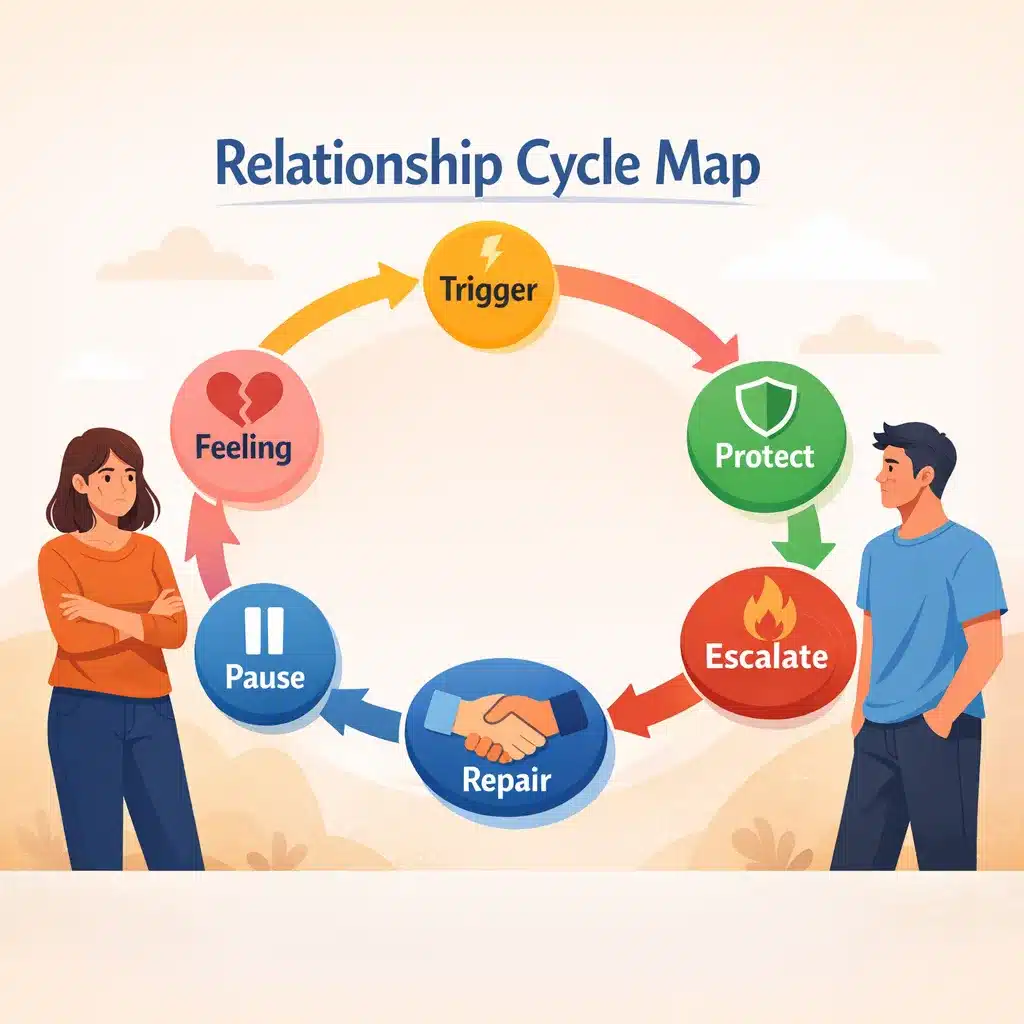
Relationship Cycle Map: 17 Ways to Stop Repeat Fights
Most marriages and long-term relationships don’t collapse from one giant blow-up. They wear down from small, repeatable moments that feel “normal” until one day they don’t.
If you keep having the same argument, you’re not broken. You’re probably stuck in a predictable Relationship Cycle Map—a loop powered by emotional deposits and withdrawals, plus communication that goes off the rails under stress.
This guide ties three practical tools into one system you can actually use: emotional deposits and withdrawals, the Relationship Cycle Map, and a 3-part communication contract that makes hard talks safer and simpler.
🔥 Why this framework works in real relationships
When couples get stuck, they usually try to “fix the topic.” However, the topic is often just the spark, not the fuel.
The fuel is the Relationship Cycle Map: triggers → vulnerable feelings → protective moves → escalation → emotional debt. Once you can see the map, you stop treating your partner like the enemy and start treating the pattern like the enemy.
That shift alone can drop the emotional temperature fast, because it creates teamwork instead of combat.
💰 Emotional deposits and withdrawals: your relationship balance
Think of your relationship like a shared emotional account. You’re always making deposits or withdrawals, even on ordinary days.
Deposits build safety, trust, and goodwill. Withdrawals drain safety, trust, and goodwill. Over time, your “balance” decides whether conflict feels manageable or dangerous. The Gottman Institute uses this “emotional bank account” idea to explain why small daily moments matter more than big gestures.
A key rule: impact beats intent. If you meant well but it lands badly, it still functions as a withdrawal.
🧾 Quick audit: deposits vs withdrawals you can spot today
Use this as a fast mirror. The goal isn’t guilt—it’s clarity.
| Deposits (Build) |
Withdrawals (Drain) |
Better Replacement |
| Notice and respond to a “bid” (small attempt to connect) |
Ignore, brush off, or delay without circling back |
“I can’t talk now, but I want to—after dinner?” |
| Appreciation for small effort |
Only speaking up when something is wrong |
1 sincere thanks per day, specific not generic |
| Gentle start-up (“I feel… I need…”) |
Harsh start-up (“You always… You never…”) |
Name one feeling + one request |
| Repair attempt (apology, humor, softening) |
Digging in to “win” |
“We’re getting stuck—can we reset?” |
| Follow-through on small promises |
Repeated broken commitments |
Shrink promises until they’re automatic |
When deposits outnumber withdrawals, your Relationship Cycle Map loses power because your nervous systems feel safer.
🗺️ Relationship Cycle Map: stop blaming, start mapping
A Relationship Cycle Map is a repeatable loop two people fall into when both are trying to protect themselves. It’s not “who’s the problem.” It’s “what happens between us.”
Emotionally Focused Therapy (EFT) describes this as a negative cycle that couples can clarify together so the pattern becomes visible and changeable.
Once you can name your Relationship Cycle Map, you can interrupt it before it turns into a full fight.
🧩 The 5-step loop inside the Relationship Cycle Map
Most couples run some version of this:
- Trigger: a look, tone, silence, forgetfulness, stress.
- Vulnerable feeling: rejection, not enough, not safe, not important.
- Protection: criticism, control, sarcasm, shutdown, avoidance.
- Escalation: defend/attack, pursue/withdraw, scorekeeping.
- Emotional debt: resentment builds, trust drops, the next trigger hits harder.
This is why “we talked about it” doesn’t fix it. The Relationship Cycle Map isn’t a one-time misunderstanding—it’s a system.
🎯 Find your triggers and the feeling under the feeling
The fastest way to weaken a Relationship Cycle Map is to identify your real trigger and the vulnerable meaning you attach to it.
Examples:
- Trigger: “You didn’t text back.” Meaning: “I’m not important.”
- Trigger: “You corrected me.” Meaning: “I’m failing.”
- Trigger: “You got quiet.” Meaning: “I’m about to be rejected.”
If you only argue about the trigger, you stay stuck. If you name the meaning, you regain choice.
🛡️ Protective moves: pursue vs withdraw (the classic loop)
A very common Relationship Cycle Map is a pursue/withdraw loop. One partner moves toward conflict (pushing for talk, clarity, change). The other moves away (silence, avoidance, delay, shutdown).
Research calls this the demand/withdraw pattern, and it’s strongly associated with lower relationship satisfaction.
Here’s the brutal truth: both are trying to feel safe. Unfortunately, both usually scare the other person more.
🧯 Flooding: why good people say dumb things in fights
When your body goes into threat mode, your brain stops doing its best work. That’s not a character flaw—it’s physiology.
The Gottman Institute describes “flooding” as a state of high arousal where productive communication becomes extremely hard. They recommend taking a break long enough to calm down before continuing.
If you ignore flooding, your Relationship Cycle Map turns into a factory that mass-produces regret.
🧰 The 3-part communication contract for safer conflict
A communication contract is a shared agreement that protects connection when emotions spike. It doesn’t eliminate feelings—it keeps feelings from turning into damage.
This is where the Relationship Cycle Map gets interrupted in real-time. Instead of “whatever comes out comes out,” you both follow a basic operating system.
Your contract has three parts:
- how we speak, 2) how we listen, 3) how we pause and repair.
🗣️ Part 1: how we speak when it matters
This part prevents tone from becoming the trigger that launches the Relationship Cycle Map.
Agreement:
- No contempt, mocking, name-calling, or threats.
- No “always/never” and no character attacks.
- Use “I feel / I need / I’m asking” language.
Simple script that works:
- “I feel ___ about ___. I need ___. Can we ___?”
Example:
- “I feel disconnected when we don’t talk at night. I need 10 minutes together. Can we sit after dinner?”
This keeps the problem small enough to solve.
👂 Part 2: how we listen (so the other person actually calms down)
Listening is not waiting for your turn to speak. Listening is proving you understood.
Active listening emphasizes acknowledging and giving feedback to ensure mutual understanding.
Agreement:
- Don’t interrupt.
- Reflect back what you heard before responding.
- Validate one piece, even if you disagree with the conclusion.
Reflection formula:
- “What I’m hearing is ___. Did I get that right?”
This slows the Relationship Cycle Map because it lowers threat.
⏸️ Part 3: how we pause and repair (without avoidance)
Pauses only work if they include a return time. Otherwise, a “break” becomes abandonment, and the Relationship Cycle Map intensifies.
Gottman-style guidance commonly recommends breaks of at least ~20 minutes (to de-escalate), with an agreed return within a reasonable window so it doesn’t become avoidance.
Agreement:
- Either partner can call a time-out.
- You set a return time (“20 minutes” or “tonight at 8:30”).
- You repair if you were sharp, rude, or unfair.
Repair line:
- “I didn’t say that well. Let me try again.”
Repairs are deposits. They directly reduce emotional debt.
🔄 How the communication contract breaks the Relationship Cycle Map
The contract targets the exact points where the Relationship Cycle Map gains speed:
- Respectful speaking reduces triggers.
- Reflective listening surfaces vulnerable feelings.
- Pausing stops flooding from doing damage.
- Repair restores trust quickly.
Over time, you stop fighting each other and start fighting the pattern.
A powerful couple sentence:
- “This feels like our Relationship Cycle Map—can we slow down and reset?”
That sentence is basically a cheat code.
📌 A practical “Cycle Map” worksheet you can use tonight
Do this once when you’re calm, not mid-fight.
Our Relationship Cycle Map usually starts when…
When that happens, I tend to feel…
- Vulnerable feeling: __________
Then I protect myself by…
- My protective move: __________
When I do that, my partner tends to…
- Their protective move: __________
The loop escalates when…
- Escalation point: __________
The one change that would help most is…
- My next right step: __________
Write it like a map, not a verdict.
📅 The daily 10-minute plan that keeps deposits ahead of withdrawals
You don’t fix a Relationship Cycle Map only during conflict. You fix it by stacking deposits until conflict is less dangerous.
Try this daily:
- 2 minutes: one specific appreciation.
- 5 minutes: “Anything you need from me today?”
- 3 minutes: a small physical or emotional connection (hug, check-in, shared laugh).
This is boring in the best way. Boring is stable.
🧭 The weekly 20-minute “repair meeting” (no chaos allowed)
Pick a predictable time. Same day, same time, short and repeatable.
Agenda:
- 1 deposit each of you noticed this week.
- 1 withdrawal each of you want to repair (no courtroom speeches).
- 1 adjustment to the Relationship Cycle Map (one tiny change).
- 1 update to the communication contract if needed.
This keeps resentment from compounding interest.
✅ The reality check (and the win)
You won’t eliminate conflict. You will eliminate repeat damage.
If you consistently build deposits, name your Relationship Cycle Map, and follow your communication contract, you create a relationship that recovers quickly instead of one that stays bruised.
That’s the goal: not perfect people—fast repair, low fear, and steady connection through a clearer Relationship Cycle Map.
❓ FAQs
❓ What is a Relationship Cycle Map?
It’s a repeat conflict loop that shows how triggers and protective reactions feed each other.
❓ Why do we keep having the same fight?
Because the Relationship Cycle Map repeats even when the topic changes.
❓ What are emotional deposits and withdrawals?
Deposits build trust; withdrawals drain trust through repeated small moments.
❓ How do I know if I’m the pursuer or the withdrawer?
Check your default under stress: push for engagement or shut down to escape pressure.
❓ Is the demand/withdraw pattern common?
Yes—research describes it as a frequent conflict pattern tied to dissatisfaction.
❓ What if my partner won’t talk about the cycle?
Start by naming your side of the Relationship Cycle Map without blaming.
❓ What is flooding in relationships?
It’s when your body is so stressed that calm communication becomes very hard.
❓ How long should a time-out be?
Often at least ~20 minutes, with a clear return time so it doesn’t become avoidance.
❓ What’s the best first step to fix our Relationship Cycle Map?
Stop mid-loop and name the pattern: “We’re in it—let’s slow down.”
❓ What is a 3-part communication contract?
A shared agreement on how you speak, listen, and pause/repair during conflict.
❓ Do communication contracts feel fake or scripted?
At first, yes—like training wheels. Then they become the new normal.
❓ How do we repair after we say something hurtful?
Own it fast, apologize clearly, and restate your point respectfully.
❓ What if one partner uses time-outs to avoid?
Time-outs must include a return time and a commitment to re-engage.
❓ How many deposits do we need for each withdrawal?
Research often describes a strong positive-to-negative balance in stable couples.
❓ Can this help if we’re already distant?
Yes, because deposits rebuild safety and the Relationship Cycle Map loses intensity.
❓ When should we get professional help?
If conflict feels unsafe, chronic, or emotionally overwhelming, a qualified therapist can help.
❓ Is this framework compatible with EFT or Gottman methods?
Yes—Relationship Cycle Map thinking aligns with EFT’s cycle focus, and deposits align with Gottman’s bank account concept.
❓ How long until we see change?
Usually within weeks if you practice daily deposits and consistent repairs.
Sources & References
- Gottman Institute: Emotional Bank Account (Gottman Institute)
- Gottman Institute: The 5:1 “Magic Ratio” (Gottman Institute)
- Christensen & Heavey (1990): Demand/Withdraw pattern (PubMed) (PubMed)
- Gottman Institute: Flooding and time-outs (Gottman Institute)
- UNC PDF: Clarifying the Negative Cycle (EFT) (cls.unc.edu)
- NCBI Bookshelf: Active Listening (StatPearls) (NCBI)
Related Videos:

Related Posts:
Respect and Recognition: 17 Daily Habits That Work
Unresolved Issues in Marriage 17 Steps That Work
Emotional Regulation for Couples 17 Conflict Skills
The Fasting mimicking diet Unlock Wellness with the 5 day Plan
When Work Becomes Harm: Understanding, Surviving, and Recovering from a Toxic Workplace