Approx. read time: 6.1 min.
Post: History of Palestine and the Canaanites – A Deep Guide Meta Description
History of Palestine and the Canaanites: A Fact-Checked Guide
The history of Palestine and the Canaanites is a layered story of peoples, languages, and empires. This guide distills peer-reviewed research and standard reference works into a clear narrative you can trust, focusing on the history of Palestine and the Canaanites. It also explains what the latest genetics tells us about continuity in the Levant.
The following sections provide deeper insights into the history of Palestine and the Canaanites, examining archaeological findings and historical texts.
🧭 What “Palestine” Has Meant Across the Ages
Ancient Greek writers used forms of the name “Palaistinê” for a district between Phoenicia and Egypt; Herodotus (5th century BCE) is the earliest clear reference in this sense. Later Roman and Byzantine usage varied, but the term endured in geography and administration. Wikipedia+1
In the 2nd century CE—after the Bar Kokhba revolt—the Roman administration renamed the province of Judaea as “Syria Palaestina,” a move most scholars interpret as political and punitive. Evidence includes coinage under Hadrian and a 139 CE military diploma using the new name. Wikipedia+1
Key takeaway: “Palestine” is a historical-geographical term with classical roots; its administrative use crystallized under Rome and Byzantium and reappeared under the British Mandate. Encyclopedia Britannica+1
🧱 Who Were the Canaanites?
The Canaanites were Semitic-speaking peoples of the Bronze Age Levant, organized as independent city-states (e.g., Tyre, Sidon, Byblos, Ugarit) sharing related languages, religion, and material culture rather than a single centralized kingdom. Live Science
Linguistically, “Canaanite” is a branch of Northwest Semitic that includes Hebrew, Phoenician, and Moabite. Encyclopedia Britannica
🧬 What Genetics Says About Continuity
A landmark 2017 ancient-DNA study sequenced Bronze Age individuals from Sidon and compared them with present-day Lebanese. Result: most ancestry in modern Lebanese derives from a Canaanite-related population, with later admixture from imperial periods (Assyrian, Persian, Macedonian/Greek, etc.). This strongly supports long-term population continuity in the central Levant, not wholesale replacement. PubMed+2ScienceDirect+2
Bottom line: While migrations and conquests left genetic traces, core ancestry shows remarkable persistence from Canaanite times into parts of today’s Levant. PubMed
🐚 Canaanites and Phoenicians: Coastal Cousins
The Iron Age “Phoenicians” are best understood as the coastal heirs of broader Canaanite culture—renowned for seafaring, trade networks, and an influential alphabet that shaped later scripts. The Phoenician language sits inside the Canaanite subgroup, closely related to Hebrew and Moabite. Encyclopedia Britannica+1
🔭 Ancient Israel and Judah in Context
Independent inscriptions help anchor the timeline. The Merneptah Stele (late 13th century BCE) is the earliest non-biblical mention of “Israel” in the southern Levant. Later finds—like the Tel Dan inscription—refer to the “House of David,” signaling polities active in the Iron Age. Biblical Archaeology Society+1
Between roughly the 10th and 7th centuries BCE, the kingdoms of Israel and Judah emerged, interacted with neighbors, and eventually faced Assyrian and Babylonian conquests. Populations persisted locally and in diaspora; cultural traditions evolved under Persian and Hellenistic rule. Encyclopedia Britannica
🏛️ Many Empires, Many Layers
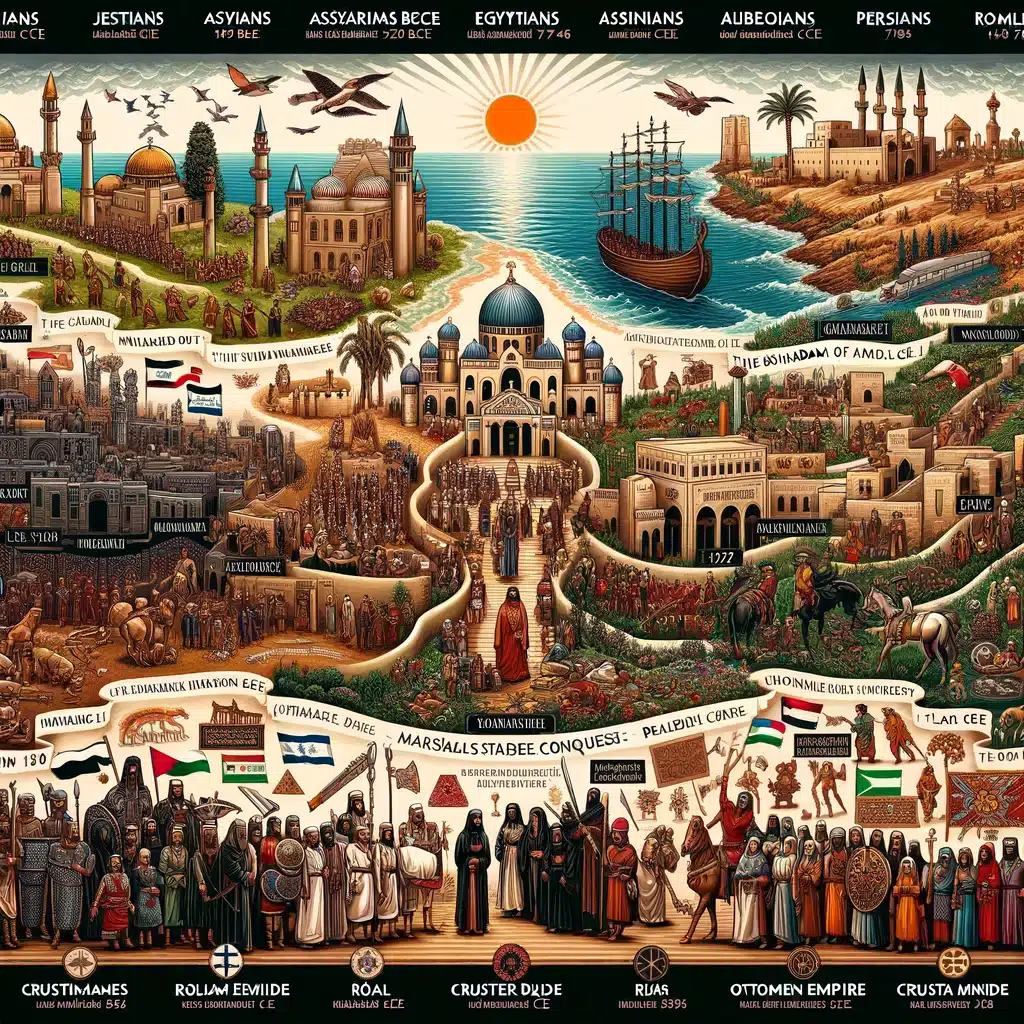
Across millennia, the land saw overlapping powers. Think of each as adding a layer rather than erasing what came before:
-
Egyptian influence over Canaanite city-states (diplomacy, garrisons, trade).
-
Neo-Assyrian and Babylonian administration and deportations.
-
Achaemenid Persian satrapies and imperial networks.
-
Hellenistic kingdoms (Seleucid/Ptolemaic) and “Hellenization.”
-
Roman and Byzantine infrastructures, urban life, and Christianity’s spread.
-
Early Muslim caliphates introducing Arabic language and Islamic governance while keeping protected status for other faith communities. Encyclopedia Britannica
☪️ The Arab-Muslim Conquest (7th Century CE)
Between c. 634–638 CE, forces of the Rashidun Caliphate took the Levant from the Byzantines. Jerusalem’s surrender in 637 became a pivotal moment; Arabic language and Islamic institutions gradually took root alongside Christian and Jewish communities. Encyclopedia Britannica+1
🕌 Four Centuries of Ottoman Rule (1516–1917)
The Ottomans defeated the Mamluks in 1516 and ruled for about four centuries. They fortified key cities (including rebuilding Jerusalem’s walls in the 1530s) and maintained complex “status-quo” arrangements at holy sites. Nineteenth-century reforms and migrations reshaped towns and countryside, setting the stage for modern politics. Encyclopedia Britannica+1
🇬🇧 The British Mandate (1920–1948)
After World War I, the League of Nations granted Britain the Mandate for Palestine (formally in force in 1923). British policy incorporated the 1917 Balfour Declaration while also pledging to protect the civil and religious rights of non-Jewish communities—tensions that proved difficult to reconcile. The period saw immigration, institution-building, growing Arab and Jewish national movements, and recurring violence. The Mandate ended amid the 1947 UN partition plan and the 1948 war. Encyclopedia Britannica+1
🧵 Continuity and Change: A Balanced Picture
-
Continuity: Languages, place-names, religious sites, farming traditions, and—per genetics—significant ancestry lines from Canaanite-related populations persisted into the present. PubMed
-
Change: Each imperial era added institutions, populations, and cultural layers; borders and administrative names shifted repeatedly. Encyclopedia Britannica
Why this matters: Understanding deep roots and layered change helps contextualize modern identities across Israel/Palestine and neighboring Lebanon and Jordan.
🧠 Common Misconceptions (Fact-Checked)
-
“The Canaanites disappeared completely.” Ancient DNA indicates strong continuity into modern Lebanese populations, with later admixture—not annihilation. PubMed+1
-
“Palestine is only a modern invention.” The term’s classical pedigree is clear (Herodotus), and its administrative use is well-documented in Roman/Byzantine and British eras. Wikipedia+1
-
“Rome always called it Palestine.” The specific provincial renaming from Judaea to Syria Palaestina dates to the 2nd century CE after the Bar Kokhba revolt. Wikipedia+1
-
“The Arab-Muslim conquest erased earlier communities.” Sources show long-running Christian and Jewish communities alongside rising Islamic institutions. Encyclopedia Britannica
❓ FAQs (Schema-ready Q&A)
Q1: Who were the Canaanites in simple terms?
A: Bronze Age Semitic-speaking peoples living in independent city-states across the Levant; culturally related, not a single empire. Live Science
Q2: Are modern people in the Levant descended from Canaanites?
A: Genetics shows strong continuity in Lebanon from Canaanite-related populations, with later admixture from imperial eras. PubMed
Q3: When did “Palestine” become an official provincial name?
A: After 132–136 CE, Rome renamed the province Syria Palaestina; a 139 CE military diploma confirms the usage. Wikipedia+1
Q4: What’s the earliest non-biblical mention of Israel?
A: The Merneptah Stele (late 13th century BCE) mentions a people called “Israel” in the southern Levant. Biblical Archaeology Society
Q5: Did the Arab-Muslim conquest erase prior communities?
A: No; Arabic language and Islamic institutions grew, but Christian and Jewish communities continued under new governance. Encyclopedia Britannica
📜 Understanding the History of Palestine and the Canaanites
Q6: How do Phoenicians relate to Canaanites?
A: Phoenician is a Canaanite language; the coastal Phoenician culture evolved from broader Canaanite foundations. Encyclopedia Britannica
Q7: What defined the British Mandate period?
A: British administration, institution-building, immigration, and rising nationalist movements; the Mandate ended in 1948 amid war. Encyclopedia Britannica
Q8: Why do names and borders change so much in this region?
A: Successive empires used different administrative systems; names tracked politics more than population identity. Encyclopedia Britannica
✅ Conclusion & CTA
The history of Palestine and the Canaanites is best seen as continuity through change. City-states, languages, sacred places, and ancestry lines endured even as names and rulers shifted. Understanding that layered past brings useful context to modern identities in Israel/Palestine and the wider Levant.

Related Posts






The Longevity Blueprint: AI-Powered Health Optimization
About the Author: Bernard Aybout (Virii8)