Approx. read time: 8 min.
Post: AI in First Aid: 16 Real-Time Ways It Saves Lives
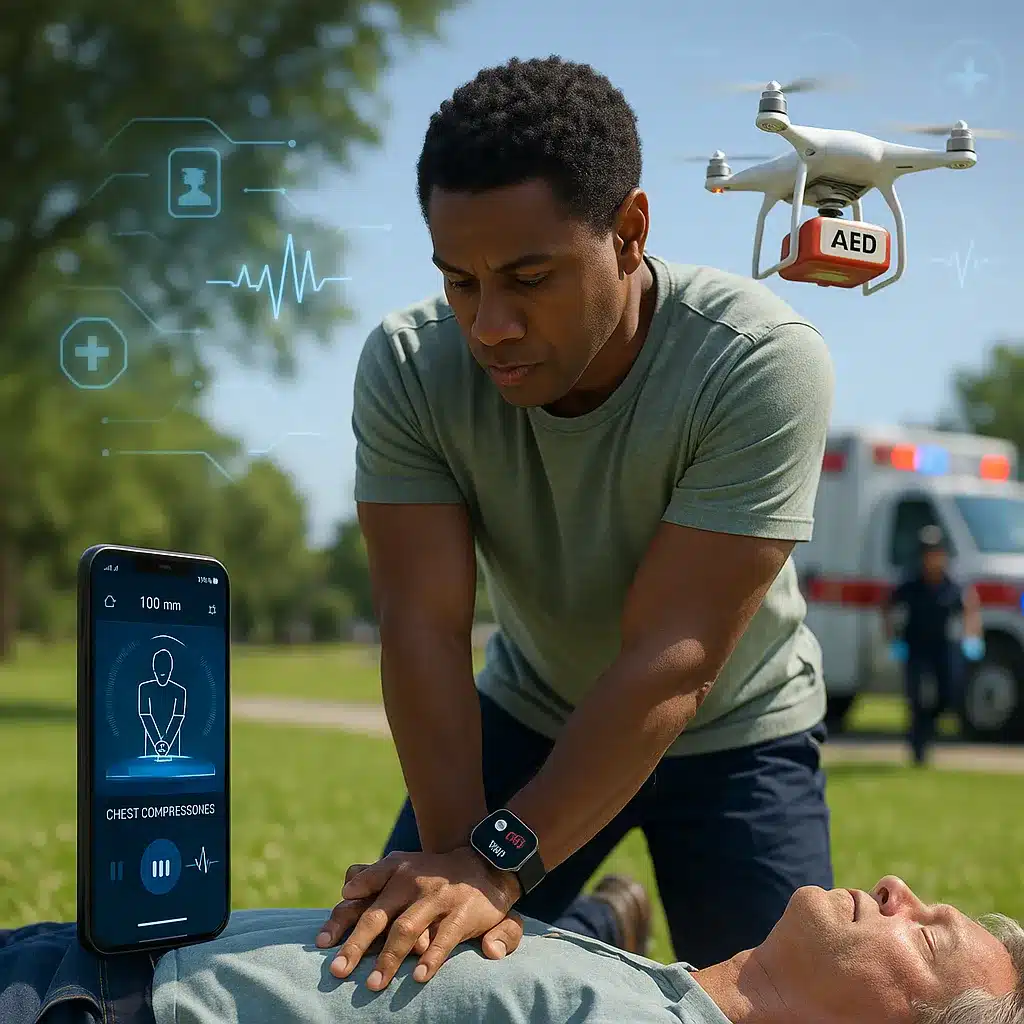
First aid is shifting from reaction to real-time intervention. Thanks to AI in first aid, bystanders get instant guidance, drones bring AEDs faster, wearables warn of danger, and responders triage smarter. Below, you'll see the practical ways AI upgrades first aid today—plus clear steps to use it safely and ethically.
🚑 Why AI in First Aid Matters Right Now
When emergencies hit, minutes matter. AI in first aid shortens time to care by turning phones, watches, cameras, and the cloud into a rapid-response layer. That means earlier CPR, earlier shocks, and better outcomes—especially where ambulances need longer to arrive. Studies show AI can recognize cardiac arrest quickly on emergency calls and speed AEDs to patients via drones.
🤖 Real-Time Guidance for Bystanders (Do the Right Thing, Right Now)
Most people hesitate in a crisis. AI-powered first-aid apps change that with step-by-step voice prompts, CPR metronomes, camera checks (is the chest rising?), and on-screen recovery-position tips. Experimental and early-market tools already show that guided responders can match trained providers for key actions in simulations. That means AI in first aid bridges the confidence gap when seconds count.
Why it helps
-
Gives clear, calm instructions.
-
Adjusts in real time as you act.
-
Starts lifesaving steps before EMS arrives.
🆘 Faster, Smarter Emergency Dispatch
Emergency call centers are piloting AI that listens for cardiac-arrest cues (breathing sounds, caller words, vocal stress) and flags the need for CPR sooner. In a Swedish study, machine-learning models recognized out-of-hospital cardiac arrest more often within the first minute than human dispatchers, suggesting earlier CPR coaching and defibrillation. This is AI in first aid at the system level.
What it means
-
Faster recognition.
-
Better prioritization.
-
Earlier bystander action while help is en route.
⌚ Wearables as Early-Warning Systems
Smartwatches now do more than count steps. They monitor heart rate, rhythm, and motion; they can detect hard falls and even auto-call services if you're unresponsive. FDA-cleared ECG features and irregular-rhythm alerts are already mainstream, and fall detection is available on popular devices. As models learn your baseline, alerts become smarter—and AI in first aid shifts from reactive to preventive.
Why it helps
-
Warns you (and caregivers) early.
-
Supports seniors and people living alone.
-
Can connect to EMS automatically after a fall.
🚁 Drone Delivery of AEDs and Critical Tools
If a cardiac arrest happens in a park or traffic jam, a drone can out-fly gridlock. Real-world programs show drones frequently beat ambulances to the scene and deliver AEDs several minutes sooner—time that saves brain and heart. Studies from Sweden and Canada demonstrate feasibility and time gains; Sweden even reported a documented life saved after a drone-delivered AED. This is AI in first aid routing and logistics at work.
Why it helps
-
AEDs, tourniquets, epinephrine arrive faster.
-
Smart routing adapts to weather and traffic.
-
Bystanders get equipment and instructions while EMS approaches.
🥽 Training 2.0: AI + VR for Skills You’ll Remember
One-off classes fade. AI-driven simulations and VR rebuild muscle memory with live feedback on depth, rate, and recoil, and they throw in real-life curveballs (noise, panic, vomiting). Meta-analyses show corrective-feedback devices improve skill acquisition and retention, and new research maps where machine learning can improve CPR quality. AI in first aid training sticks when the pressure's real.
Why it helps
-
Realistic practice lowers panic.
-
Feedback hard-wires correct technique.
-
Employers and schools can train at scale.
🗣️ Break Language Barriers in Emergencies
In multilingual cities and travel hubs, communication can stall care. AI translation and domain-specific paramedic apps reduce delays, and research shows feasibility for multilingual tools. Scoping reviews catalog dozens of translation options across care settings. Sign-language recognition systems are emerging too, pointing to better inclusion for Deaf and hard-of-hearing patients. AI in first aid makes help understandable.
Why it helps
-
Faster, clearer triage questions.
-
Fewer misunderstandings about allergies, meds, history.
-
Better equity for LEP and D/HH communities.
🩺 AI Triage & Decision Support for First Responders
On scene or in the ED, AI platforms can analyze vitals, symptoms, and history to flag risk and suggest protocols. Reviews across 2024–2025 detail AI's promise for triage, forecasting deterioration, and decision support; clinical pilots show human+AI "cross-checking" catches different misses. The takeaway: AI in first aid augments medics; it doesn't replace them.
Why it helps
-
Prioritizes who needs care first.
-
Reduces diagnostic misses under stress.
-
Pre-alerts hospitals with structured data.
🧠 Computer Vision & AR Glasses at the Scene
A research wave is combining computer vision with wearable AR to detect bleeding, burns, fainting, and distress, then overlay instructions in the responder's view. It's early, but points to hands-free, head-up guidance and shared feeds to remote clinicians—another frontier for AI in first aid.
🧭 Smarter Community Response Networks
AI can match nearby trained volunteers, available AEDs, and the fastest routes. Link that to drones and dispatch AI, and neighborhoods become response networks. Cities that integrate these layers will see earlier CPR and shocks—core goals of AI in first aid. (See the time-to-AED gains from drone studies.)
🧾 Cost, ROI & Funding Paths
-
Faster time-to-treatment → higher survival → lower downstream ICU costs.
-
VR/AI training → fewer retraining hours and better skill retention.
-
Dispatch AI & drones → more targeted deployment and fewer false sends.
Grants for EMS innovation, municipal pilots, and public-private partnerships often fund these rollouts.
🔐 Privacy, Security & Bias (Do It Right)
Ethics matter. WHO's guidance (2021, updated 2025 for multimodal AI) sets principles for safety, transparency, and fairness. In the EU, the AI Act (in force Aug 1, 2024) treats most medical AI as high-risk with strict requirements, phasing in over the next 24 months and beyond. Build governance early: document data sources, test for bias, keep humans in the loop.
🛠️ Your Implementation Roadmap (Organizations & Teams)
-
Pick use-cases: dispatch decision support, public AED drones, VR CPR, translation.
-
Procure responsibly: require audit trails, clinician oversight, and bias testing.
-
Train people: short refreshers, scenario drills, and "call-to-CPR" scripts.
-
Measure: time-to-CPR, time-to-AED, compression quality, survival to discharge.
-
Govern: align with WHO ethics and (if applicable) EU AI Act high-risk rules.
📊 Quick Comparison — Traditional vs AI-Assisted First Aid
✅ Key Takeaways & What You Can Do Today
-
For everyone: install a reputable CPR/first-aid app and learn the prompts.
-
For families & seniors: enable fall detection and emergency SOS on wearables.
-
For communities: map AEDs, recruit volunteers, and explore drone pilots.
-
For agencies: trial dispatch AI and VR refresher training; measure time-to-care.
❓ FAQs
💡 What is “AI in first aid”?
It's the use of AI tools—apps, wearables, dispatch software, drones, VR—to guide bystanders, shorten time to care, and support responders.
🫀 Can AI actually improve survival in cardiac arrest?
AI can recognize arrest sooner on calls and speed AED arrival via drones—both linked to better outcomes when combined with fast CPR.
⌚ Are smartwatch alerts reliable?
Major brands offer FDA-cleared ECG features and irregular rhythm notifications, plus fall detection and auto-call options. They help—but don't replace doctors.
🚁 Are drone AEDs available where I live?
Programs are expanding. Sweden has active deployments, and Canadian trials show strong feasibility and time savings. Check your local EMS.
🗣️ How does AI help if we don’t speak the same language?
Paramedic-ready translation tools and emerging sign-language systems reduce delays and errors during triage.
🧯 Will AI replace first responders?
No. The best results come from AI in first aid + human expertise, with oversight and clear protocols
🧭 What should agencies do to adopt AI responsibly?
Follow WHO ethics guidance and, if in the EU, the AI Act. Start with small pilots, measure impact, and keep humans in control.
📚 Sources & References
-
Byrsell F. Resuscitation (2021): ML recognized OHCA faster in calls.
-
Schierbeck S. Lancet Digital Health (2023): Drone AEDs beat ambulances in two-thirds of cases.
-
Everdrone case (2022): AED delivery saved a 71-year-old patient in Sweden.
-
Apple Support: Irregular rhythm notifications & fall detection.
-
Systematic reviews on ED triage and training devices.
-
WHO Ethics & Governance (2021; 2025 LMM update). EU AI Act (2024) timelines. Artificial Intelligence Act+3World Health Organization+3World Health Organization+3
Related Videos:

Related Posts:
Happy Being Unhappy 15 Ways It Quietly Ruins Growth
The Emotional Divide Between Genders and Its Daily Cost
Understanding Immature Conflict Behavior and How to Stop It
Cannabinoid Hyperemesis Syndrome – 7 Key Insights on Dealing
Mothers bond with adult children – 12 Truths for Lasting Trust
Related Posts




The Longevity Blueprint: AI-Powered Health Optimization
About the Author: Bernard Aybout (Virii8)