Approx. read time: 9.6 min.
Post: Explosive Insights on AI Mental Health Apps 15 Pros, Cons & Real-World Tips
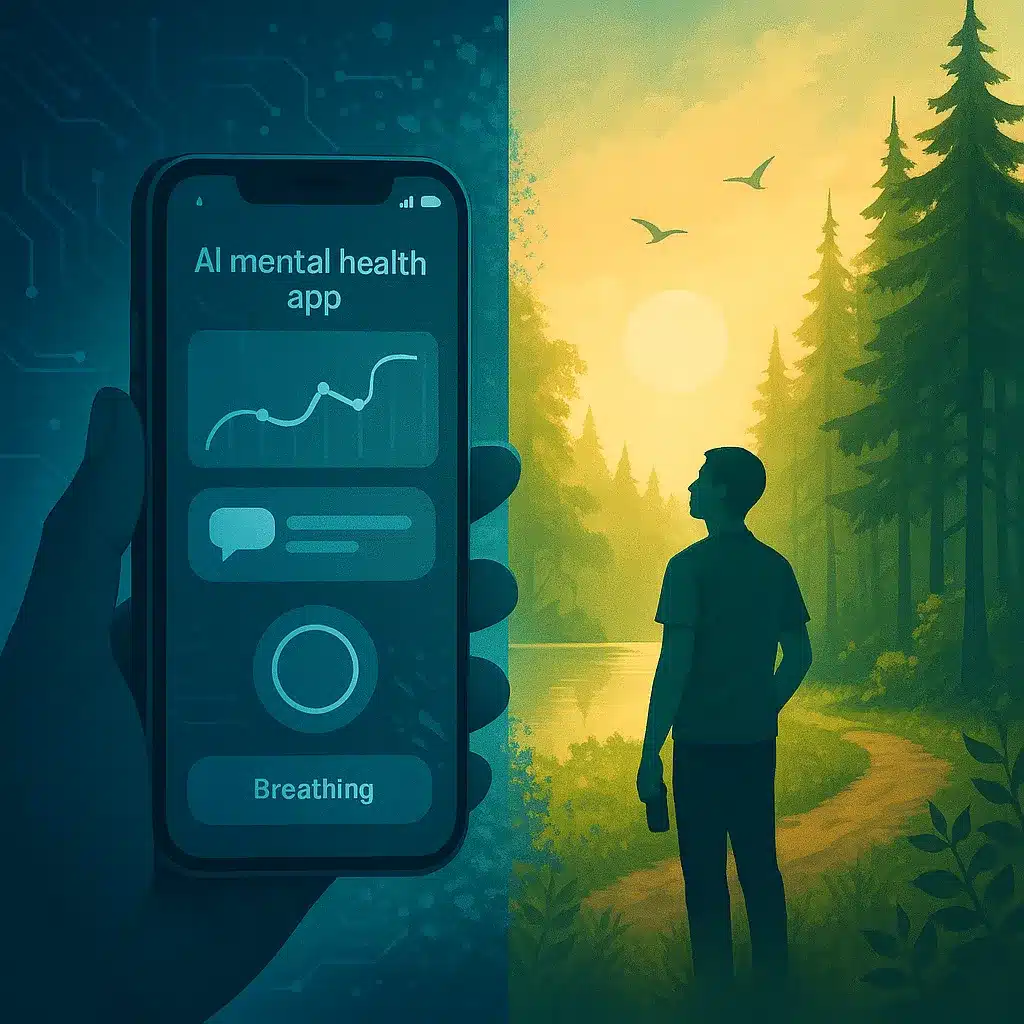
AI mental health apps are everywhere—coaching you through CBT, tracking your mood, nudging your sleep, and chatting at 2 a.m. when anxiety spikes. Used well, they can be a lifeline. Used poorly, they can become a crutch that keeps you on a screen and away from the people, places, and practices that actually heal.
This guide cuts through hype and fear to show you how to use AI mental health apps as tools—not traps. You’ll get evidence-based pros and cons, privacy guardrails, a 30-day plan that blends tech with nature, and a quick checklist so you don’t become a slave to the device.
🌐 What Counts as “AI Mental Health Apps” (and Why It Matters)
We’re talking about any app that uses artificial intelligence to support mental wellbeing: CBT and ACT coaches, mood trackers with predictive insights, LLM chatbots (e.g., “therapy-style” companions), voice or image-based mood detection, and blended models that mix AI with licensed clinicians.
Why define it? Because expectations shape outcomes. An AI coach can complement care, but it isn’t a therapist. Evidence suggests these tools can help with symptoms for some people—especially when they’re scoped correctly and used alongside human support. A 2025 meta-analysis of 92 RCTs found small-to-moderate benefits from digital mental health apps overall (g≈0.43), which is promising yet far from a cure-all.
✅ Accessibility & Equity: Where AI Shines
-
Lower barriers: For rural users, those facing stigma, mobility limits, or cost concerns, AI mental health apps can mean faster first access to exercises and psychoeducation—often free or low-cost.
-
Short-term symptom relief: RCTs show some chatbots and guided CBT apps can reduce anxiety and depressive symptoms versus control, at least in the short term.
-
Bridge to care: For many, AI tools are a first step that builds readiness to try therapy or join a support group.
Bottom line: AI mental health apps can widen the front door to support—but they don’t replace licensed care.
🕒 Consistency & Anonymity: The Always-On Support Factor
-
24/7 availability helps during off-hours distress.
-
Anonymity lowers the threshold for people who aren’t ready to talk live.
-
Micro-nudges (journaling prompts, breathing timers, sleep hygiene tips) maintain momentum between therapy sessions.
Used intentionally, these features can anchor healthy routines.
📈 Data Tracking: Pattern-Finding That Humans Often Miss
AI can spot trends across sleep, movement, check-ins, and language. Sometimes, the pattern itself is the breakthrough: seeing how Sunday nights trigger spikes, or how 15 minutes of morning light calms afternoons. The strongest outcomes happen when insight → action (e.g., you adjust bedtime, increase sunlight, text a friend, schedule therapy).
⚠️ Overreliance on Artificial Connection (Don’t Train Your Brain on Bots)
Chatbots feel friendly. Some users even report a sense of bond. But bots don’t hold context, accountability, or ethical duty like humans do. If you’re venting only to a bot, you may blunt your motivation to build real relationships—the strongest protective factor in mental health.
Use rule: When you tell the bot something important, also tell a person you trust (or your therapist) within 24–48 hours.
🌀 Avoidance Loops vs. Resilience
Check-in → quick relief → scroll away. Repeat. Many apps are great at soothing but not great at helping you stay with discomfort long enough to learn from it. Real resilience grows by feeling and processing, not just distracting. If your app time crowds out reflection, journaling (with a pen!), or hard conversations—you’ve slipped into an avoidance loop.
🔐 Privacy & Data: Your Most Sensitive Info, On a Server
This is the thorniest risk. Privacy practices vary widely:
-
The U.S. FTC finalized an order in 2023 restricting how BetterHelp can share sensitive health data for advertising and secured $7.8 million for refunds—underscoring how high the stakes are for mental-health data.
-
Mozilla’s Privacy Not Included project repeatedly flags many mental health apps for poor privacy and security practices. Review your app there before you commit.
-
In Canada, the Mental Health Commission of Canada (MHCC) publishes data & privacy standards and maintains a list of MHCC-assessed apps—useful for Canadians seeking vetted options.
Quick protect:
-
Turn off ad tracking and data sharing in the app settings.
-
Use email aliases (not your main inbox).
-
Prefer apps with clear, specific policies that say data isn’t sold or used for ads.
-
If the app offers local-only storage or end-to-end encryption, turn it on.
🎯 The Illusion of Progress (Gamification ≠ Growth)
Streaks and “good job” dots feel productive—but mental health change is messy and nonlinear. If a green check replaces real-life experiments (calling a friend, walking outside, setting a boundary, booking therapy), you’re optimizing for feel-good scores instead of real-world shifts.
🧪 Where AI Mental Health Apps Help Most (Use-Cases & Boundaries)
Great for:
-
Psychoeducation, CBT/ACT skills, breathing and sleep hygiene.
-
Mood tracking that informs actionable changes.
-
Bridging waitlists or supplementing therapy.
Use with caution for:
-
Suicidality, psychosis, complex trauma processing, medication changes.
-
Teens: choose human-supervised tools and high-privacy settings. Some jurisdictions are actively restricting AI-only therapy for safety reasons—watch your local rules.
🚫 When to Pause or Stop Using an App
-
You’re using it instead of therapy you need.
-
You’re isolating more (less time with people, more time with the bot).
-
You feel nudged to overshare or to upgrade constantly.
-
You can’t get a straight answer about how your data is used.
If any of these happen, step back and reassess.
🌲 Nature Heals: A Low-Tech, High-Impact Antidote
You don’t need another app to calm your nervous system. Time in nature & green spaces reliably reduces stress, lifts mood, and restores attention. Studies suggest even 20–30 minutes in nature can lower cortisol—the body’s stress hormone.
Fast practices:
-
20-minute green break (no headphones).
-
Morning light within 60 minutes of waking.
-
Micro-greens: sit by a window with trees, add a plant to your desk, take a 5-minute “sky break.”
🏃 Embodiment & Movement: Feel It in Your Body
Healing is physical. Gentle cardio, yoga, dance, tai chi, or a brisk walk help discharge stress and rebalance mood. If an app reminds you to move, great—just make sure the movement happens off the screen.
Try: 10 slow breaths + shoulder rolls + a 10-minute walk before opening an app when you’re anxious.
🗣️ Human Connection Beats Any Algorithm
Friends, peer groups, faith communities, support circles, and therapy are protective. They offer accountability, nuance, and empathy no bot can replicate. Use AI to practice a script; use humans to live it.
📱 AI Mental Health Apps: A Safe-Use Setup (10 Rules)
-
Define the job: “This app reminds me to breathe and track sleep. It’s not my therapist.”
-
Privacy first: Read policies; disable ad tracking; use aliases. Check Mozilla’s reports.
-
Choose Canada-vetted options if you’re in Canada (check MHCC assessed apps).
-
Pair with people: Share key app insights with a friend or therapist weekly.
-
Cap usage: Two short sessions/day (e.g., 10 min morning, 10 min evening).
-
Nature minimums: Hit a 20-minute outdoor break 3×/week.
-
Movement before mobile: Walk for 10 minutes before you open the app.
-
Red-flag check: If you feel worse, more isolated, or more screen-attached, pause.
-
Crisis plan: Know local crisis lines; do not rely on a bot in emergencies.
-
Review monthly: Keep what helps, delete what doesn’t.
📅 A 30-Day Balanced Plan (Digital + Natural + Human)
Week 1 — Audit & Boundaries
-
List your current AI mental health apps and what each is for.
-
Turn off ad tracking; set a 20-minute/day cap across all mental-health apps.
-
Start 20-minute outdoor sessions 3× this week (phone on airplane mode).
Week 2 — Skills + Movement
-
Pick one CBT/ACT skill to practice daily (e.g., cognitive reframing).
-
Add 10-minute walks after lunch 5× this week.
-
Share one insight (sleep/mood pattern) with a real person.
Week 3 — Social & Sleep
-
Schedule two face-to-face meetups (friend, group, mentor).
-
Get morning light most days; dim screens 1 hour before bed.
-
Use the app for sleep hygiene prompts only—no doomscrolling.
Week 4 — Review & Reset
-
Check progress: mood, sleep, energy, connection.
-
Keep the one app that delivered the most real-world change; archive the rest.
-
Plan one half-day nature trip (no headphones; pack a notebook).
🧭 Quick Decision Tree: Tool or Trap?
-
Does this app nudge me into the world—or keep me in the app?
-
Can I explain how it handles my data? If not, it’s a no.
-
Am I talking to people more—or less—since using it?
-
If the streak vanished today, would my practice continue?
If your answers drift toward “trap,” re-scope or uninstall.
🧰 Buyer’s Guide: What to Look For Before You Download
-
Transparent privacy policy (no ads, no data sale; clear retention periods). MHCC’s standards outline what good looks like.
-
Evidence claims with citations (peer-reviewed RCTs, not vague “clinically proven”). See synthesis papers and meta-analyses for the current state of evidence.
-
Crisis disclaimers and emergency resources built-in.
-
Human handoffs (easy ways to reach licensed care).
-
Local rules awareness: If your region restricts AI-only therapy, choose human-supervised options.
🙋♀️ FAQs
Q1. Are AI mental health apps actually effective?
Some are, for some goals. Meta-analyses and RCTs show small-to-moderate benefits for anxiety/depression when these apps teach real skills and users practice them consistently. They work best as adjuncts, not replacements.
Q2. Are privacy risks overblown?
No. Multiple investigations highlight significant problems in this category. Read policies, check Mozilla’s reports, and prefer apps with no advertising data-sharing and clear deletion options.
Q3. Can I rely on a chatbot during a crisis?
No. Chatbots aren’t crisis services. Save local crisis numbers and seek human help immediately.
Q4. What’s a safe daily limit for app use?
Try two sessions of ~10 minutes each. If you’re spending more time in the app than outside doing the behavior, tighten limits.
Q5. How do I mix apps with nature and movement?
Use the app to set reminders, then leave the phone behind for a 20-minute outdoor break and a 10-minute walk. Track outcomes weekly.
Q6. What should Canadians look for specifically?
Check the MHCC-assessed app list and read their data & privacy standards; align choices with those benchmarks.
Q7. Are there places restricting AI-only therapy?
Yes. Some U.S. states are moving to restrict AI-only mental-health therapy, especially for vulnerable groups. Stay updated on your local rules.
Q8. What’s the red flag that tells me to uninstall?
If you’re more isolated, confused about data use, or chasing streaks instead of real-world change—delete it and re-center with people, nature, and structured care.
🔚 Final Thoughts (and Your Next Step)
AI mental health apps can help you get started, stay consistent, and notice patterns—but they’re not the finish line. Healing happens in your life, not on your screen: under trees, on sidewalks, across tables with people who know your name.
Use apps as tools, not crutches. Guard your data. Build real-world practices. And if you’re ready for support or want help choosing a safe setup, reach out.
📚 Sources & Further Reading (Selected)
-
FTC actions regarding BetterHelp and mental-health data privacy (press releases & case page).
-
Mozilla Foundation: Privacy Not Included report pages on mental-health apps.
-
Nature Digital Medicine (2025): Meta-analysis on digital mental-health apps’ efficacy.
-
MHCC (Canada): Data & privacy standards; MHCC-assessed apps list.
-
Evidence on 20–30 min nature exposure reducing stress hormones.
Related Videos:

Related Posts:
Happy Being Unhappy 15 Ways It Quietly Ruins Growth
The Emotional Divide Between Genders and Its Daily Cost
Understanding Immature Conflict Behavior and How to Stop It
Cannabinoid Hyperemesis Syndrome – 7 Key Insights on Dealing
Mothers bond with adult children – 12 Truths for Lasting Trust
Related Posts





The Longevity Blueprint: AI-Powered Health Optimization
About the Author: Bernard Aybout (Virii8)