Approx. read time: 14.9 min.
Post: Mindset Burnout 5 Gifts of Kindness to Protect Your Soul
Mindset Burnout: Gifts of Kindness to Protect Your Soul
Mindset burnout isn’t just “being tired.” It’s when your brain and soul feel like they’ve been stuck in always-on mode for too long. You still show up. You still push through. But inside, something feels cooked.
Officially, burnout is described as a syndrome caused by chronic workplace stress that hasn’t been managed well, leading to exhaustion, cynicism about work, and a feeling that you’re no longer effective.
Mindset burnout is the same energy — but zoomed in on your inner world: your thoughts, self-talk, expectations, and the way you carry your life. It’s the quiet erosion of hope, motivation, and meaning.
This article is your manual for three things:
-
Understanding mindset burnout and how it hits your soul.
-
Learning the gifts of kindness toward yourself that refuel you.
-
Using a simple daily + weekly routine to prevent burnout before it blows up your life.
You’re not weak for feeling this way. You’re just human and overdue for a different way of relating to yourself.
💡 What Is Mindset Burnout (And Why It Matters)
Let’s keep it real: mindset burnout often looks like you “functioning” on the outside while quietly falling apart inside.
You might notice:
-
You wake up tired in your bones, not just your body.
-
Your thoughts tilt toward “What’s the point?” far more than you admit.
-
Even small tasks feel heavy, like everything has extra emotional gravity.
-
You don’t feel like you anymore — more like a blurry, automated version.
From a clinical angle, burnout is tied to chronic stress and emotional exhaustion, especially at work.
From a soul angle, mindset burnout is when:
-
Your inner voice turns harsh and unforgiving.
-
Joy feels suspicious or undeserved.
-
You live in survival mode, not creation mode.
It matters because this isn’t just about “stress.” It’s about the long-term shape of your inner life. If you ignore mindset burnout, it can slide into anxiety, depression, or total shut-down of motivation.
🔥 How Mindset Burnout Impacts Your Soul
Call it your soul, your core, your true self — whatever language works for you. Mindset burnout hits at that level.
Here’s what that impact often looks like:
-
Emotional numbness: You stop feeling excited about anything, including stuff you used to love.
-
Loss of meaning: Life turns into tasks and obligations, not purpose or calling.
-
Self-betrayal: You keep saying “yes” when your whole body is screaming “no.”
-
Disconnection from self: You can’t remember the last time you did something for you that wasn’t “productive.”
Psychology research shows chronic stress and burnout can trigger both mental and physical symptoms — including insomnia, irritability, headaches, and increased risk of anxiety and depression.
On a soul level, mindset burnout feels like this:
You’re still alive, but you’re not really living — you’re just managing.
The good news? The same way burnout is built one small compromise at a time, healing begins with small kind choices toward yourself.
💗 Why Gifts of Kindness to Yourself Are Serious Prevention
Many people think kindness to themselves is a luxury — something you do when everything else is handled. That thinking is exactly how you end up in mindset burnout.
Self-kindness isn’t fluff. It’s preventive maintenance for your mind and soul.
Research on self-compassion (essentially, being kind to yourself instead of brutal) shows it’s linked to:
-
Lower anxiety, depression, and stress
-
More happiness, optimism, and sense of connection
-
Better emotional regulation and resilience under pressure
-
Being your own enemy drains you.
-
Being your own ally protects you from mindset burnout.
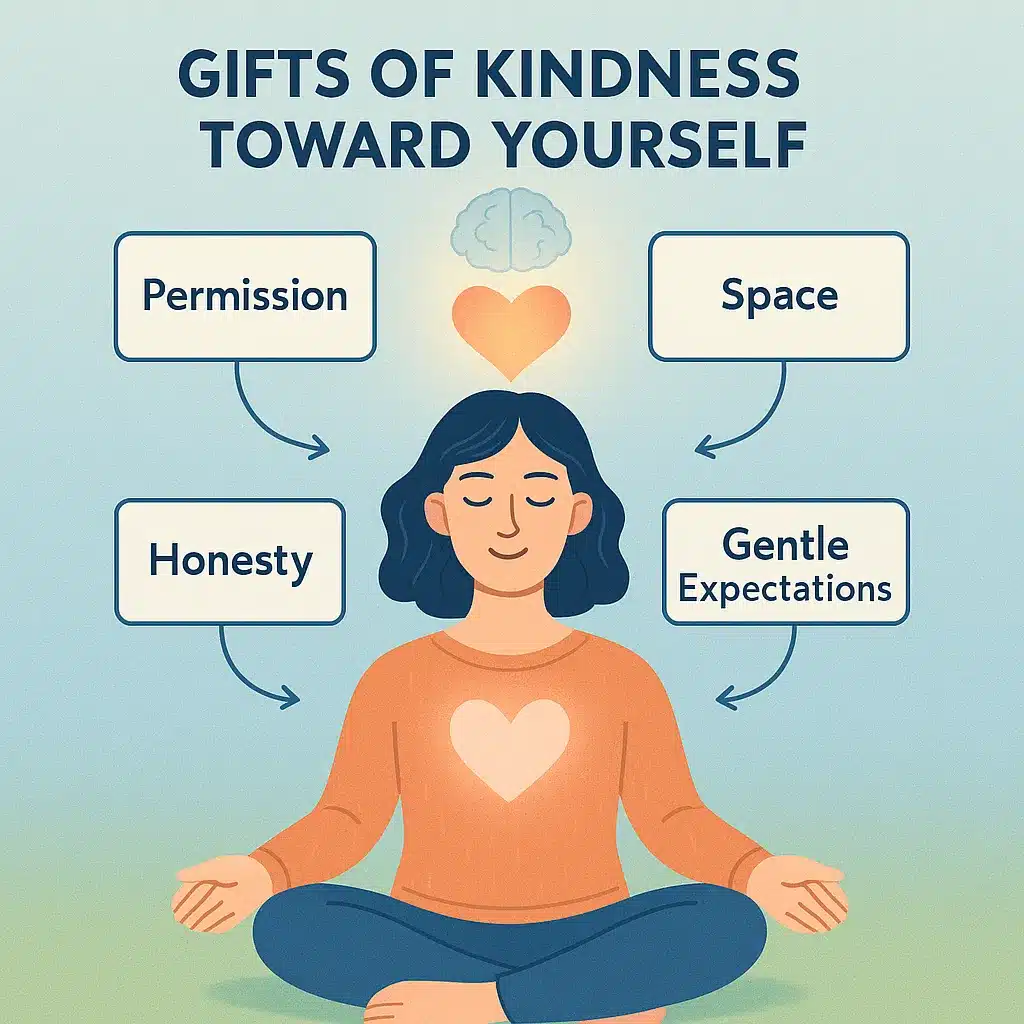
The most powerful tools are what we’ll call gifts of kindness — inner habits that fuel your emotional, mental, and spiritual health.
🎁 Gift #1: Permission to Be Fully Human
Mindset burnout loves perfectionism. It thrives on the belief that you should:
-
Always be “on”
-
Never falter
-
Never rest unless you’ve “earned” it
The first gift of kindness is permission:
-
Permission to be tired
-
Permission to be imperfect
-
Permission to have limits
This isn’t being lazy — it’s being real.
Try saying to yourself (out loud if you can):
-
“It makes sense that I’m tired.”
-
“Of course I’m struggling — I’ve been carrying a lot.”
-
“Needing rest does not mean I’m failing.”
When you give yourself this kind of permission, your nervous system gets the message: We are safe enough to slow down. That’s where healing starts.
🌿 Gift #2: Space for Your Nervous System to Breathe
Mindset burnout thrives in constant stimulation: screens, messages, notifications, obligations, noise.
Space doesn’t mean a three-week retreat in the mountains (though if you can, enjoy). It means:
-
Micro pockets of quiet in your day
-
Intentionally turning down mental volume
-
Doing nothing for a few minutes on purpose
Some examples:
-
Sitting in your car for 3 minutes before going inside, just breathing
-
Walking around the block without headphones
-
Taking a shower without a podcast, just hot water and silence
These tiny spaces are where your soul stretches out and says, “Oh. I’m still here.”
🧭 Gift #3: Radical Honesty With Yourself
Mindset burnout is often supported by your ability to lie to yourself convincingly. Things like:
-
“It’s not that bad.”
-
“Other people have it worse.”
-
“I just need to push through this week/month/year.”
Kindness doesn’t mean sugar-coating. It means telling the truth gently:
-
“I’m not okay, and I need to admit that.”
-
“This workload is not sustainable.”
-
“I feel resentful and that matters.”
Radical honesty isn’t drama. It’s data. When you name your reality, you can finally respond to it.
Ask yourself:
-
What is one feeling I keep dodging?
-
What truth would I tell a close friend in my exact situation?
Then extend that same honest care to yourself.
🧸 Gift #4: Gentle Expectations Instead of Inner Whiplash
One of the most brutal parts of mindset burnout is unrealistic inner standards:
-
“I should be able to handle this like I used to.”
-
“I shouldn’t need breaks.”
-
“I should always be productive.”
Gentle expectations sound more like:
-
“Today, my energy is a 4/10. I’ll act like it.”
-
“Doing one meaningful thing is enough.”
-
“Rest is a part of performance, not the opposite of it.”
You’re not a machine. Machines overheat, too — and they get turned off to cool down.
Your soul needs seasons. A kind mindset allows ebb and flow, not just grind and crash.
🎉 Gift #5: Celebration of Small Wins and Quiet Survival
Mindset burnout makes you blind to your effort. You only see what’s undone, not what you’ve carried.
Celebration doesn’t mean balloons and confetti every night. It means acknowledgment.
Examples of small wins worth celebrating:
-
“I answered that difficult email calmly.”
-
“I said no once today.”
-
“I took my lunch away from my desk.”
-
“I didn’t spiral after that mistake.”
You can literally write one line a night:
“Today, I’m proud that I _______.”
This rewires your brain to see progress instead of only problems, which is a direct antidote to mindset burnout.
🌊 How Self-Kindness Flows Outward to Others (Without You Forcing It)
Here’s the twist: when you treat yourself better, everyone else gets the upgrade too.
Self-kindness tends to create:
-
More patience with other people’s limits
-
Less resentment when you help someone
-
More honesty in your relationships
-
A calmer, safer presence overall
Research on self-compassion shows it’s strongly linked to feelings of connectedness and lower levels of shame and isolation.
Instead of giving from depletion — “I’ll help you even if it destroys me” — you start giving from overflow:
“I’ll help you from a place where I’m allowed to matter, too.”
That’s cleaner, healthier kindness. No bitterness, no martyr energy.
🧠 A Simple Daily Routine to Protect Against Mindset Burnout
Now let’s turn this into something concrete: a daily routine that protects you from mindset burnout instead of waiting until you’re already fried.
You don’t need a huge overhaul. You need small, repeatable habits.
🌅 Morning: Set Your Emotional Pace
Goal: Start the day aligned with your real energy, not your fantasy energy.
-
One-minute check-in
-
Ask: “What is my energy today — low, medium, or high?”
-
Be brutally honest.
-
-
Match your pace
-
Low: Focus on one important task + rest where possible.
-
Medium: Two or three priorities, with breaks.
-
High: Go ahead and lean in — but don’t schedule your whole life assuming every day is like this.
-
-
Name your anchor
-
Choose one sentence for the day:
-
“I will move at the speed of my nervous system.”
-
“One good thing done well is enough.”
-
-
This simple pace-setting makes it harder for mindset burnout to hijack your day.
🕒 Midday: Micro-Reset for Your Brain
Goal: Interrupt the slide into stress before it becomes a crash.
Once sometime between late morning and mid-afternoon:
-
Step away for 3–5 minutes.
-
Drop your shoulders, unclench your jaw, breathe slowly.
-
Ask: “What would make the rest of today 10% easier?”
Examples:
-
Sending one honest “I need more time” message
-
Pushing a non-urgent task to tomorrow
-
Ordering food instead of forcing yourself to cook after a brutal day
Then actually do that one thing. That’s self-kindness in action, not theory.
🌙 Evening: Closure for Your Mind and Soul
Goal: Tell your brain, “We’re done for today.”
-
Three handled things
-
Write down three things you handled — big or small.
-
This directs your attention to completion, not failure.
-
-
One thing to release
-
Say: “I release worrying about ______ until tomorrow.”
-
Visualize putting it in a mental box or folder and setting it aside.
-
-
One “day is done” ritual
-
A short walk
-
A hot shower
-
Lighting a candle
-
Putting your phone in another room
-
You’re teaching your soul: I am not just my productivity. I deserve rest.
📅 Weekly: Recalibrate With a Tiny Ritual
Once a week, give yourself 10–20 minutes to look at your life like a gentle coach, not a harsh judge.
You can use this simple structure:
| Check-In | Questions | Next Step |
|---|---|---|
| What drained me? | Which tasks, people, or situations left me feeling empty? | Can I reduce, delegate, or add boundaries? |
| What fed me? | What moments gave me energy or joy? | Can I intentionally create more of these next week? |
| What did I learn? | What did this week teach me about my limits and needs? | What’s one change I’ll test next week? |
This becomes your weekly “conversation with your soul” — a small but powerful protection against mindset burnout.
🚧 Non-Negotiables That Keep You Out of the Danger Zone
These aren’t nice-to-haves. They are minimum safety settings:
-
Reasonable sleep as often as you can manage
-
Real breaks during the day — not just scrolling your phone
-
Some separation between work time and personal time
-
One small joy event every week (coffee with a friend, hobby, walk, movie, gaming session)
These basics are not selfish. They’re maintenance.
🧪 Early Warning Signs You’re Slipping Into Mindset Burnout
You don’t go from “fine” to “burned out” in one day. There are early warning signs:
-
You sigh all the time and don’t notice until someone points it out.
-
You fantasize about running away or quitting everything.
-
You feel guilty whenever you rest.
-
You start resenting people you care about for “needing” you.
-
You can’t remember the last time something felt genuinely fun.
If you see two or more of these regularly, consider that your inner “check engine” light for mindset burnout.
🛡️ When to Reach Out for Extra Support
Kindness to yourself also means knowing when to call in backup.
Please consider reaching out to a mental health professional, doctor, or counselor if:
-
Your sleep is consistently wrecked.
-
You feel hopeless most days.
-
You lose interest in things you normally care about.
-
You think about self-harm or feel like people would be better off without you.
Burnout and depression can overlap heavily, and sometimes what feels like “just stress” is actually something deeper that deserves proper care.
There is zero shame in needing help. In fact, asking for help is one of the strongest “gifts of kindness” you can give your future self.
🚀 Turning Mindset Burnout Into a Kindness-Based Reset
Mindset burnout is brutal, but it’s also a signal. It’s your inner world yelling:
“The way we’ve been doing life is no longer sustainable.”
Instead of treating that as failure, treat it as an invitation.
By practicing:
-
Permission to be human
-
Space for your nervous system
-
Honest self-check-ins
-
Gentle expectations
-
Daily celebration of effort
…you’re not just “recovering from mindset burnout.” You’re building a life where your soul is allowed to exist — not just your output.
And remember: prevention beats repair. The daily routine you just read isn’t about perfection. It’s about staying close to yourself so you don’t abandon your soul in pursuit of performance.
If mindset burnout is hitting hard right now, you don’t have to fix everything today. Start with one gift of kindness to yourself, today, on purpose.
And if you need more support, don’t hesitate to reach out through your site’s Contact or Support page to connect with professionals, resources, or community that can walk with you.
❓ FAQs About Mindset Burnout, Self-Kindness, and Soul Care
Q1. What is mindset burnout in simple terms?
Mindset burnout is when your thoughts, emotions, and inner world are exhausted from constant pressure, self-criticism, and stress. You can still function, but inside you feel drained, cynical, and disconnected from yourself.
Q2. How is mindset burnout different from regular stress?
Stress comes and goes with specific situations. Mindset burnout is more chronic and pervasive. It shows up as long-term exhaustion, loss of motivation, and a sense that nothing you do is enough.
Q3. Can mindset burnout affect my physical health?
Yes. Chronic burnout is linked to sleep problems, headaches, muscle tension, and increased risk of anxiety and depression.
Q4. How does mindset burnout impact my soul or sense of self?
It erodes your inner sense of worth and identity. You start to see yourself only through the lens of productivity, mistakes, or performance, rather than as a whole, valuable human being.
Q5. What’s the first step to healing mindset burnout?
The first step is awareness with kindness: admit you’re burned out without attacking yourself. From there, start with one small change — like a daily check-in or a 5-minute pause — instead of trying to overhaul your life overnight.
Q6. Are gifts of kindness to myself just “self-care” with a fancy name?
Not exactly. A “gift of kindness” is less about bubble baths and more about how you relate to yourself: permission, honesty, gentle expectations, and celebration. Sometimes the kindest thing is a nap. Sometimes it’s a tough boundary.
Q7. Won’t being kind to myself make me lazy or less driven?
Research says the opposite. People who practice self-compassion tend to be more motivated, more resilient after failure, and more likely to take responsibility without getting stuck in shame.
Q8. How can I practice self-kindness if I’ve had a harsh inner critic my whole life?
Start small and concrete. Notice one harsh thought. Then ask, “What would I say to a friend in this same situation?” Say that to yourself instead. You’re retraining a lifetime habit; it will feel awkward at first.
Q9. What routines help most with mindset burnout?
Simple ones you actually stick to:
-
Morning energy check-in
-
Midday 3–5 minute reset
-
Evening closure ritual
-
Weekly reflection + one joy event
Consistency beats intensity here.
Q10. How does being kinder to myself help my relationships?
When you stop abusing yourself internally, you show up with more patience, less resentment, and clearer boundaries. You also stop over-giving from guilt and start giving from a place of choice and respect.
Q11. Is mindset burnout only about work?
No. The official definition of burnout is work-related, but mindset burnout can come from caregiving, family roles, activism, or long-term emotional strain in any area of life.
Q12. How do I know if I need professional help for mindset burnout?
If your symptoms are intense, persistent, or interfere with daily functioning — especially if you feel hopeless or have thoughts of self-harm — it’s time to talk to a therapist, doctor, or other qualified professional.
Q13. Can spirituality or faith help with mindset burnout?
For many people, yes. Practices like prayer, meditation, community, and reflection can restore meaning and connection. The key is to combine spiritual practices with practical steps like boundaries, rest, and honest conversations.
Q14. How long does it take to recover from mindset burnout?
There’s no single timeline. It depends on how long you’ve been burned out, your current stressors, and the support you have. But most people start noticing shifts within weeks when they consistently practice self-kindness and adjust their load.
Q15. What’s one thing I can do tonight to start healing mindset burnout?
Tonight, write down three things you handled today, one thing you’re proud you survived, and one thing you give yourself permission not to fix until tomorrow. That’s a small but powerful gift of kindness to your soul.
📚 Sources & References
-
World Health Organization – Burn-out as an occupational phenomenon (ICD-11 definition and context). World Health Organization+2World Health Organization+2
-
Canadian Psychological Association – “Psychology Works” Fact Sheet on Workplace Burnout. CPA+1
-
Neff, K. – Research on self-compassion and mental health outcomes (reduced anxiety, depression; increased wellbeing). Scientific American+3PMC+3Self-Compassion+3
-
Rochester Behavioral Health Partners – Self-Compassion and Your Mental Health (2025). University of Rochester Medical Center+1
-
Bianchi, R. et al. – Evidence base for burnout and its overlap with depression. PMC+1

Related Posts





The Longevity Blueprint: AI-Powered Health Optimization
About the Author: Bernard Aybout (Virii8)