Approx. read time: 9.6 min.
Post: Respect and Recognition: 17 Daily Habits That Work
Respect and Recognition in Relationships: Daily Habits That Make Love Feel Safe
🔥 Respect and recognition: the quiet deal-breakers
Most relationships don't fall apart because two people stop caring. They crack because someone feels small, invisible, or unsafe to be honest.
That's why respect and recognition matter so much. They're not "nice extras." They're the emotional oxygen of a healthy relationship.
A useful (non-stereotype) lens is this: many people feel most secure when they experience respect (my contribution matters, I'm trusted) and recognition (my inner world matters, I'm understood). Plenty of men crave recognition. Plenty of women crave respect. The win isn't "who's right." The win is learning what your partner experiences as respect and recognition—then doing more of that on purpose.
🧭 What “respect” means in real life
Respect isn't obedience. It isn't dominance. And it definitely isn't "never disagree."
Real respect looks like:
- Dignity in tone (no contempt, no belittling).
- Trust in competence (room to do things without being managed).
- Fairness (standards apply to both people).
- Private correction (no public shaming).
- Being taken seriously (your opinions don't get swatted away).
Respect is basically: "You matter, and I treat you like you matter—even when I'm upset."
🌿 What “recognition” means in real life
Recognition is emotional visibility. It's being seen as a whole person, not just a role.
Recognition looks like:
- Naming what you notice ("You've seemed drained this week.")
- Validating feelings ("That makes sense.")
- Listening without fixing (at least for the first few minutes).
- Caring about the process, not only the outcome.
- Remembering details (what stresses them, what helps them, what they're trying to grow).
Recognition says: "Your inner world is real to me. I'm with you in it."
🧨 Where couples get stuck (and why it’s not “men vs women”)
Here's the trap: one partner uses actions to show love, the other uses connection to feel love.
- Partner A: "I solved the problem. We're good."
- Partner B: "You solved the problem, but you ignored my feelings. We're not good."
Then it flips:
- Partner B: "I'm sharing my feelings so we can be close."
- Partner A: "You're criticizing how I do things. I feel disrespected."
Now both feel wronged. And both are usually trying.
A simple reframe: respect and recognition are two different doors into safety. Your partner might need one door opened first before they can walk through the other.
🧩 Map your respect and recognition triggers
If you don't map it, you'll keep fighting the same fight in new costumes.
Try this 10-minute exercise (separately, then share):
- When I feel respected, it usually looks like… (3 examples)
- When I feel disrespected, it usually sounds like… (tone/words)
- When I feel recognized, it usually feels like… (what they do)
- When I feel unseen, I usually start to… (withdraw, argue, get loud, shut down)
- One childhood pattern I can notice in myself is… (people-pleasing, defensiveness, fear of criticism)
Then swap notes. No debate—just learning.
Quick Reference Table: Conflict Patterns vs. Repair Tools
🗣️ Daily respect and recognition habits (respect side)
If you want respect to land, do fewer speeches and more micro-moves.
Daily respect habits:
- Let them finish. No interruptions, no "here's what you should do."
- Assume competence by default. Ask, don't command: "What's your plan for this?"
- Praise in public, correct in private.
- Be clean with language. Critique the behavior, not the person.
- Stop the "tone war." If tone is harsh, call a pause, then restart calmer.
Respect scripts that work:
- "I don't agree yet, but I'm listening. Keep going."
- "I trust you to handle it. Tell me what you need from me."
- "I appreciate the effort you put in today."
👂 Daily respect and recognition habits (recognition side)
Recognition is mostly about attention and naming reality.
Daily recognition habits:
- Mirror first, fix later. Give them 2 minutes of reflection before solutions.
- Validate without agreeing. "I get why you'd feel that way" is not the same as "you're right."
- Ask open questions. "What was the hardest part of your day?"
- Catch emotional labor. "Thanks for keeping track of all that."
- Remember one small thing. A meeting, a worry, a goal, a win.
Harvard Health's active listening tips are basically recognition in action: let them talk, show empathy, ask open-ended questions, and check your understanding.
🧯 Conflict protocol when emotions spike
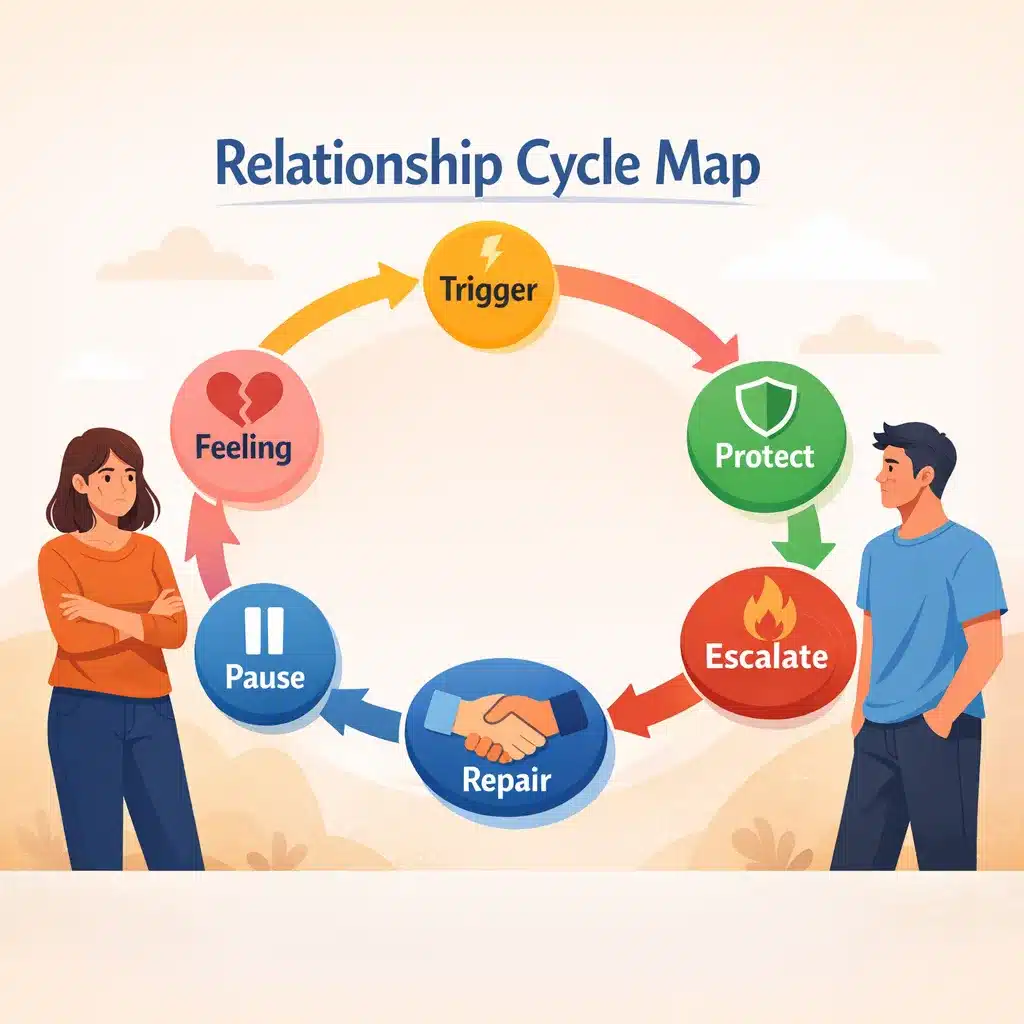
When emotions surge, respect and recognition get replaced by survival moves: attack, defend, withdraw, punish.
Use this simple 90-second reset:
- Name the state: "I'm getting flooded. I'm not thinking clearly."
- Pause (2–10 minutes): water, breathing, quick walk—no doom-scrolling.
- Restart with one sentence: "Here's what I'm feeling, and here's what I need."
Then use the one-topic rule:
- Pick one issue.
- Define it in one line.
- Agree on the goal (solve, understand, or plan).
If you try to fix your entire relationship in one argument, congratulations—you've just scheduled a sequel.
🛠️ Repair language that saves hours of fighting
Repairs are the secret weapon of couples who last. They're short phrases that stop damage mid-moment.
Try these:
- "I'm coming out harsh. Let me restart."
- "I hear you. I'm not against you."
- "That landed wrong. I didn't mean it that way."
- "Can we be on the same team for this?"
- "What would feel respectful right now?"
- "What would help you feel recognized right now?"
This is where couples shift from winning to building.
🚫 The respect-killers to quit today
If you want a fast upgrade in your relationship, stop doing the things that poison safety.
The Gottman Institute calls contempt (mocking, superiority, disgust, sneering) one of the most destructive patterns in relationships.
Respect-killers to cut immediately:
- Contempt (sarcasm, eye-rolls, "what's wrong with you?")
- Public shaming
- "Always/never" language
- Scorekeeping (using kindness as currency)
- Weaponizing old failures
- Silent punishment (not the same as taking space)
If you want a strict rule: No contempt in the house. Not "less contempt." None.
🌱 Build a culture of appreciation
You don't build closeness by avoiding conflict forever. You build it by stacking small positive moments so conflict doesn't erase the relationship.
Gottman's work emphasizes how destructive patterns like criticism, contempt, defensiveness, and stonewalling can predict serious relationship trouble if they become the norm.
One practical antidote is building a culture of appreciation: you notice what's going right, you say it out loud, and you keep it specific.
Appreciation that actually works:
- "Thanks for making dinner" (good)
- "Thanks for making dinner—when you do that, I feel cared for" (better)
- "Thanks for making dinner—especially after your long day. That meant a lot" (best)
Appreciation is the overlap zone where respect and recognition become the same thing.
⏱️ The 5-minute daily check-in
Do this once per day. No phones. No problem-solving unless asked.
The 10–10–10 (5-minute version):
- 1 minute: "How are you, really?"
- 2 minutes each: each partner shares (listener only reflects)
- Final minute: one appreciation + one small request
Prompts:
- "One thing that stressed me today was…"
- "One thing I'm proud of today is…"
- "One way you supported me was…"
- "Tomorrow, what I need most is…"
This tiny habit prevents resentment from becoming a personality trait.
📅 The weekly growth meeting
Once a week, 20 minutes. Set a timer. Keep it boring on purpose.
Agenda:
- What worked this week? (2 minutes)
- What felt hard? (5 minutes each)
- One request each (2 minutes each)
- One plan (4 minutes)
The APA highlights that communication and regular check-ins are key pieces of healthy relationships.
If you can do a weekly meeting about groceries, you can do one about feelings. Same skill. Higher payoff.
🧒 When childhood patterns run the show
Sometimes the conflict isn't about dishes or money. It's about what those things symbolize.
- Being corrected might trigger: "I'm not good enough."
- Silence might trigger: "I'm being abandoned."
- A raised voice might trigger: "I'm unsafe."
- "Fixing" might trigger: "My feelings don't matter."
These aren't excuses. They're explanations. And once you can name the pattern, you can stop treating your partner like the enemy.
Also, research on listening in couples suggests attentive listening during stress conversations relates to how couples cope together. In other words: how you listen when it's hard really matters.
✅ Conclusion: grow respect and recognition on purpose
Healthy love isn't built by "finding the right person." It's built by becoming the kind of partner who creates safety—daily.
If you want a practical target, aim for this: no contempt, more appreciation, better listening, faster repair. That's the foundation that keeps both respect and recognition alive.
When you practice respect and recognition consistently, "forever" stops feeling like pressure—and starts feeling like teamwork.
❓ Respect and recognition FAQs
❓ Is respect and recognition only a "men vs women" thing?
No. They're human needs. People just prioritize them differently.
❓ What's the fastest way to show respect during conflict?
Lower your tone, stop interrupting, and focus on the specific issue—not the person.
❓ What's the fastest way to show recognition during conflict?
Reflect the feeling first: "That sounds overwhelming. I get why you're upset."
❓ Does validation mean I'm admitting I'm wrong?
No. Validation means you understand their experience, not that you agree.
❓ What if my partner says "nothing I do is enough"?
Ask for two concrete examples of what "enough" would look like this week.
❓ How do I ask for respect without sounding controlling?
Use impact language: "When that happens, I feel dismissed. Please speak to me calmly."
❓ How do I ask for recognition without sounding needy?
Make it simple: "I don't need fixing right now. I need you to hear me."
❓ What destroys respect the most?
Contempt—mocking, superiority, or disgust—because it humiliates instead of solves.
❓ What destroys recognition the most?
Minimizing feelings ("you're overreacting") or rushing to solutions.
❓ What if one partner shuts down (stonewalls)?
Pause, regulate, then restart. Flooded brains can't do safe conversation.
❓ How often should we do a check-in?
Daily for 5 minutes is ideal, plus a weekly 20-minute meeting.
❓ Can respect exist without warmth?
It can, but it often feels cold. Add appreciation to keep it connected.
❓ Can recognition exist without boundaries?
No. Recognition without respect can feel chaotic. You need both.
❓ What's one daily habit that helps both?
Specific appreciation: "Thanks for doing X—it helped me feel Y."
❓ How do we stop repeating the same fight?
Name the pattern, pick one topic, and agree on one small change to test.
❓ Do kids make respect and recognition harder?
Yes—stress rises and attention drops. That's why micro-check-ins matter.
❓ When should we consider professional help?
If contempt, fear, or chronic shutdown is the norm—or if issues never repair.
📚 Sources and references
- The Gottman Institute — The Four Horsemen: Contempt (The Gottman Institute)
- The Gottman Institute — The Four Horsemen: The Antidotes (The Gottman Institute)
- American Psychological Association — Healthy relationships (American Psychological Association)
- Harvard Health — Active listening (Harvard Health)
- PubMed — "The power of listening" (Journal of Family Psychology, 2018) (PubMed)
- NCBI Bookshelf (NIH) — Active Listening (StatPearls) (NCBI)

Related Posts




The Longevity Blueprint: AI-Powered Health Optimization
About the Author: Bernard Aybout (Virii8)