Approx. read time: 8.8 min.
Post: Autonomous Car Explained: SAE Levels, Tech, Challenges
What Is an Autonomous Car? (Definition, SAE Levels, and Real Challenges)
🤖 What Is an Autonomous Car?
An autonomous car is a vehicle that can sense what’s around it and drive without a human actively driving. In the purest version of the idea, the vehicle can handle the full driving job—steering, braking, accelerating, observing the road, and responding to surprises—without needing you to take over.
In real life, “autonomous car” gets used as an umbrella term for everything from basic driver assistance all the way to a car that could drive anywhere, anytime, with nobody in the driver’s seat. That’s why the SAE levels matter: they stop marketing words from turning into confusion. The U.S. government and safety agencies commonly reference SAE’s framework when talking about automation levels.
🧭 Autonomous Car Levels: The SAE 0–5 Framework
SAE defines six levels of driving automation, from Level 0 (no automation) to Level 5 (full automation). NHTSA has a clear, plain-English breakdown that’s great for non-engineers.

What Is An Autonomous Car?
Here’s the key mindset shift:
- Levels 0–2: You drive, you monitor.
- Level 3: System drives sometimes, but you must be ready to take over when asked.
- Levels 4–5: System drives and monitors—humans become passengers (within limits for Level 4).
| SAE Level | Common name | Who monitors the road? | Where it works | Reality check |
|---|---|---|---|---|
| 0 | No automation | Human | Everywhere (human capability) | Traditional driving |
| 1 | Driver assistance | Human | Limited features (one task) | Helps steer or brake/accelerate |
| 2 | Partial automation | Human | Limited features (two tasks) | Helps steer and brake/accelerate, but you’re still responsible |
| 3 | Conditional automation | System (when engaged) | Specific conditions | You must be “fallback” when the system requests it |
| 4 | High automation | System (when engaged) | Limited service area / conditions | Often geofenced; humans can be passengers |
| 5 | Full automation | System | Everywhere a human could drive | Not available for consumer purchase today (per NHTSA) |
🆚 Autonomous vs. Automated vs. Self-Driving
This part is where people argue online, so let’s make it simple:
- Automated (SAE’s preferred term): Focuses on the driving task being performed by a system, not on the vehicle “having free will.” SAE’s J3016 taxonomy is built around this idea.
- Autonomous: In everyday speech, it means “drives itself.” In philosophy, “autonomy” implies choice and self-direction. That’s why engineers avoid it.
- Self-driving: Usually means the car can drive itself in some situations, but humans still matter (often Level 2–4 in practice).
If a system still requires you to supervise the road, it’s not the sci-fi version of an autonomous car—no matter what the badge says.
📡 How an Autonomous Car “Sees”: Sensors + Sensor Fusion
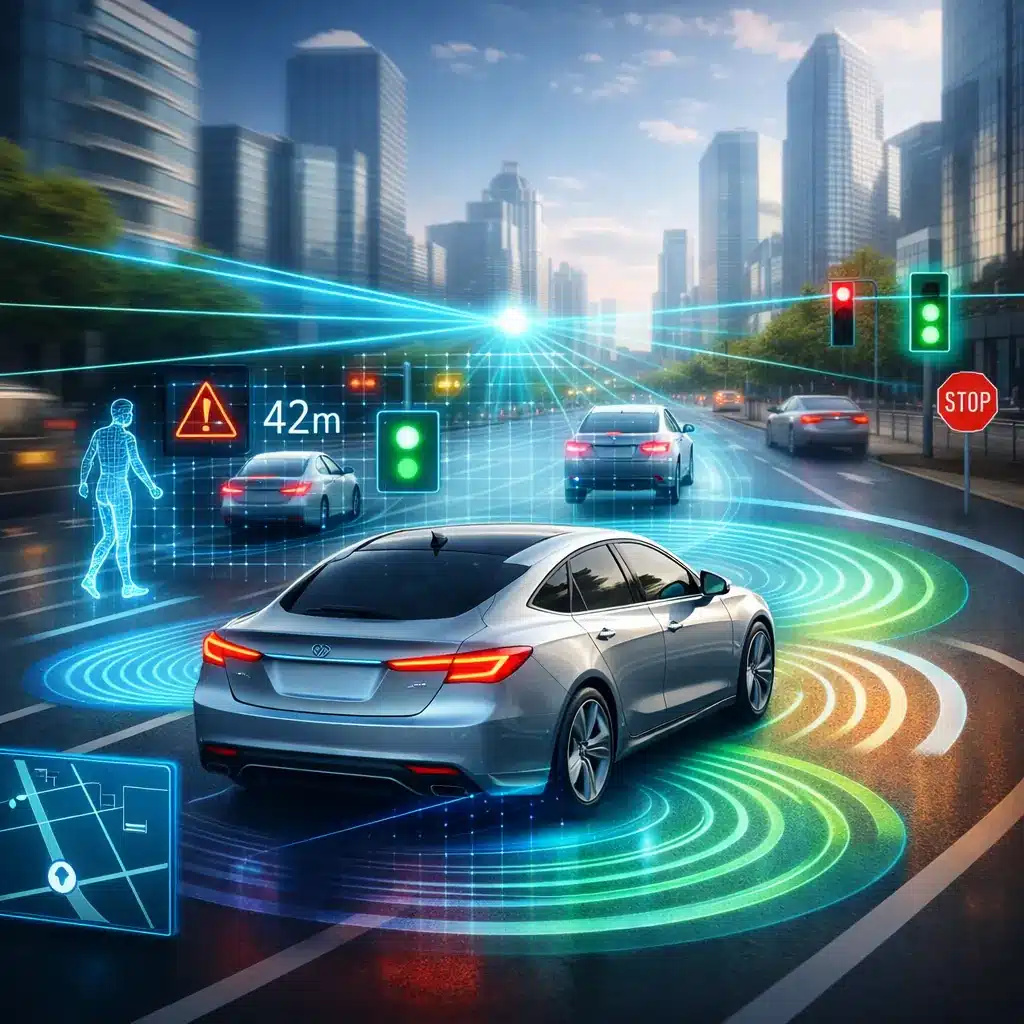
An autonomous car doesn’t “see” like you do. It builds a model of the world using multiple sensors, then merges them (sensor fusion) to reduce blind spots.
| Sensor | Best at | Weak at |
|---|---|---|
| Cameras | Color, text, signs, signals, lane paint, object classification | Glare, darkness, fog, heavy snow, dirty lenses |
| Radar | Distance + speed (great for tracking moving vehicles) | Fine detail (shape/edges), some clutter scenarios |
| LiDAR | 3D shape and distance (point clouds) | Cost, packaging, weather effects, potential cross-talk concerns |
| Ultrasonic | Close-range detection (parking, curbs) | Long range, complex scenes |
🧠 The “Brain”: Perception, Prediction, and Decision-Making
Think of the software stack in three layers:
- Perception: Detects and labels things (cars, pedestrians, cyclists, cones).
- Prediction: Guesses what those things will do next (will that pedestrian step out?).
- Planning + Control: Picks a safe path, then executes it smoothly.
This is why autonomy is hard: the car isn’t just reacting—it’s constantly forecasting and updating.
🗺️ Maps and Localization: “Where Am I, Exactly?”
GPS alone isn’t enough for automation. It can drift, get blocked, or bounce signals.
So many systems use a mix of:
- GPS + inertial sensors
- Camera/radar/lidar landmarks
- Pre-built “HD maps” in some deployments
In simple terms: the car needs to know where it is within a lane, not just which street it’s on.
🛣️ Planning and Control: Turning Software Into Steering
Once the car has a world model, it must:
- Choose a trajectory (safe + legal + comfortable)
- Maintain spacing
- Negotiate merges
- Handle stops, turns, and sudden obstacles
Then it sends commands to actuators (steering, brakes, throttle). That last step is why reliability testing is brutal: software mistakes become physical mistakes.
🌧️ Weather and Road Conditions: The Lane Lines Vanish
Bad weather is a reality check for every autonomous car vision stack:
- Snow hides lane markings and curbs.
- Rain creates glare and reduces camera clarity.
- Fog can reduce effective range for multiple sensors.
Humans “fill in the blanks” using experience. Machines need strong redundancy and a safe fallback plan.
🚦 The Human Factor: Eye Contact, Gestures, and “Road Negotiation”
Humans communicate constantly without realizing it:
- A quick wave to merge
- A hesitant step at a crosswalk
- A driver creeping forward to claim space
Autonomous systems must interpret these “soft signals” or behave conservatively. Conservative sounds safe… until it causes indecision, weird stops, or traffic disruption.
🕳️ Tunnels, Bridges, and GPS-Denied Weirdness
Tunnels, urban canyons, bridges, and construction zones create stacked problems:
- GPS can degrade
- Lane markings shift
- Lighting changes fast
- Work zones introduce unpredictable layouts
This is where “it drives fine on sunny suburban streets” stops being impressive.
🏛️ Laws and Regulation: Why It’s Not One Rule Everywhere
Rules don’t scale neatly.
- In the U.S., states pass different automated vehicle laws and definitions, which complicates deployment across borders.
- Federal guidance often focuses on higher levels (Level 3–5) and safety frameworks, but the legal landscape still varies by jurisdiction.
Translation: a car that’s legal in one place may need new approvals, reporting, or operating limits elsewhere.
⚖️ Liability: Who’s at Fault in a Crash?
Liability is messy because “driver” becomes ambiguous.
- At Level 2, the human is still responsible because they must monitor the environment.
- At Level 4, occupants may be treated as passengers (within the system’s operating domain).
If a future Level 5 vehicle has no steering wheel, you can’t reasonably blame a passenger for failing to “take over.” That pushes responsibility toward manufacturers, operators, and software update decisions.
🔐 Cybersecurity: The Unsexy Problem That Can Kill the Whole Dream
Here’s the blunt truth: software is now a core safety component.
McKinsey notes that today’s cars have about 100 million lines of code, and many observers expect roughly 300 million by 2030.
More code means:
- More features
- More complexity
- More places for bugs and vulnerabilities
So “autonomous car cybersecurity” isn’t optional. It’s the foundation. If the public doesn’t trust the system, the tech loses—no matter how good it is in demos.
🌱 Why Autonomous Cars Could Matter: Mobility + Climate + Cities
The hype isn’t totally nonsense. There is real upside when automation is paired with the right policies.
A major report by UC Davis (STEPS) and ITDP frames three combined shifts—electrification + automation + shared mobility—as the path to major impact.
ITDP summarizes the potential clearly: with those “3 revolutions,” cities could cut urban transport CO₂ emissions by up to ~80% by 2050, and reduce urban vehicle transportation costs by about 40%.
My opinion: this is the only version of the autonomous car future that’s actually worth chasing—electric + shared + well-managed, not “everyone owns a robot SUV that drives empty all day.”
🧪 Where We Are Today: Level 2 Everywhere, Level 4 in Pockets
Most consumer tech on the road still lives in Level 0–2 land (driver assistance). Meanwhile, Level 4 shows up in limited service areas where conditions are controlled and mapped.
And Level 5? NHTSA is direct: Level 4 and Level 5 systems are not available for consumer purchase today.
If someone tells you “Level 5 is basically here,” they’re either confused, selling something, or both.
🧰 Autonomous Car Capability Wish List: What’s Real vs. Hype
Let’s sort your wish list into three buckets.
Likely / already happening (in some form):
- Object recognition (vehicles, pedestrians, signs)
- Night vision / enhanced perception (IR cameras exist, fusion helps)
- Adaptive cruise control (common today)
Possible, but complicated (privacy + security + policy):
- Facial recognition / biometrics for keyless security (feasible, but spoofing + privacy risks are real)
- Global V2X safety standards (valuable, but slow—standards and rollout take years)
Mostly “cool idea,” not near-term road reality:
- Windshield overlay for movies while driving (fine only when you’re truly a passenger; otherwise it’s a safety nightmare)
- Flying cars (eVTOLs exist as aircraft-ish vehicles, but that’s a whole different regulatory universe)
❓ FAQs
1) What is an autonomous car in simple terms?
It’s a vehicle that can sense its surroundings and drive itself—partly or fully—using sensors and software.
2) Are “autonomous” and “self-driving” the same?
People use them interchangeably, but “self-driving” often implies the human must still be present and ready, while true “autonomous” implies no human needed.
3) What are the SAE levels of driving automation?
They range from Level 0 (no automation) to Level 5 (full automation). NHTSA publishes a clear level-by-level breakdown.
4) What level are most cars on the road today?
Most are Level 0–2 (driver assistance), where the human still monitors the road.
5) Is Level 5 available to buy right now?
No—NHTSA states Level 4/5 technologies are not available on today’s vehicles for consumer purchase.
6) Do autonomous cars need LiDAR?
Not always. Some systems emphasize cameras and radar, while others use LiDAR heavily. What matters is redundancy and reliability.
7) Why is snow such a big problem for self-driving systems?
Snow can hide lane lines, curbs, and road edges—exactly the clues many perception systems rely on.
8) Who is responsible if an automated car crashes?
It depends on the automation level and who was responsible for monitoring and control in that moment.
9) Can autonomous cars be hacked?
Any connected, software-heavy system carries risk. Modern cars already run massive software stacks, which raises cybersecurity stakes.
10) When will we get true “drive anywhere” Level 5?
Nobody credible can promise a date. The hard part isn’t highway cruising—it’s rare edge cases, messy human behavior, and safety validation at scale.
📚 Sources & references
- NHTSA – Levels of Automation (PDF) (NHTSA)
- SAE – J3016 taxonomy and definitions (PDF copy) (UNECE Wiki)
- USDOT/NHTSA – ADS test case framework noting USDOT adoption of SAE levels (PDF) (NHTSA)
- McKinsey – Connected car cybersecurity (100M → ~300M lines of code) (McKinsey & Company)
- ITDP + UC Davis (STEPS) – “Three Revolutions” report + summary (CO₂/cost potential) (Steps Plus)

Related Posts





The Longevity Blueprint: AI-Powered Health Optimization
About the Author: Bernard Aybout (Virii8)