Approx. read time: 20.9 min.
Post: Canadian Justice System: 17 Essential Parts Explained
Canadian Justice System: 17 Essential Parts Explained
The Canadian justice system isn't just "court stuff." It's the rulebook for everyday life in Canada—driving, work, renting, buying, getting benefits, running a business, and protecting people from harm. If you've ever signed a contract, filed a complaint, gotten a ticket, dealt with insurance, or even argued with a neighbour about property lines, you've already been living inside it.
This is a plain-English, practical guide that explains how the system works, why it exists, and how the pieces fit together—from Parliament and the Charter, to courts and tribunals, to civil vs criminal cases.
Friendly warning: This is general information, not legal advice. If you have a specific legal problem, talk to a qualified lawyer or paralegal.
🇨🇦 Canada’s System of Justice: A Comprehensive Overview
The law is an omnipresent force that influences nearly every facet of daily life in Canada, from the regulation of driving and employment to the foundational protections against crimes like robbery and murder. It provides a set of rules for conduct designed to protect the rights of every individual, rooted in the principles of the rule of law, democratic freedom, and mutual respect. By balancing individual rights with social obligations—such as the duty of a driver to follow road rules in exchange for the right to drive—the legal system ensures a stable, functional society.
Here's the key idea: the Canadian justice system is built to replace chaos with process. Instead of "whoever is louder wins," the system aims for rules, evidence, fairness, and predictable outcomes. That doesn't mean it's perfect (no justice system is), but it does mean there's a structure—and structure is what stops daily life from turning into a lawless free-for-all.
🎯 The Necessity and Goals of Law – Canadian justice system
Without law, society would arguably descend into chaos where the strongest individuals exert control through fear. The law serves as a peaceful mechanism for resolving disputes; rather than resorting to physical conflict, individuals turn to the courts to decide matters such as property ownership. Beyond maintaining order, Canadian laws are instruments of social policy. They facilitate government systems that provide healthcare, student loans, unemployment insurance, and workers' compensation. Furthermore, laws protect the vulnerable by preventing stronger groups from taking unfair advantage of others.
In practice, law does three big jobs:
- Prevents harm (through rules and consequences)
- Resolves conflict (through courts, tribunals, and negotiated settlements)
- Organizes society (benefits, licensing, standards, and government services)
If you want a simple mental picture: law is the "traffic system" for human behaviour. Without it, everyone crashes into everyone—eventually.
⚖️ Public Law vs. Private Law
The Canadian legal system categorises laws into two primary domains:
- Public Law: This governs the relationship between the individual and society. It includes criminal law (crimes and punishments), constitutional law (the structure of government and human rights protections), and administrative law (government operations). A crime is viewed as a wrong against the entire community.
- Private Law (Civil Law): This settles disputes between individuals or groups and focuses on compensation for victims. For example, if a person accidentally damages a neighbour's property, the matter is handled under private law to determine restitution.
This split matters because it changes everything about the process:
- Who brings the case (the state vs a private person)
- What the goal is (punishment/protection vs compensation/repair)
- What proof standard applies
- What outcomes are available
A practical example:
- Criminal: assault, theft, impaired driving (the Crown prosecutes)
- Civil: car accident injury claim, contract dispute, property damage (a person sues another person)
And then there's the third "quiet giant" people forget: administrative law, where government decisions get reviewed (benefits, licensing, immigration procedures, human rights processes, and more).
🏛️ Foundations and Origins: A Bijural Tradition
Canada is a bijural country, meaning it operates under two distinct legal traditions inherited from France and England.
- Common-Law Tradition: Used in most of Canada, this system relies on precedent—decisions made by judges in previous similar cases—rather than a single written code. It is flexible, allowing judges to adapt legal doctrines to changing social circumstances.
- Civil-Law Tradition: Quebec is the only province that uses a Civil Code, based on the French Code Napoléon. This code is a comprehensive statement of rules and general principles that courts consult first before looking at previous decisions.
Additionally, the system recognises Aboriginal and treaty rights, which stem from the historical occupancy of the land and formal agreements between the Crown and Aboriginal peoples. These rights are constitutionally protected.
Canada's bijural setup is one reason the Canadian justice system can feel "different" depending on where you are. In common law provinces, judges lean heavily on prior cases. In Quebec's civil law tradition (for private law), the code is the starting point.
🧠 Why precedent matters (common law)
Precedent makes outcomes more predictable:
- Similar facts should lead to similar results
- Courts explain reasoning so future courts can follow it
- The law evolves gradually over time
📘 Why a civil code matters (civil law)
A code-based system aims for clarity and structure:
- A central text sets the general rules
- Courts interpret and apply those rules
- Prior cases help, but the code is the anchor
🪶 Aboriginal and treaty rights
Section 35 of the Constitution Act, 1982 recognizes and affirms existing Aboriginal and treaty rights. (Laws and Regulations of Canada)
That constitutional protection has real-world impact in areas like land claims, resource development, and the Crown's duty to consult.
🧾 The Legislative Process: How Laws Are Made – Canadian justice system
Canada is a federation, meaning law-making power is shared between the federal Parliament in Ottawa and the legislatures of the ten provinces and three territories. Laws passed by these bodies are known as statutes, acts, or legislation, and they supersede common law precedents on the same subject.
The federal process involves several rigorous stages:
- Examination: Ministers or public servants study a problem and suggest a legislative solution.
- Drafting: The proposed law is written out.
- Cabinet Approval: The prime minister's cabinet must approve the version presented to Parliament.
- Parliamentary Debate: The bill is studied and debated in both the House of Commons and the Senate.
- Royal Assent: To become law, a bill must be approved by a majority in both houses and receive Royal Assent from the Governor General in the name of the Queen.
Due to the complexity of modern society, legislatures often pass regulations. These are specific laws created by government departments under the authority of a general statute to handle technical details, such as food safety standards.
A modern clarification (without changing your wording): Canada's formal structure is a constitutional monarchy, and bills need Royal Assent from the Governor General acting for the Monarch. Parliament's own explainer confirms the bill must pass both Houses in identical form, then go to the Governor General for Royal Assent. (Learn About Parliament)
🧩 What regulations do (in real life)
Statutes set the big rules. Regulations fill in the technical details:
- Safety standards
- Licensing conditions
- Reporting requirements
- Industry compliance rules
This is why two laws can "feel" different: one is a high-level Act, the other is the detailed regulation that actually tells you what to do.
📜 The Canadian Constitution
The Constitution is the supreme law of Canada, providing the fundamental principles that govern the country and defining the powers of the three branches of government. It includes the Constitution Act, 1867 (which created Canada as a union of colonies) and the Constitution Act, 1982 (which "patriated" the Constitution from the UK and added the Charter of Rights and Freedoms).
The three branches of government are:
- The Executive: Comprised of the Queen (represented by the Governor General), the Prime Minister, and the Cabinet. They are responsible for government business and departments.
- The Legislative: The Parliament, which debates and passes bills.
- The Judiciary: Independent judges who interpret and apply the law and the Constitution.
Federalism dictates that Parliament handles national issues like national defence, criminal law, and money, while provinces manage local matters like education, hospitals, and property rights.
This is the "big frame" of the Canadian justice system:
- The Constitution tells governments what they can and can't do.
- It divides powers (federal vs provincial).
- It protects rights (Charter + Section 35).
If a law conflicts with the Constitution, that law can be challenged and potentially struck down or limited.
🛡️ Rights and Freedoms: The Charter
The Canadian Charter of Rights and Freedoms is part of the Constitution, meaning it takes priority over other legislation. It ensures that governments must respect fundamental human rights in all their actions.
Categories of protected rights include: Canadian justice system
- Fundamental Freedoms: Freedom of religion, thought, expression, peaceful assembly, and association.
- Democratic Rights: The right to vote and to have an election called at least every five years.
- Mobility Rights: The right for citizens to enter, remain in, or leave Canada, and for residents to work in any province.
- Legal Rights: Protection against arbitrary arrest, the right to be presumed innocent until proven guilty, and the right to a fair trial within a reasonable time.
- Equality Rights: The right to equal treatment regardless of race, sex, age, or disability.
- Language Rights: English and French have equal status as official languages in federal institutions.
Rights are not absolute; Section 1 of the Charter allows for "reasonable limits" that can be justified in a free and democratic society. Additionally, the notwithstanding clause allows legislatures to pass laws that temporarily override certain Charter rights, though this requires public accountability and five-year reviews.
Justice Canada's Charterpedia explains Section 1 as the balancing mechanism that allows limits when they can be demonstrably justified in a free and democratic society. (Ministère de la Justice)
✅ Practical takeaway
Charter issues usually involve government action:
- A law passed by Parliament or a legislature
- A policy by a government department
- Police conduct, detention, search, seizure
- Court procedure and fairness
Private disputes (like a contract fight) are often more "civil code / common law / statute" than Charter—unless government action is involved.
🏗️ The Court System
The judicial system is organized hierarchically to ensure fairness and the possibility of appeal.
- Supreme Court of Canada: The final court of appeal for all of Canada. It consists of nine judges, three of whom must be from Quebec.
- Federal Courts: Specialized courts handling matters like taxes, maritime law, and intellectual property.
- Provincial/Territorial Courts: The lower level, handling most criminal, family, and small claims cases.
- Superior Courts: The highest courts in a province, dealing with serious crimes and civil cases.
Administrative Boards and Tribunals also play a vital role, resolving disputes outside of the formal court system regarding topics like employment insurance or human rights.
Two quick "accuracy anchors" from official sources:
- The Supreme Court is Canada's final court of appeal, and three judges must be from Quebec. (Supreme Court of Canada)
- The court structure is hierarchical to allow review and appeals. (Ministère de la Justice)
🧠 Why hierarchy matters
Because humans make mistakes. The appeal system exists so:
- errors can be corrected
- law can become more consistent
- serious issues can be reviewed at higher levels
🧑⚖️ Civil and Criminal Case Procedures
The processes for civil and criminal matters differ significantly:
- Civil Cases: A plaintiff sues a defendant, typically seeking damages (monetary compensation) or an injunction (an order to stop an action). The standard of proof is the balance of probabilities—meaning it is more likely than not that the defendant is liable.
- Criminal Cases: The state (the Crown) prosecutes an accused person for offences categorized as either summary (minor) or indictable (serious). The Crown must prove guilt beyond a reasonable doubt. Sentencing aims to deter future crime, punish the offender, and encourage rehabilitation.
Justice Canada clearly states that civil cases use "balance of probabilities," while criminal cases require proof "beyond a reasonable doubt." (Ministère de la Justice)
⚖️ Why the proof standards differ
Because what's at stake is different.
- In civil cases, money or orders are usually at stake.
- In criminal cases, liberty and criminal records can be at stake.
So the criminal system demands stronger proof before the state can punish someone.
🤝 Victims, Youth, and Restorative Justice
The system has evolved to include:
- Victims of Crime: The Canadian Victims Bill of Rights (2015) gives victims a voice, allowing for victim impact statements and restitution orders.
- Restorative Justice: Rooted in Aboriginal traditions, this approach focuses on healing relationships between the victim, the offender, and the community.
- Youth Justice: Governed by the Youth Criminal Justice Act (YCJA), this system treats youth aged 12–17 with a focus on rehabilitation and fair accountability, recognizing their reduced level of maturity.
The Canadian Victims Bill of Rights includes victims' participation rights, including presenting a victim impact statement. (Laws and Regulations of Canada)
Correctional Service Canada explains restorative circles as community dialogue based on traditional Aboriginal peacemaking practices. (Canada)
Justice Canada states the YCJA applies to youth aged 12–17. (Ministère de la Justice)
🧒 Youth justice: accountability + rehabilitation
The point is not "no consequences." The point is consequences that match youth development and aim at rehabilitation—because society benefits when young people don't get stuck in lifelong crime cycles.
🔄 Restorative justice: when healing is the priority
Restorative programs can involve:
- victim-offender dialogue (where appropriate and safe)
- community circles
- agreements focused on repair and responsibility
It's not "soft." Done properly, it can be intensely demanding—because it requires real accountability and repair, not just punishment.
👥 The Role of the Public
The public contributes to the justice system through jury duty and testifying as witnesses. While ignorance of the law is not an excuse for breaking it, citizens are encouraged to use public resources to stay informed about their legal rights and duties. For those with low income, legal aid programs help ensure that everyone has access to legal representation.
Legal aid is one of the biggest "access to justice" pressure valves. In Ontario, Legal Aid Ontario explains that if you qualify financially and have a covered legal issue, LAO can help pay for representation and outlines how to apply. (Legal Aid Ontario)
🧩 Practical “Real Life” Examples
Here's how the Canadian justice system shows up in normal life—without the textbook fog.
🚗 Example 1: A car accident
- Civil side: insurance claims, injury claims, damages
- Criminal side (sometimes): impaired driving, dangerous driving, hit-and-run
Same event, different legal pathways.
🏠 Example 2: A landlord-tenant conflict
Often handled through administrative tribunals, not "regular court." This is why "court" is not the whole justice system—tribunals do a ton of the real-world workload.
💼 Example 3: Workplace discrimination complaint
This can involve:
- employment standards processes
- human rights processes
- sometimes civil claims
Again, the forum depends on the issue and the law.
🧾 Example 4: You got sued (civil)
General steps usually include:
- receiving a claim/application
- deadlines to respond
- disclosure of documents
- settlement talks or mediation
- trial if it doesn't resolve
The "win" in civil court is often money or an order, not jail time.
🚔 Example 5: You’re charged (criminal)
The state prosecutes. The Crown must prove the case beyond a reasonable doubt. (Ministère de la Justice)
Outcomes can include diversion (where available), probation, fines, or custody—depending on the offence and circumstances.
🧠 Putting it all together (the safety net)
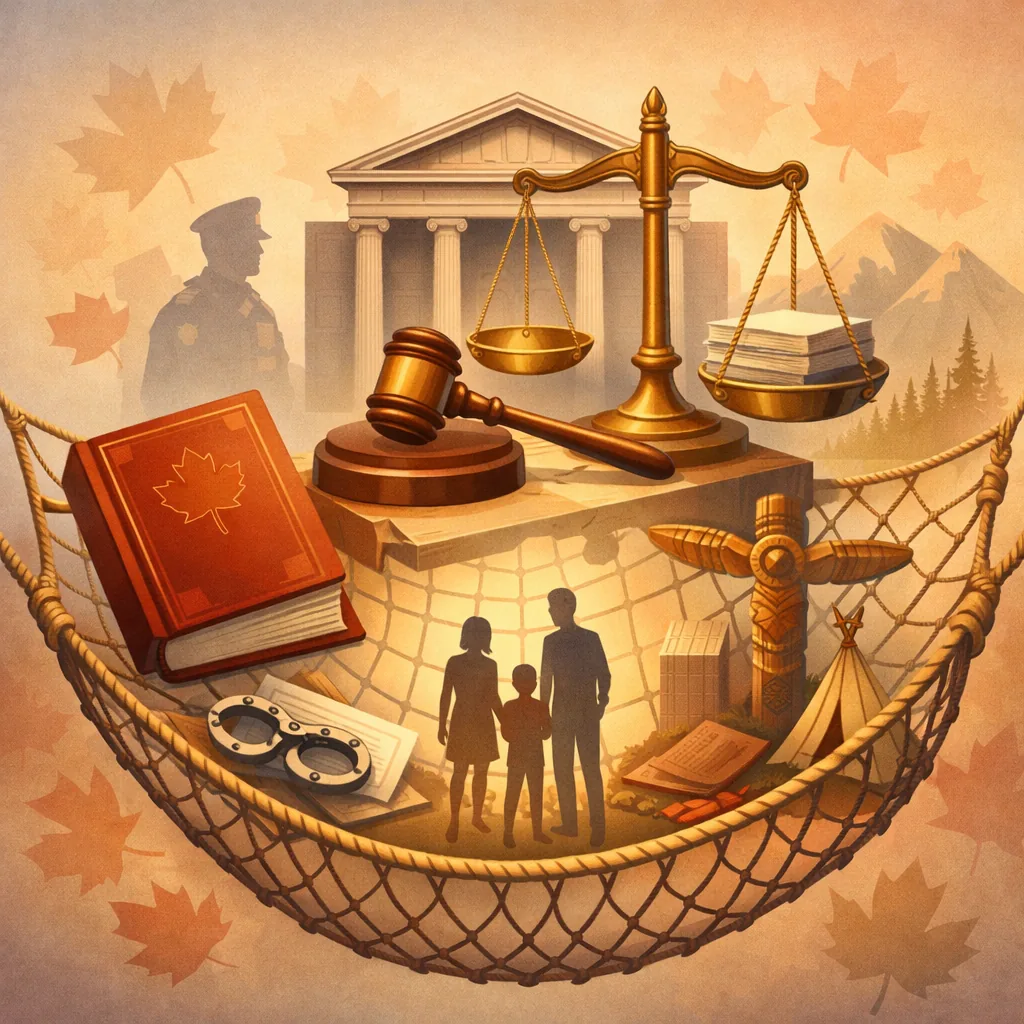
To understand the Canadian justice system, imagine a large, multi-layered safety net. The individual strands are the laws that protect us daily; the strong outer frame is the Constitution that holds everything together; and when a strand breaks, the courts act as the repair team, ensuring the net continues to support everyone equally.
That's the cleanest "big picture" summary you can keep in your head:
- Laws = strands
- Constitution/Charter = frame
- Courts/tribunals = repair team
- Public participation (jury/witness) = the system's human fuel
❓ Frequently Asked Questions: Canada’s System of Justice
❓ What is the Canadian justice system in plain English?
It's the structure Canada uses to create laws, protect rights, resolve disputes, and enforce rules fairly.
❓ What is the law and why do we need it?
The law provides a set of rules for conduct that protect the rights of every individual while balancing them against social obligations. Without laws, society would face chaos and danger where the strongest individuals exert control and people live in fear. Laws provide a peaceful mechanism for resolving disputes through the courts rather than through conflict.
❓ What are the different types of law in Canada?
Laws are primarily divided into public law and private law. Public law governs the relationship between the individual and society, including criminal, constitutional, and administrative law. Private law, also known as civil law, sets the rules between individuals to settle disputes and compensate victims.
❓ What is the difference between Common Law and Civil Law, and why is Quebec different?
Canada is a bijural country, meaning it uses two legal traditions. The common-law tradition, used in most of Canada, is a system of rules based on precedent—previous judicial decisions that guide future cases. The civil-law tradition, used exclusively in Quebec for private matters, relies on a Civil Code containing a comprehensive statement of rules and general principles.
❓ What is the supreme law of Canada?
The Constitution of Canada is the supreme law, consisting of the Constitution Act, 1867 and the Constitution Act, 1982. It defines the powers of the three branches of government: the executive (the Queen and Cabinet), the legislative (Parliament), and the judiciary (judges).
❓ How does the federal system divide power?
In Canada's federal system, the federal Parliament deals with national issues like defence, criminal law, money, and the postal service. Provincial legislatures have the authority to make laws regarding education, property, civil rights, hospitals, and the administration of justice within their borders.
❓ How is a federal law created?
The process begins with government ministers or public servants drafting a proposed law after examining a problem. This draft becomes a bill that must be debated and approved by a majority in both the House of Commons and the Senate. Finally, the bill must receive Royal Assent from the Governor General to become law.
❓ What is the Canadian Charter of Rights and Freedoms?
The Charter is part of the Constitution and takes priority over all other legislation. It requires that all government actions, laws, and policies respect the fundamental rights and freedoms of individuals.
❓ What specific rights does the Charter protect?
The Charter protects several categories of rights:
- Fundamental Freedoms: Freedom of religion, thought, speech, and peaceful assembly.
- Democratic Rights: The right to vote and the requirement for elections every five years.
- Mobility Rights: The right for citizens to enter, remain in, or leave Canada and to work in any province.
- Legal Rights: Protection against arbitrary arrest, the right to a fair trial, and the right to be presumed innocent.
- Equality Rights: The right to be treated without discrimination based on race, sex, age, or disability.
- Language Rights: The equal status of English and French in federal institutions.
❓ Are Charter rights absolute?
No, rights are not absolute; Section 1 of the Charter allows for reasonable limits if they are justified in a free and democratic society. Additionally, the notwithstanding clause allows Parliament or a legislature to temporarily override certain rights, provided they accept the political consequences and review the declaration every five years.
❓ What is Section 1 of the Charter?
It allows "reasonable limits" on rights if the government can justify them in a free and democratic society.
❓ What is Section 35 of the Constitution Act, 1982?
It recognizes and affirms existing Aboriginal and treaty rights.
❓ How are the courts organized in Canada?
The system is hierarchical, starting with provincial and territorial courts at the lower level, followed by superior courts. Above these are the provincial/territorial appeal courts and the Federal Court of Appeal. The Supreme Court of Canada sits at the top as the final court of appeal for the entire country.
❓ What is the role of the Supreme Court of Canada?
The Supreme Court consists of nine judges, three of whom must be from Quebec. It hears appeals from provincial, territorial, and federal appeal courts and decides on important constitutional or controversial legal questions.
❓ What are administrative boards and tribunals?
These are less formal bodies that resolve disputes over the application of specific laws and regulations, such as employment insurance or refugee claims. While not part of the formal court system, their decisions can be reviewed by courts to ensure fairness.
❓ What’s the difference between civil and criminal cases?
Civil cases usually involve compensation or court orders, while criminal cases involve the state prosecuting offences and must be proven beyond a reasonable doubt.
❓ What happens in a civil case?
A civil case begins when a plaintiff sues a defendant over a legal disagreement or injury. The process involves pleadings (filing the complaint), discovery (exchanging evidence), and a trial. The standard of proof is the balance of probabilities, meaning the plaintiff must prove it is more likely than not that the defendant is liable.
❓ What happens in a criminal case?
The state (the Crown) prosecutes an accused person for offences defined in the Criminal Code. There are two types of offences: summary (minor) and indictable (serious). The Crown must prove the accused's guilt beyond a reasonable doubt.
❓ Can court decisions be appealed?
Yes, the right to appeal is an important safeguard against errors. A higher court may affirm the original decision, reverse it, or order a new trial.
❓ What are the rights of victims?
The Canadian Victims Bill of Rights (2015) provides victims with clear rights at the federal level. Victims have their safety considered in bail decisions, can provide victim impact statements, and may be granted restitution as part of an offender's sentence.
❓ How does the youth justice system work?
Governed by the Youth Criminal Justice Act (YCJA), this system applies to youth aged 12 to 17. It emphasizes rehabilitation and fair accountability while recognizing that young people have a reduced level of maturity compared to adults.
❓ What is restorative justice?
Restorative justice focuses on healing relationships and fixing damage caused by crime rather than just punishment. It requires offenders to recognize the harm they caused, accept responsibility, and make amends to the victim and community.
❓ What is the role of the public in the justice system?
Citizens contribute by serving on a jury or testifying as witnesses. While people do not need to be legal experts, ignorance of the law is no excuse for breaking it, and citizens are expected to use public resources to understand their legal duties.
❓ Where can low-income people get help with legal issues, and who is eligible for legal aid?
Legal aid is available for low-income individuals who meet financial criteria and are accused of a crime that could result in jail or loss of livelihood. Some provinces also provide legal aid for civil matters, such as family law.
✅ Call to Action – Canadian justice system
Technology and AI are now baked into how the Canadian justice system works—sometimes quietly, sometimes in big headline ways. Courts and tribunals rely on digital filing, virtual hearings, and electronic disclosure to move cases faster and reduce costs, especially when people live far from courthouses or need accommodations. Police and regulators use data systems, body-worn camera workflows, and digital evidence pipelines that make "what counts as proof" more about authenticity, chain of custody, and metadata than ever before. That's a huge shift: the justice system still runs on fairness and due process, but the inputs (evidence, records, surveillance, communication) are increasingly digital.
AI adds another layer: it can help with triage (routing cases to the right forum), document review, translation, accessibility tools, and even spotting inconsistencies in large evidence sets—but it also creates fresh legal headaches. Deepfakes, synthetic audio, and AI-edited content raise the bar for verifying evidence. Automated decision systems used by institutions can trigger administrative law challenges if they're opaque, biased, or impossible to appeal in a meaningful way. So the connection is simple: the Canadian justice system is still the safety net—but technology and AI are changing the shape of the net, forcing courts, lawmakers, and tribunals to update rules around privacy, disclosure, reliability, and accountability so rights protections keep up with modern tools.
If you need help with a legal issue or want guidance through a process, reach out to our legal and paralegal services here:
🔗 Sources & References (Authoritative)
- Parliament of Canada — How a Bill Becomes a Law (Learn About Parliament)
- House of Commons — Legislative Process (House of Commons)
- Justice Laws — Constitution Act, 1982 (Section 35) (Laws and Regulations of Canada)
- Justice Canada — Charterpedia (Section 1) (Ministère de la Justice)
- Supreme Court of Canada — Judges (Quebec requirement) (Supreme Court of Canada)
- Justice Canada — Civil and criminal cases (proof standards) (Ministère de la Justice)

Related Posts






The Longevity Blueprint: AI-Powered Health Optimization
About the Author: Bernard Aybout (Virii8)