Approx. read time: 14.7 min.
Post: Connected Car Data Privacy: 11 Shocking Truths Drivers Miss
Connected Car Data Privacy: 11 Shocking Truths Drivers Miss
Connected car data privacy is the new "check engine light" for modern drivers: most people ignore it until it costs them money, stress, or both. Today's vehicles are rolling computers with an internet connection, a sensor suite, and (often) a smartphone sync that hoovers up your life. The result is simple: your car can remember more about your routine than your best friend.
This article breaks down what connected cars can collect, how that data can travel, why insurers and advertisers care, and what practical steps you can take to reduce your exposure. No panic. No paranoia. Just a clear plan.
🚗 Why Connected Car Data Privacy Matters Now
Years ago, "car privacy" meant someone peeking through your window. Now it can mean your driving behavior being packaged into a score, your location history lingering longer than it should, and your infotainment system quietly storing phone-related data you never intended to share.
Most drivers never see the dashboard for their data. In many cases, they can't easily download it, review it, or delete it. That's the problem: you can't control what you can't see.
Connected services also keep expanding. As vehicles add more cameras, driver monitoring, voice assistants, and cloud features, the value of your data rises. And when data becomes valuable, it attracts everyone—from product teams to marketers to the occasional sketchy third party.
📡 Sensors That Power Connected Car Data Privacy Problems
Connected cars don't collect "a little bit of data." They collect streams of data. Hundreds of sensors can track speed, braking, steering input, wheel speed, stability control activity, seatbelt usage, door events, and more.
Some data stays in the vehicle. However, plenty of data can be transmitted to the manufacturer or service providers for diagnostics, safety features, navigation, and product improvement. The tricky part is that "product improvement" can be a wide umbrella.
In addition, sensors don't only measure the car. They measure you—your habits, your routes, your timing, and your behavior patterns. Those patterns can become personally identifying fast, even if someone says the data is "anonymized."
🧠 Infotainment Systems and Your Personal Data
Your infotainment system is the most underrated privacy risk in the whole vehicle. People treat it like a fancy radio. In reality, it's the social hub that often touches navigation, Bluetooth, voice commands, apps, and phone syncing.
If you've ever paired a phone, imported contacts, made calls hands-free, or used built-in navigation, you've given the infotainment system a chance to store personal data. That can include contact lists, call logs, device identifiers, and sometimes messages or other metadata depending on platform and settings.
And here's the uncomfortable truth: your car can outlive your phone. That means your personal data can remain behind in the vehicle long after you've forgotten you ever connected it.
📍 Telematics, OnStar, and the “Always-On” Car
Telematics is the umbrella term for collecting and transmitting vehicle data over cellular networks. Services like emergency response, roadside assistance, stolen vehicle support, remote unlock, and location-based features usually sit on top of telematics.
General Motors' OnStar is one of the best-known examples of connected services, and it dates back to the mid-1990s. That long history matters because it shows how long "connected" has been normal in parts of the auto industry.
However, an always-on connection changes the privacy equation. If a vehicle can be located on demand, or if driving behavior can be logged over time, then connected car data privacy becomes less about "what the car can do" and more about "who can see the outputs."
🧾 What Data a Connected Car Can Store and Transmit
Connected car data privacy gets clearer when you sort data into buckets. Here's a practical way to think about it: location, driving behavior, vehicle health, and "your stuff" (phone/app data).
| Data category | What it can reveal | What you can do |
|---|---|---|
| Location & routes | Home/work patterns, visits, routines, sensitive stops | Limit location sharing, disable cloud route history where possible |
| Driving behavior | Hard braking, speeding, late-night driving, cornering style | Opt out of "driver score" programs and insurance-sharing features |
| Diagnostics | Vehicle health, faults, maintenance patterns | Keep safety/diagnostics, but review app permissions and sharing toggles |
| Infotainment / phone sync | Contacts, call logs, device IDs, sometimes media metadata | Use "guest" profiles, deny contact sync, and wipe data before selling |
Not every vehicle collects every item the same way. Still, these categories cover most of the real-world privacy issues drivers run into.
🏢 Who Uses the Data (Automakers, Apps, Insurers)
Let's be blunt: if data exists, someone will try to monetize it. Automakers want data for safety, engineering, warranty analysis, and product design. That's the "reasonable" side of the story.
Then the incentives widen. Data can also support marketing experiments, feature targeting, upsells, and partnerships. Meanwhile, insurance companies and data intermediaries love behavioral signals because they can be turned into risk models.
Even if a program is labeled "optional," the design can push you toward enabling it. That's why connected car data privacy is often less about what's technically possible and more about what the default settings encourage.
⚖️ The FTC vs GM: A 2025 Reality Check
If you want a single example of why connected car data privacy matters, look at what happened with driving behavior data in the U.S. In January 2025, the U.S. Federal Trade Commission announced an action involving General Motors and OnStar over allegations tied to collecting and sharing precise location and driving behavior data without clear consumer consent.
The headline lesson for drivers is not "never use connected features." It's this: treat driver scoring and data-sharing programs like you'd treat a credit report. If it can impact pricing or access to services, you want visibility and control.
So, even if your car promises "safe driver rewards," read the toggles. Otherwise, connected car data privacy turns into connected car data surprise.
🔧 The Chevy Volt Case Study (What Forensics Revealed)
A popular privacy experiment involved a Chevrolet vehicle and a forensic-style look at what the car stored. At a high level, the takeaway was simple: infotainment systems can hold a surprising amount of personal and location-related information, especially when phones are paired and used regularly.
To keep this safe and responsible, I'm not going to walk through "how" anyone did it. The only point that matters for everyday drivers is the outcome: data can persist locally in systems you never think about, and you can't assume it disappears when you unpair your phone.
If you want a visual reminder of where that kind of computer lives, here are two images (from your original material) that show the infotainment module being accessed and copied in a controlled forensic context:
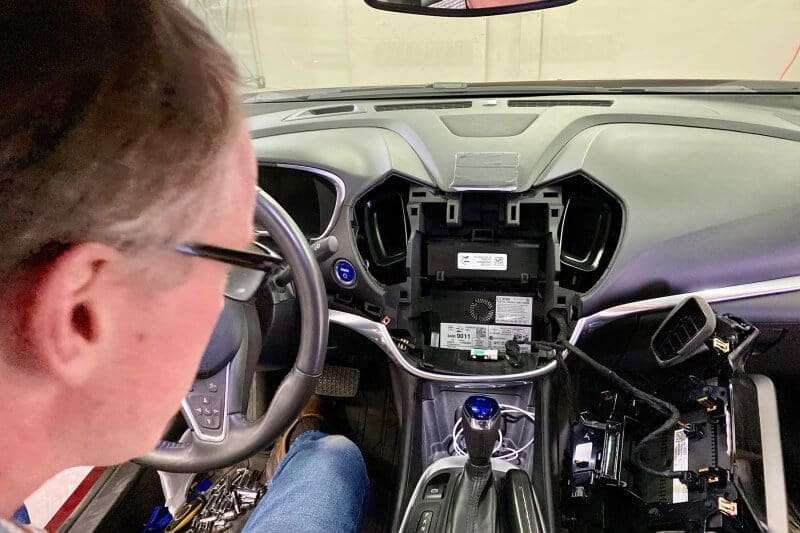
Buried Behind The Touch Screen And Radio Controls Sits A Chevrolet's Infotainment Computer.
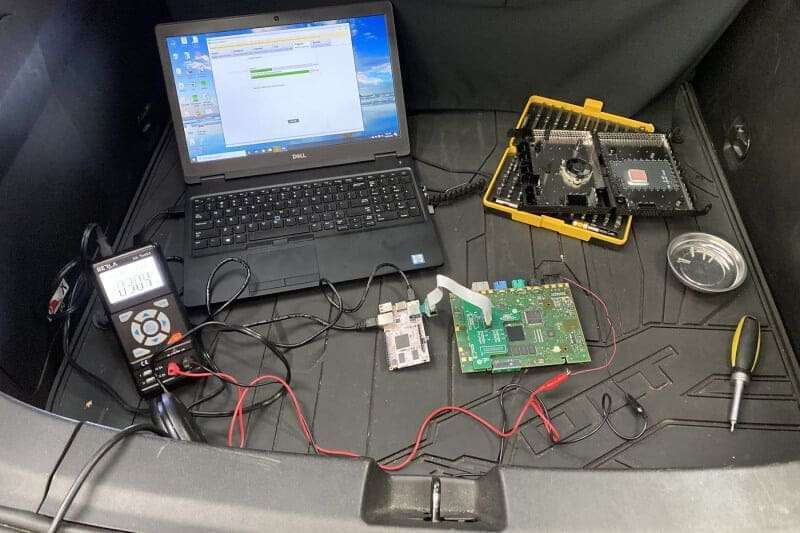
The Infotainment Computer Is Connected To Hardware To Copy Its Contents To A Laptop (Forensics Context).
Again: don't "mess around and find out" with your dashboard. If you need privacy help, use settings and official support channels. That's the grown-up way.
🛡️ Security Risks: How Data Turns Into Real-World Risk
Privacy isn't abstract. When location history leaks, stalking risk increases. When personal contacts and identifiers linger, identity-related risks rise. When a vehicle account gets compromised, remote features can become a problem.
In addition, cars now sit inside a bigger ecosystem: phone apps, cloud accounts, third-party services, and sometimes fleet portals. That means your "car security" is only as strong as your weakest password and your sloppiest app permission.
So yes, connected car data privacy includes cybersecurity basics: unique passwords, two-factor authentication where offered, and keeping your vehicle software updated.
🧩 Consent and Privacy Policies: Why Drivers Get Burned
Most privacy policies are written like a legal stress test. Drivers don't read them because they're long, vague, and full of "may collect" language that can mean almost anything.
Consent also gets messy because cars are shared. If two adults and a teen share one vehicle, whose consent counts? If you sell the car, did you remove your data? If you rent a car, what did the last driver leave behind?
Connected car data privacy needs a better model than "click accept once and forget it forever." Until that happens, you have to build your own habits and cleanup steps.
🇨🇦 Connected Car Data Privacy in Canada
Canadian drivers aren't immune. Connected cars operate in Canada, use Canadian cellular networks, and create data that can be sensitive under privacy principles—especially location data and behavioral data.
Canada has also been building more formal attention around vehicle cybersecurity and the broader connected/automated vehicle ecosystem. That matters because strong cybersecurity supports privacy: fewer weak points means fewer opportunities for data misuse.
Practically, the advice stays the same: treat connected car data privacy like you treat online banking. Review settings, limit sharing to what you actually need, and don't assume the default is the safest option.
✅ A Connected Car Data Privacy Checklist You Can Use Today
Here's the part people actually want: what to do right now. This checklist focuses on realistic wins, not fantasy "turn your car into a 1997 Corolla" advice.
- Audit the car's user profiles: delete old driver profiles you don't use.
- Review connected services: turn off marketing analytics, personalized ads, and "improve products" sharing where possible.
- Disable driver scoring programs: opt out unless you truly want it and understand the sharing.
- Lock down the app: use a strong password, enable MFA if available, and remove unused devices.
- Limit phone syncing: deny contact import and message access unless you need it.
- Use guest mode: if your system supports it, use guest/temporary profiles for passengers.
- Update software: apply official updates for the vehicle and the companion app.
- Before selling: factory reset the infotainment system and remove the car from the app account.
None of this breaks features like emergency assistance. You're not "disconnecting from society." You're cutting unnecessary sharing.
📱 How to Pair Your Phone Without Oversharing
Phone pairing is where connected car data privacy quietly falls apart. People tap "Allow" because they want the music to work. Then the car offers to import contacts, call history, and messaging access. That's where you should slow down.
When prompted, choose the minimum permissions. Allow audio and calls if you want. Decline contact sync if you don't need it on-screen. Also consider using CarPlay/Android Auto in a way that keeps more data on the phone rather than copying it into the car's local storage.
If you use multiple phones in the same car, clean up old pairings regularly. Otherwise, the infotainment system becomes a museum of your past devices.
🧼 Buying or Selling Used: Reset and Account Cleanup
Selling a connected car without wiping it is like selling a laptop without signing out. It's not "oops," it's a privacy fail.
Before you sell or trade in:
- Factory reset infotainment: remove contacts, navigation favorites, garage addresses, and call logs.
- Delete paired devices: remove every phone and Bluetooth profile.
- Remove the vehicle from your app account: don't leave remote access tied to your login.
- Confirm key fobs and digital keys: revoke access for any shared keys.
If you're buying used, do the same in reverse. Assume the previous owner left something behind until you reset it yourself.
🔮 The Future: 5G, Cabin Cameras, and V2X
Connected car data privacy will get harder before it gets easier. Faster cellular networks, more advanced driver assistance systems, and cabin monitoring features push more data through more systems.
Some of this improves safety. However, safety features still need clear limits, secure storage, and honest disclosure. Drivers shouldn't have to choose between "safe" and "private."
Expect bigger conversations around standards, access rights, and transparency dashboards. The industry has been promising "better control" for years, and regulators are starting to pay closer attention. That pressure is healthy.
❓ Connected Car Data Privacy FAQs
❓ What is connected car data privacy in plain language?
It's about what your car collects about you, where that data goes, and how much control you have over sharing, storage, and deletion.
❓ Can my car track my location even if I don’t use navigation?
Many vehicles can still collect location data for services like safety, diagnostics, or connected features, depending on settings and subscriptions.
❓ Does Bluetooth pairing copy my contacts into the car?
It can. Many systems ask to sync contacts and call history. You can often decline that permission.
❓ Is CarPlay or Android Auto safer for privacy?
They can be, because more processing stays on your phone. Still, you should review what the car stores locally and what permissions you grant.
❓ What is telematics?
Telematics is vehicle data collection and transmission over cellular networks for features like emergency response, diagnostics, and remote services.
❓ Can driving behavior data affect my insurance rates?
It can. Usage-based insurance and some data-sharing arrangements can influence risk models and pricing decisions.
❓ What’s a “driver score” or “safe driver” program?
It's a feature that measures driving behaviors like braking and acceleration and may offer feedback or discounts, sometimes involving data sharing.
❓ Do connected cars record audio or video inside the cabin?
Some models have cabin microphones and cameras for features like voice commands or driver monitoring. The policies and storage vary by manufacturer.
❓ Can I turn off connected services completely?
Sometimes you can disable parts of them, but full shutoff depends on the vehicle. Emergency features may remain active by design.
❓ What should I do before selling my car?
Factory reset infotainment, delete pairings, remove the vehicle from your app account, and revoke digital key access.
❓ What should I do right after buying a used connected car?
Factory reset everything, delete old profiles, and set up your own account from scratch.
❓ Is “anonymized” car data truly anonymous?
Not always. Location patterns can be highly identifying, even when names are removed.
❓ Can law enforcement access data from cars?
In some cases, yes—especially through legal processes and forensic tools. The specifics depend on jurisdiction and scenario.
❓ Are older cars better for connected car data privacy?
Often, yes, because they have fewer sensors and fewer cloud services. However, they may also lack modern security updates and safety features.
❓ How often should I review my connected car settings?
At least every few months, and any time you install app updates or enable new subscriptions.
❓ What’s the single best privacy move for most drivers?
Opt out of driver scoring and marketing sharing, then minimize phone syncing permissions.
❓ Can I request access to the data my car company has on me?
Depending on where you live and the company's policies, you may be able to request access or deletion. The process varies by jurisdiction.
❓ Can connected cars be hacked?
Yes. Like any internet-connected system, connected cars can have vulnerabilities in apps, accounts, and vehicle software. The best defense is keeping software updated, using strong passwords, enabling MFA where available, and minimizing data sharing you don't need.
❓ How to remove personal data from a car?
Factory reset the infotainment system, delete all driver profiles, remove paired phones, clear navigation favorites/home addresses, revoke digital keys, and remove the vehicle from the manufacturer app/account before selling or trading it in.
❓ How much data does a connected car generate?
It depends on the vehicle and features. Basic telematics may generate relatively small amounts, while camera-heavy driver assistance systems can generate far more. Also, "generated" data is not the same as "uploaded" data—many cars don't transmit everything they collect.
❓ Is it safe to pair your phone with your car?
Usually, yes—if you restrict permissions. Allow audio/calls if needed, decline contact/message syncing unless you truly use it, and regularly delete old pairings or use a guest profile.
🧠 Conclusion: Take Back Your Connected Car Data Privacy
Connected car data privacy doesn't require a tinfoil hat. It requires boundaries. Keep the safety features you want, cut the marketing sharing you don't, and stop your infotainment system from becoming a long-term storage locker for your contacts and routines.
If you want help tightening your privacy setup across your phone, vehicle apps, and home network, check out Helpdesk Support or reach out via Contact. For wellness-focused privacy and safety tips, you can also visit Health.
Recommended Video: Cops Are Extracting Data From 10,000 Different Car Models' Infotainment Systems | Forbes
URL: https://www.youtube.com/watch?v=kzkHSHBSpDA
Why: It highlights how vehicle data can be accessed in real investigations, which makes the "wipe your infotainment" advice very real.
📚 Sources & references
- U.S. FTC – Action involving GM/OnStar driver data (Jan 2025)
- Transport Canada – Vehicle Cyber Security Strategy (Oct 2025)
- Mozilla Foundation – Cars rated worst product category for privacy (Dec 2024)
- OnStar – History and evolution (launch era background)
- SC Media – Automaker privacy principles background (2014)
- Office of the Privacy Commissioner of Canada – Connected car privacy research (2019)

Related Posts




The Longevity Blueprint: AI-Powered Health Optimization
About the Author: Bernard Aybout (Virii8)