Approx. read time: 9.1 min.
Post: Elon Musk on U.S.-China Tensions: 9 Big Supply Risks
Elon Musk on U.S.-China Tensions: 9 Big Supply Risks
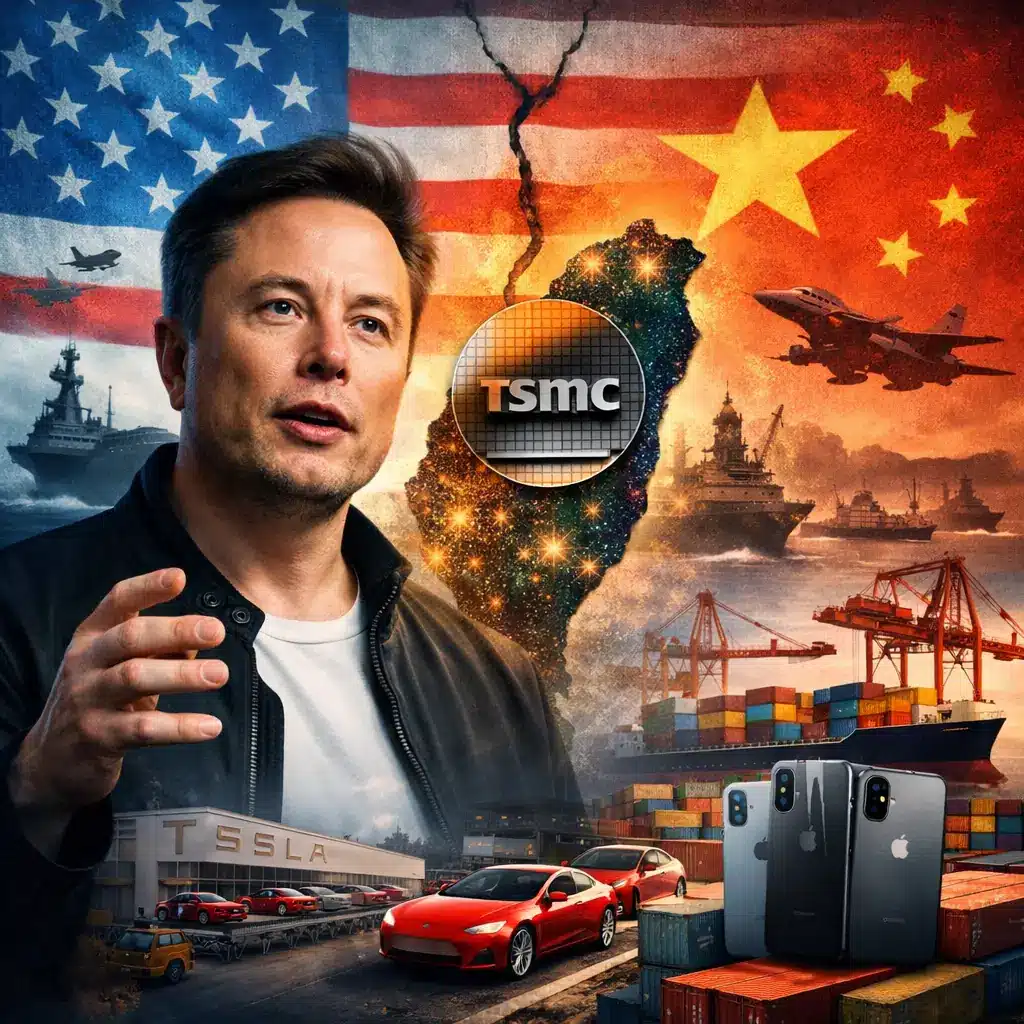
Elon Musk on U.S.-China tensions is one of those warnings that sounds like “politics” until you realize it’s really about your phone, your car, and the world’s most fragile game of industrial Jenga. In a CNBC interview after Tesla’s shareholder meeting, Musk said rising tension between the U.S. and China “should be a concern for everyone,” and he didn’t mince words about Taiwan’s place in the story.
This article breaks down what he said, what it means in plain English, and why businesses (and regular people) should care—without the doom-scrolling.
🌍 Why Elon Musk on U.S.-China tensions matters right now
When the CEO of a company that builds cars in China, sells into the U.S., and depends on advanced chips says “everyone should worry,” it’s not a hot take—it’s a supply-chain weather report.
And here’s the blunt truth: the U.S.–China relationship is a systems risk, not a headline risk. If it gets worse, it doesn’t just hit one sector. It hits shipping, semiconductors, insurance, financing, pricing, and consumer confidence—all at once.
🗞️ What Musk said in the CNBC interview
In the interview, Musk was asked about “growing belligerence” between the U.S. and China. He responded that it should worry everyone. He also pointed directly at Taiwan, saying China’s stated position is that Taiwan should be integrated, and that people should take that policy seriously.
He used a memorable analogy: China’s economy and the global economy are like “conjoined twins,” and trying to separate them would be brutal. Then he went for the everyday punchline: if things break badly, where do you even get an iPhone?
🧭 Taiwan explained without the political fog
Taiwan is a self-governed island with its own democratic government. China claims it as part of its territory and insists on the “One China” principle. That’s not a fringe view—it’s a core part of official Chinese foreign policy messaging.
Meanwhile, the U.S. maintains its own long-standing policy framework for how it approaches Taiwan and cross-strait stability, including opposition to unilateral changes to the status quo.
That’s the “why it’s complicated” layer. The “why it matters” layer is simpler:
Taiwan sits at the center of advanced semiconductor manufacturing.
🧩 Why Taiwan matters to chips and everyday devices
Modern life runs on chips. Cars, phones, routers, medical devices, factories—everything. Taiwan is especially critical because it’s home to Taiwan Semiconductor Manufacturing Company (TSMC), the world’s biggest contract chipmaker.
Business Insider’s recap of Musk’s comments also notes that TSMC is a key supplier to Apple.
So when Elon Musk on U.S.-China tensions ties Taiwan to “everyone,” that’s what he’s pointing at: the parts supply that makes “tech” actually exist.
🚗 Tesla’s exposure: factories, sales, and “it’s not demand”
Tesla builds vehicles in multiple regions—including the U.S., Germany, and China.
China matters a lot because Tesla’s Shanghai operation has been a major production engine for the company.
In the CNBC discussion, Musk also said Tesla had constraints on expansion in China and that production limits weren’t a demand problem—more of a “we’re making as many cars as we can” situation.
Translation: even if Tesla can sell more, geopolitics and industrial policy can cap growth.
📱 The “where do you get an iPhone?” point is bigger than Apple
Musk’s iPhone comment is basically a shortcut to explain supply-chain concentration. Even when companies diversify, it takes time.
Apple began assembling iPhone 14 units in India as part of reducing manufacturing reliance on China.
That’s real progress—but it also proves Musk’s underlying point: shifting complex manufacturing is hard, slow, and expensive. Supply chains aren’t Lego bricks. They’re spaghetti.
🧠 The “conjoined twins” analogy and what it really means
Here’s what Musk’s “conjoined twins” metaphor gets right: the U.S., China, and the broader global economy are deeply intertwined through: Elon Musk on U.S.-China tensions
- manufacturing capacity
- consumer markets
- capital flows
- logistics networks
- component ecosystems
- industrial know-how
Trying to “separate” quickly tends to create shortages, inflation spikes, and unpredictable second-order effects.
Also: decoupling isn’t one switch. It’s a thousand painful rewires.
🧮 9 practical supply risks businesses should watch
Below are nine real-world ways tension can hit—without needing a worst-case scenario.
- Export controls that restrict advanced chips or chip equipment
- Retaliatory controls on critical materials or manufacturing inputs
- Shipping insurance and routing shocks (costs rise, routes change)
- Supplier compliance drag (more paperwork, audits, delays)
- Currency volatility that changes effective costs overnight
- Tariff spikes that hit margins or retail prices
- Sudden demand drops driven by consumer fear and uncertainty
- Talent and knowledge constraints (who can work where, on what)
- Tech fragmentation (different standards, different stacks)
None of these require a dramatic “event.” They can unfold as policy decisions.
🧯 Scenario map: de-risking without fantasy “decoupling”
Most serious companies aren’t aiming for total decoupling. They’re aiming for risk reduction:
- keep China where it’s efficient
- add redundancy where failure is catastrophic
- build buffers where timing matters
Think of it like earthquake engineering: you don’t stop earthquakes—you stop buildings from collapsing.
🏭 What companies are doing: China+1 and resilience
The most common playbook looks like this: Elon Musk on U.S.-China tensions
- China+1: keep China, add India/Vietnam/Mexico/etc.
- dual-sourcing: two suppliers for key components
- regionalization: assemble closer to end markets
- inventory strategy: stock critical parts, not everything
- design flexibility: components that can swap suppliers faster
Apple’s India assembly move is a textbook example of “China+1” in action.
🛰️ Why chips are the pressure point (TSMC, nodes, capacity)
Musk also said Tesla depends on TSMC for processors.
Whether you’re Tesla, Apple, or basically any modern manufacturer, the pattern is the same:
- you can redesign software faster than you can redesign silicon
- chip fabs take years and massive capital to build
- leading-edge capacity is scarce and strategic
That’s why Taiwan stays in the center of the story even when you try to talk about anything else.
🧑⚖️ Policy reality check: what leaders have said about Taiwan
U.S. policy statements have varied in phrasing over time, but in high-profile interviews President Joe Biden has said the U.S. would defend Taiwan if it were invaded—comments reported widely and reflected in interview transcripts.
At the same time, official policy documents and congressional research explain the U.S. framework and the sensitivity around maintaining stability.
Bottom line: policymakers talk carefully because the stakes are huge—and because miscalculation is the real enemy.
🧰 What Tesla can do (and what it can’t)
Tesla can’t control U.S.–China politics. Full stop.
But Tesla can do the usual survival moves:
- diversify certain suppliers
- build flexibility into chip sourcing where possible
- keep regional manufacturing balanced (U.S./EU/China)
- prepare for regulatory friction and export constraints
- communicate risk clearly to investors (without panic)
And yes, Tesla’s scale gives it leverage—just not sovereignty.
👩💼 What investors and everyday buyers should watch
If you want practical signals (not vibes), watch:
- new export-control announcements (especially semiconductors)
- shipping/insurance price spikes in Asia routes
- earnings calls: listen for words like “constraints,” “delays,” “compliance”
- supplier geography shifts (Apple-style moves)
- factory utilization and delivery timelines
For consumers: don’t hoard iPhones like it’s toilet paper in 2020. But do expect that global tension can show up as price bumps and longer waits.
❓ Frequently Asked Questions – Elon Musk on U.S.-China tensions
❓ Is Elon Musk on U.S.-China tensions talking about war?
He’s talking about risk—including the risk that policy or conflict disrupts trade and tech supply chains.
❓ Why does Taiwan matter so much to the global economy?
Because Taiwan’s chip ecosystem—especially TSMC—sits at the core of advanced semiconductor supply.
❓ Would a Taiwan crisis hurt Tesla more than other companies?
Musk suggested many companies could be hit even harder, using Apple as a quick example.
❓ Didn’t Apple move iPhone production out of China already?
Apple started assembling iPhone 14 in India, but diversification is gradual and partial.
❓ Where does Tesla manufacture vehicles?
Tesla operates major manufacturing sites in the U.S., Germany, and China, among others.
❓ What does “One China” mean in this context?
It refers to China’s position that Taiwan is part of China—stated in official diplomatic messaging.
❓ What’s the biggest near-term risk: tariffs or chips?
Chips, because advanced capacity is harder to replace quickly than tariff math.
❓ Can companies fully “decouple” from China?
Not quickly—not without huge cost and disruption. Most pursue de-risking instead.
❓ What should small businesses do if they import tech hardware?
Ask suppliers where parts come from, identify substitutes early, and avoid single-source dependencies.
❓ Is this just investor fear-mongering?
No. Even without a crisis, policy changes can raise costs and slow shipments.
❓ Does U.S. policy guarantee Taiwan’s defense?
Policy is complex and carefully worded; public statements have differed from formal frameworks.
❓ What’s the simplest takeaway from Elon Musk on U.S.-China tensions?
When geopolitics hits chips, it hits everything.
📊 Supply-chain impact snapshot
| Area | Why it’s sensitive | What disruption looks like |
|---|---|---|
| Semiconductors | Advanced capacity is concentrated and slow to replace | Delays, redesigns, price spikes |
| Smartphones | Multi-country parts, but heavy manufacturing concentration | Higher prices, longer lead times |
| EVs & Autos | Cars now depend on chips + global parts networks | Production bottlenecks, feature cuts |
| Logistics | Insurance, routing, and port throughput react fast | Shipping cost jumps, slower delivery |
| Trade policy | Rules can change faster than factories can move | Tariffs, compliance drag, uncertainty |
✅ Conclusion: the practical meaning of Elon Musk on U.S.-China tensions
Elon Musk on U.S.-China tensions isn’t “just politics.” It’s a warning that the world’s most important manufacturing relationship is under stress—and Taiwan is the pressure valve.
If you run a business, invest, or even just buy modern tech, the smart move is not panic. It’s resilience: diversify suppliers, avoid single points of failure, and assume friction increases over time.
📚 Sources & References – Elon Musk on U.S.-China tensions
- Business Insider (CNBC interview recap) (Business Insider)
- U.S. Congressional Research Service (Taiwan/U.S. policy context) (Notatesla App)
- China Ministry of Foreign Affairs (One China principle statements) (Reuters)
- TechCrunch / TIME (Apple iPhone 14 assembly in India) (Tesla Investor Relations)
- Tesla (official manufacturing locations) (Tesla)

Related Posts



The Longevity Blueprint: AI-Powered Health Optimization
About the Author: Bernard Aybout (Virii8)