Approx. read time: 10.9 min.
Post: Indie Game Marketing: Stop Falling for LinkedIn Gurus
Indie Game Marketing: Stop Falling for LinkedIn Gurus
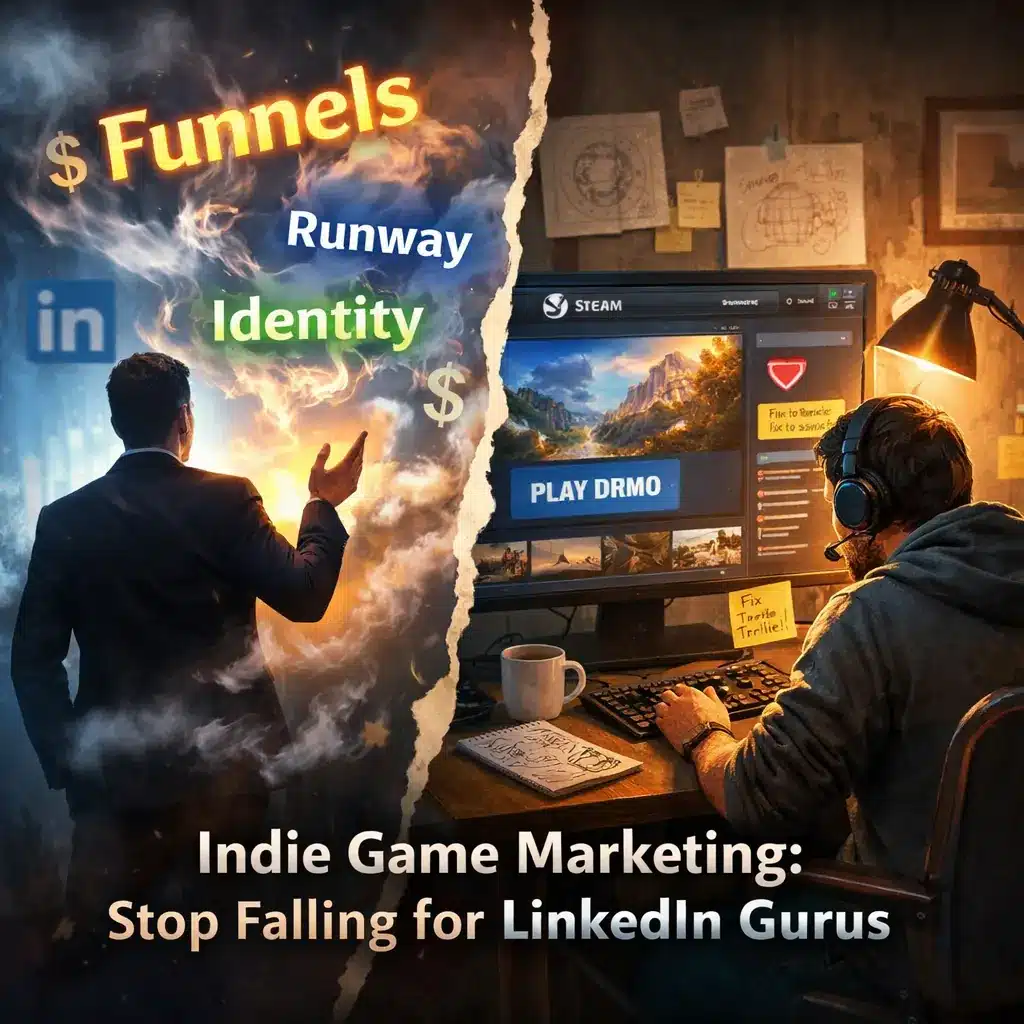
If you've been building games long enough, you've seen it: someone with a crisp headshot and a loud opinion tries to "explain" your success with a pile of corporate buzzwords. They'll say your game didn't win because it looked fun, felt good, or hit a hungry genre at the right time. Nope. It won because of some made-up strategy term that just happens to sound like a paid consultation package.
That's the core problem with indie game marketing advice on LinkedIn: it often rewards confidence, not accuracy. It's a stage built for wordsmiths, not for people who actually ship.
And in January 2026, Hooded Horse CEO Tim Bender basically said the quiet part out loud: stop buying the snake oil. (LinkedIn)
🧨 Why indie game marketing attracts “guru math”
Indie game marketing is stressful because it's uncertain.
You can do a hundred things "right" and still launch to silence. Therefore, when someone claims they have a simple framework that guarantees traction, your brain wants to believe it. That's not stupidity. That's survival.
However, the "guru economy" thrives on one trick: it takes messy, human reasons people buy games (taste, genre love, streamer hype, timing, novelty) and replaces them with neat labels that sound scientific.
If your advice can't survive one basic question—"How do you know that's true?"—it's probably performance art.
🐎 The Hooded Horse moment that exposed the whole game
In early January 2026, an "expert" posted an unsolicited breakdown of Manor Lords and tried to attribute its success to a fancy concept described as "Identity Ownership." (The Escapist)
The pushback was blunt. The CEO response, paraphrased into plain English, was essentially: we show people cool games and they decide if they want them; why would we track people? (The Escapist)
That short exchange landed because it hit something real: a lot of public marketing analysis is just storytelling after the fact—and the storyteller often sells services.
🧃 “Identity Ownership” explained like a normal person
Let's translate the jargon without the smoke machine.
"Identity Ownership" (in marketing-speak) usually implies:
- capturing emails early,
- building direct channels (newsletter/Discord),
- reducing dependence on platforms (Steam/Twitter/TikTok),
- tracking behavior across touchpoints.
Some of that can be useful. But here's the trap: it's not a magic cause of success. It's a tool. A tool doesn't replace product-market fit.
When someone claims your game succeeded because of my buzzword, they judge the world backward. They see the outcome, then invent the engine.
🎯 The uncomfortable truth: your game’s “marketing” starts with the game
This is the part people hate hearing:
Your Steam page can't save a game that looks generic.
Your trailer can't hide weak hooks.
Your funnel can't manufacture interest where none exists.
Indie game marketing works best when your game has a sharp promise:
- a clear fantasy,
- a clean genre target,
- a "wait, what?" twist,
- and screenshots that sell the loop instantly.
Marketing is not a substitute for appeal. It's a megaphone.
📈 What Manor Lords proves about indie game marketing
We're not guessing that Manor Lords had major interest. It piled up huge Steam wishlists and hit major early sales milestones around its Early Access debut. (Game Developer)
This matters because wishlists aren't "vibes." They're intent. And on Steam, intent is leverage.
So the real lesson isn't "identity ownership." It's:
- make something that spreads,
- show it clearly,
- build momentum before launch,
- and let the platforms amplify what players already want.
🛒 Steam is not your enemy, but it is not your friend
Steam is a marketplace with incentives.
It tends to amplify what:
- converts well (page → wishlist → purchase),
- keeps attention (demo retention, playtime),
- gets external traffic (creators, press, socials),
- generates strong early velocity.
You don't "hack" this with jargon. You align with it by building an offer that clicks fast.
Steam's own documentation makes it clear wishlists trigger notifications (including release and discount emails). That's one reason they're valuable. (partner.steamgames.com)
🧱 Build a Steam page that converts (before you chase virality)
Here's a practical Steam page reality check:
- Capsule art: readable at tiny sizes.
- Short description: genre + hook + twist, no poetry.
- First 10 seconds of trailer: show the loop, not logos.
- Screenshots: must communicate the fantasy instantly.
- Tags: match what players browse, not what you wish you were.
If a stranger can't answer "what do you do in this game?" in 7 seconds, your page is leaking wishlists.
🧪 Demos: the closest thing to legal cheating
Demos don't just help players. They unlock opportunities:
- festivals,
- creator coverage,
- streamer "let's try this" moments,
- player word-of-mouth.
Chris Zukowski has written extensively about demos as a marketing unlock, especially around Steam festivals. (How To Market A Game)
My take: if your game benefits from "feel," ship a demo. If it's a pure narrative spoiler risk, ship a tight vertical slice or prologue.
🎪 Steam Next Fest: plan it like a campaign, not a weekend
Next Fest is not "upload demo and pray."
Treat it like:
- 2–4 weeks of prep (page polish, trailer refresh, demo onboarding),
- press/creator outreach (give creators time),
- daily updates during the event (patch notes, community clips),
- post-event follow-through (update wishlist call-to-action, roadmap, newsletter push).
Yes, it's work. However, it's the kind of work that compounds.
🎥 Creators are not “a channel.” They’re the marketplace.
Most indie teams underuse creators because they pitch wrong.
They send:
- long emails,
- vague descriptions,
- keys with no context,
- and nothing that makes content easy.
Instead, give creators:
- a one-paragraph pitch,
- a 10-second hook,
- a "what makes this fun to watch?" angle,
- a demo (or curated build),
- and permission to monetize content.
Also: don't be sketchy with endorsements. If you're sponsoring content, disclosures matter. The FTC is explicit about influencer disclosures and transparency. (ftc.gov)
🧠 “Direct-to-player” without being creepy
I like direct-to-player marketing when it's consent-based.
That means:
- people opt in,
- you tell them what they'll get,
- you don't stalk them around the internet,
- you respect unsubscribe and privacy.
A newsletter can be great. It becomes your "steady drumbeat" channel when social algorithms change overnight.
This is where "identity" talk can go off the rails: players aren't leads. They're people. Treat them like people and your marketing gets easier.
🔢 Metrics that matter in indie game marketing
Not all numbers are equal.
Here's a grounded view:
Notice what's missing: "runway," "funnels," and whatever new nonsense gets invented next Tuesday.
🚩 Red flags: how to spot guru advice in 30 seconds
If someone claims they can fix your indie game marketing, watch for these tells:
- They explain results without evidence.
- They speak in abstractions ("identity," "ownership," "engagement") with no action list.
- They avoid showing their work (case studies with numbers, not vibes).
- They claim credit for someone else's hit with suspicious certainty.
- They try to sell urgency instead of clarity.
If the advice can't be turned into a checklist, it's probably a sales pitch.
🧾 How to vet an indie game marketing consultant (without getting fleeced)
A legit consultant should be comfortable with:
- auditing your Steam page live,
- giving blunt feedback,
- showing prior work (and what changed),
- defining success metrics,
- explaining tradeoffs.
They should also ask you hard questions:
- Who is your real audience?
- What games do they already buy?
- What is your hook in one sentence?
- What proof do you have that your loop lands?
If they don't ask that, they're not marketing. They're motivational speaking.
🧰 A no-buzzword indie game marketing playbook you can execute
Here's a practical path that works for most PC indies:
- Define the promise (genre + hook + twist).
- Build the Steam page early (months early).
- Iterate capsule/trailer/screens until conversion rises.
- Ship a demo if your game benefits from feel.
- Pick 3–5 marketing beats (festivals, updates, creator bursts).
- Run creator outreach with a clear angle.
- Keep a steady cadence (Steam updates + community posts).
- Measure wishlist velocity and adjust.
- Launch when you have momentum, not when you're tired.
None of this is sexy. That's why it works.
🧭 Why GameDiscoverCo and HowToMarketAGame are the opposite of guru fluff
Tim Bender specifically pointed indie devs toward Simon Carless (GameDiscoverCo) and Chris Zukowski (How To Market A Game) instead of LinkedIn "gurus." (LinkedIn)
That recommendation tracks because both:
- focus on practical actions,
- talk openly about discoverability constraints,
- and publish repeatable frameworks instead of mystical "secret sauce."
If you want indie game marketing education, start there. Then test everything against your own data.
🧩 Final takeaway: indie game marketing is simpler than the gurus want
Indie game marketing isn't easy, but it's not mysterious.
Make something players want.
Show it clearly.
Build momentum with repeatable beats.
Respect your audience.
And the next time someone tries to sell you "Identity Ownership" as the reason your game worked, do what Tim did: ask for reality, not word soup. (LinkedIn)
If you want an outside set of eyes on your indie game marketing plan (Steam page teardown, trailer critique, creator outreach template, launch beats), reach me here: Contact or open a ticket via Helpdesk Support. If stress is piling up while you build, keep Health bookmarked too.
❓ Frequently Asked Questions
❓ What is indie game marketing in plain English?
It's everything you do to help the right players discover your game and get excited enough to wishlist, try a demo, and buy.
❓ Why do LinkedIn marketing posts feel so confident but so wrong?
Because confidence gets engagement. Also, vague frameworks are easier to sell than real work.
❓ Are wishlists really that important for indie game marketing?
Yes. Wishlists are one of the clearest intent signals you can build pre-launch, and they drive platform notifications. (partner.steamgames.com)
❓ How early should I build my Steam page?
As early as you can show the core loop clearly—often months before launch.
❓ What's the fastest way to improve a Steam page?
Fix the first 10 seconds of your trailer, upgrade screenshots, and sharpen the one-sentence hook.
❓ Do I need a demo?
If your game is "feel-based," a demo can be your best marketing asset because it unlocks creators and festivals. (How To Market A Game)
❓ What should a good demo do in the first minute?
Prove the fun fast: clear goal, smooth controls, and a visible payoff loop.
❓ How do I get creators to cover my game?
Give them a strong angle, a good build, and enough lead time. Make content easy to create.
❓ Should I pay creators?
Sometimes. If you sponsor content, be transparent and follow disclosure guidance. (ftc.gov)
❓ Is a newsletter worth it for indie game marketing?
Yes—if it's consent-based and you send meaningful updates, not spam.
❓ What are "marketing beats"?
Planned moments that spike attention: demo drops, festival entries, major updates, trailers, or announcements.
❓ How do I know if a marketing consultant is legit?
They show work, define metrics, and give actionable feedback. They don't hide behind buzzwords.
❓ What's the biggest indie game marketing mistake?
Trying to market a game with an unclear promise. Fix the product positioning first.
❓ Can marketing save a game that looks generic?
It can help, but it's uphill. A sharp hook and clear genre fit make everything easier.
❓ What's the "snake oil" warning about?
It's about people selling invented narratives instead of practical guidance grounded in reality. (LinkedIn)
❓ Where should I learn indie game marketing from instead of gurus?
Start with GameDiscoverCo and How To Market A Game for practical, repeatable guidance. (newsletter.gamediscover.co)
✅ Online research verification (what was fact-checked)
- Tim Bender's public warning about LinkedIn "snake oil" and his recommendation of Carless/Zukowski was verified via his LinkedIn post and The Escapist's captured excerpt. (LinkedIn)
- Manor Lords wishlist/sales milestone reporting was cross-checked via GameDeveloper.com coverage. (Game Developer)
- Wishlist notification mechanics were verified via Steamworks documentation. (partner.steamgames.com)
- Influencer disclosure expectations were verified via FTC guidance and the Federal Register entry for the updated Endorsement Guides. (ftc.gov)
- Background on Carless/Zukowski resources was verified via their official newsletter/site pages. (newsletter.gamediscover.co)
📚 Sources & References
- Tim Bender LinkedIn post (Jan 2026) (LinkedIn)
- The Escapist coverage (Jan 9, 2026) (The Escapist)
- GameDeveloper.com: wishlists & sales milestone (Game Developer)
- Steamworks: Wishlists documentation (partner.steamgames.com)
- FTC: Endorsements, influencers, and reviews (ftc.gov)
- How To Market A Game (Chris Zukowski) (How To Market A Game)
- GameDiscoverCo (Simon Carless) (newsletter.gamediscover.co)
Related Videos:

Related Posts:
LinkedIn Scraping: Methods, Risks, and Defense Playbook
Web Application Security Testing: 17 Pro Tactics That Win
IDOR Vulnerability: 15-Step Burp Lab Walkthrough Guide
XSS and SSRF Testing: Burp Labs That Build Real Skills
Adobe Genuine Service Explained: What It Does, Why It Runs, and Your Real Options
Burp Suite Intruder Automation: XSS & SSRF in 19 Steps
Related Posts




The Longevity Blueprint: AI-Powered Health Optimization
About the Author: Bernard Aybout (Virii8)