Approx. read time: 13.4 min.
Post: Intel Moovit Acquisition: 9 Powerful Reasons It Matters
Intel Moovit Acquisition: 9 Powerful Reasons It Matters
🚗 Why the Intel Moovit acquisition happened
Autonomous driving isn’t only a “car problem.” It’s a city problem. You can build incredible self-driving tech, but if your service can’t route, predict demand, and coordinate with real transit systems, you don’t have a business—you have a demo.
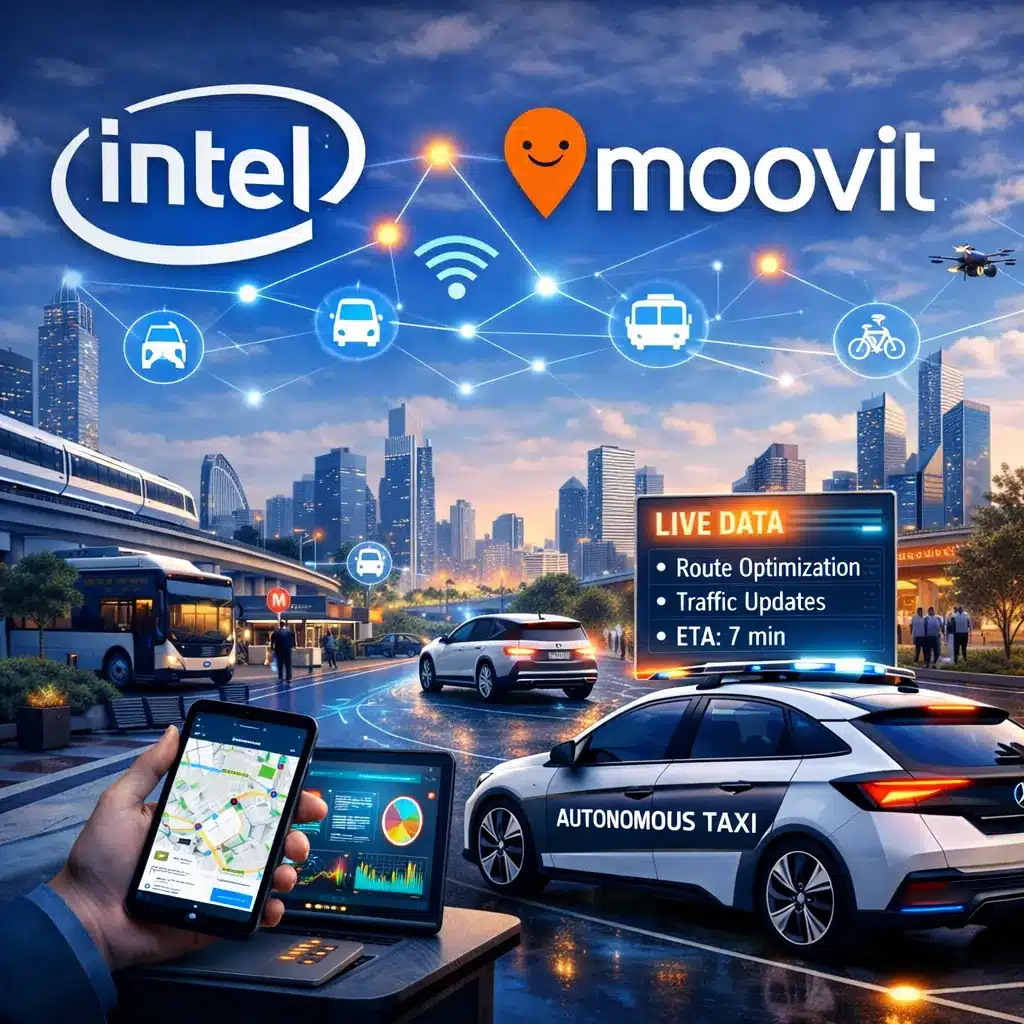
That’s why the Intel Moovit acquisition makes strategic sense. Moovit sits on top of public transit, micromobility, walking routes, ride-hailing integrations, and the messy reality of how people actually move. Intel wanted that layer because it speeds up the path from “self-driving capability” to “self-driving service people can use.”
- Reason #1: Moovit brings global mobility demand signals.
- Reason #2: Moovit adds multimodal routing (not just car routing).
- Reason #3: Moovit helps Mobileye ship Mobility-as-a-Service (MaaS) faster.
- Reason #4: Moovit strengthens fleet planning and dispatch logic.
- Reason #5: Moovit supports partnerships with transit agencies and operators.
- Reason #6: Moovit’s scale creates distribution for future robotaxi services.
- Reason #7: Moovit improves mapping context (stops, stations, and city rules).
- Reason #8: Moovit provides real-time mobility intelligence at city scale.
- Reason #9: Moovit adds talent and an execution hub in Israel.
🧠 What Moovit actually does (and why that’s hard)
Moovit looks simple on the surface: you enter a destination and it tells you how to get there. Under the hood, it’s a constantly updating model of a city’s transportation system—routes, schedules, delays, station locations, detours, closures, and rider behavior.
More importantly, Moovit doesn’t only serve commuters. It also sells B2B tools to cities, agencies, and enterprises that need analytics, planning support, and operational visibility. That “boring” B2B side is where a lot of long-term autonomy value hides.
In the Intel Moovit acquisition, Intel didn’t just buy an app. Intel bought a global mobility platform that already knows how to ingest messy public data, normalize it, and turn it into usable recommendations.
🛰️ Data is the fuel: real-time traffic, transit, and mobility intelligence
Self-driving cars need more than sensors. They need context. They need to understand what’s normal at 8:10 AM downtown, what changes on game nights, and what happens when a subway line shuts down and everyone floods the streets above.
This is why the Intel Moovit acquisition hits so hard. Moovit’s value grows with scale: more cities, more riders, more routes, more real-world patterns. That creates a feedback loop that’s painful for competitors to copy quickly.
And yes, this is where “AI and big data analytics” becomes real. Not in a hype deck—inside routing logic, demand forecasting, service reliability scoring, and dispatch recommendations that save agencies time and reduce rider frustration.
🗺️ Mapping beyond roads: stops, routes, stations, and cities as living systems
Most people think mapping means roads and lanes. Transit mapping is different. You have stops, platforms, entrances, transfer points, timed schedules, service alerts, accessibility constraints, and local rules that change constantly.
Moovit’s dataset is valuable because it represents how cities breathe. The Intel Moovit acquisition effectively gives Intel/Mobileye a faster path to “city-grade” mobility services, not just “car-grade” autonomy.
That matters because robotaxis don’t win by driving well in a suburb. They win by handling the chaos of cities—efficiently, safely, and at scale.
🤖 How Mobileye fits into the Intel Moovit acquisition story
Mobileye is the anchor here. Intel already had Mobileye as its autonomous driving powerhouse, built around computer vision, mapping, and driver-assistance systems. The missing piece was the service layer: the city-facing mobility platform that can turn autonomy into something people actually book and ride.
The Intel Moovit acquisition effectively plugs that gap. You can think of it like this: Mobileye helps the vehicle “see and decide.” Moovit helps the service “plan and deliver.” Together, that’s a credible MaaS stack.
If you want a clean way to explain autonomy levels to readers, you can reference the SAE-style scale used by regulators (Level 0 to Level 5). For example, Level 4 often means “fully automated within a limited service area,” which is basically the robotaxi playbook.
🧩 Where Moovit plugs into the autonomous stack
Autonomous driving stacks usually get described like a layer cake: sensing, perception, localization, prediction, planning, control, safety, and so on. Moovit sits above that cake. It lives in the “mobility operations” world: where demand, supply, pricing, routing, and partnerships decide whether you have a sustainable service.
Here’s a practical view of what Moovit adds after the Intel Moovit acquisition—and why it’s not replaceable with “just another map.”
| Moovit Asset | What It Does | Why It Matters for Autonomy |
|---|---|---|
| Multimodal trip planning | Routes across transit, walking, ride-hailing, bikes | Robotaxis become one option inside a full journey |
| Real-time service + alerts | Adjusts routes as conditions change | Autonomy must react to city disruptions instantly |
| Demand analytics | Forecasts rider needs by time/place | Fleet sizing and dispatch decide profitability |
| Agency/operator relationships | B2B tools and integrations | Robotaxis scale faster with local partnerships |
| Global scale data | Patterns across thousands of cities | Better models, better coverage, faster expansion |
🚕 Robotaxis: the business model Intel and Mobileye keep chasing
Robotaxis are the “big prize,” but they’re also the hardest version of autonomy. They need safety, yes. However, they also need utilization, dispatch efficiency, rider trust, customer support, and coordination with city policies.
This is where the Intel Moovit acquisition becomes a business move, not a tech flex. If Moovit can become the front door for booking and routing, then Mobileye-powered autonomous fleets can plug into a platform millions already use.
In plain English: Intel didn’t buy Moovit to win the map wars. Intel bought Moovit to win the “who owns the mobility customer” war.
🏙️ Cities, agencies, and the “boring” B2B wins
People love consumer app stats, but governments and transit agencies control the rules of the road in most urban environments. If your autonomous service can’t coordinate with them, you’ll hit delays, restrictions, or outright bans.
Moovit has long sold tools to help agencies plan and operate. That gives the Intel Moovit acquisition a serious “inside baseball” advantage: a platform that can talk to agencies in their language—service areas, ridership, load balancing, on-demand coverage, and accessibility.
And when autonomy arrives, agencies will ask a simple question: “How does this help my city?” Moovit is a ready-made answer.
📉 COVID-19: why the timing looked weird but made sense
At the time, the deal discussions happened during a brutal moment for transportation. Lockdowns crushed commuting demand, and many transit agencies cut service. On the surface, buying a mobility app during a mobility collapse looks backwards.
Yet the Intel Moovit acquisition also looks opportunistic in a smart way. Crisis forces systems to modernize. Moovit launched services aimed at helping agencies and enterprises adapt quickly, including on-demand emergency mobilization tools for essential workers.
When the world restarts after a shock, the platforms that helped keep it running often gain deeper institutional trust. That’s a powerful wedge into long-term city partnerships.
💼 The talent play: retention, Israel, and speed
Big tech acquisitions often come down to two things: the product and the people. The product is hard to rebuild, but talent can be even harder to assemble fast—especially in data-heavy mobility systems.
The Intel Moovit acquisition also strengthened Intel’s Israeli automotive hub around Mobileye. Israel has deep strength in mobility tech, mapping, and AI. Intel already invested heavily there, and Moovit fits the pattern: buy a working system, keep the team, and move faster than competitors expect.
In deals like this, “retention packages” aren’t fluff. They’re a sign that Intel wanted continuity and execution speed, not a slow integration that bleeds momentum.
🧾 The numbers: $900M vs $1B and what “net” means
Early reporting floated a round-number headline: “Intel to buy Moovit for $1B.” That kind of estimate is common when negotiations are close and sources talk in ranges.
Intel later announced the acquisition at approximately $900 million, and it noted a lower net cost after accounting for Intel Capital’s equity gain. In other words, Intel already had exposure, so the final effective cost wasn’t the same as a clean cash purchase.
This matters because the Intel Moovit acquisition wasn’t just a one-off bet. It was part of a longer strategy where Intel invested, partnered, and then consolidated the asset when the timing aligned.
🥊 Competitive landscape: why Intel needed Moovit vs rivals
Autonomy has no shortage of competitors: automakers, ride-hailing giants, mapping companies, and pure-play self-driving labs. Many of them can build vehicles that drive well in controlled environments.
What separates winners is the ability to operate as a service: booking, routing, dispatch, customer experience, and city relationships. The Intel Moovit acquisition gives Intel a strong answer to that challenge because Moovit already lives in the operations layer.
Also, Moovit’s multimodal approach matters. It treats robotaxis as part of a journey, not the whole journey. That’s more realistic, and it tends to scale better in dense cities.
🔐 Privacy and trust: what riders should care about
Whenever mobility platforms scale, privacy questions follow. People want to know what happens to location history, trip patterns, and behavioral data. They also want transparency about how data gets aggregated and used.
The Intel Moovit acquisition makes these questions more important, not less, because Moovit’s value comes from insights at scale. Strong privacy practices, clear user controls, and responsible aggregation will decide whether riders and cities keep trusting the platform.
If you’re writing this for a general audience, keep it simple: “Data makes services smarter, but the platform must earn trust.” That’s the whole story.
🧠 Lessons for founders watching the Intel Moovit acquisition
Founders love to imagine a giant exit, but the pattern here is more specific. Moovit didn’t just build a popular app. It built infrastructure: data pipelines, partnerships, and a product that worked across thousands of cities.
The Intel Moovit acquisition shows what big buyers pay for:
- Distribution: a product millions already use
- Defensible data: hard-to-copy patterns and coverage
- Operational depth: B2B tools that cities rely on
- Integration readiness: a platform that can plug into bigger stacks
If you want a blunt takeaway: apps are easy to copy, but ecosystems are not. Build the ecosystem.
📈 What the Intel Moovit acquisition means in 2025 and beyond
In 2025, the autonomy conversation has matured. People talk less about magical “self-driving everywhere tomorrow” and more about scoped deployments, safety frameworks, and real operating economics.
That shift makes the Intel Moovit acquisition look even smarter. Moovit supports the “scoped, practical” path: limited service areas, multimodal routing, and partnerships that let autonomous fleets enter cities without starting from zero.
Also, infrastructure wins over hype. Platforms that connect riders, cities, and fleets have compounding value. Moovit’s position as a mobility layer can keep paying off as autonomous services expand region by region.
❓ FAQs about the Intel Moovit acquisition
❓ What is the Intel Moovit acquisition?
The Intel Moovit acquisition is Intel’s purchase of Moovit, a mobility-as-a-service platform best known for its urban mobility app and transit data tools.
❓ Why did Intel buy Moovit?
Intel bought Moovit to strengthen Mobileye’s mobility-as-a-service strategy with global routing, demand signals, and city-scale mobility data.
❓ How much did Intel pay in the Intel Moovit acquisition?
Intel announced the deal at approximately $900 million, with a lower net cost after accounting for Intel Capital’s equity gain.
❓ Was Moovit already working with Intel before the Intel Moovit acquisition?
Yes. Intel Capital had invested in Moovit, and Moovit had links to Mobileye’s broader autonomy ecosystem.
❓ How does Moovit help autonomous cars?
Moovit helps with routing, demand prediction, and service operations—critical pieces for running robotaxi or shuttle services in real cities.
❓ Does the Intel Moovit acquisition change the Moovit app for users?
Intel stated the app experience would continue and Moovit would keep serving users and partners while joining Mobileye’s business.
❓ What is MaaS and why is it central to the Intel Moovit acquisition?
MaaS (Mobility as a Service) bundles multiple transport modes into one experience. It’s central because robotaxis work best as one option inside a full journey.
❓ What’s the connection between Mobileye and the Intel Moovit acquisition?
Mobileye is Intel’s autonomous driving arm, and Moovit strengthens Mobileye’s plan to operate end-to-end mobility services.
❓ Does the Intel Moovit acquisition mean Intel will run robotaxis?
It supports that direction through Mobileye’s MaaS ambitions, but deployments depend on partnerships, regulation, and service economics in each region.
❓ Why is real-time transit data valuable for autonomy?
Because it reveals how cities behave: delays, closures, crowding, and shifting demand that affects safe routing and fleet planning.
❓ How did COVID-19 factor into the Intel Moovit acquisition timeline?
COVID reduced travel demand, but it also accelerated the need for adaptive routing and emergency mobility services that Moovit offered during the crisis.
❓ What does “Level 4 autonomy” usually mean for robotaxis?
Level 4 often means the system drives without a human within limited service areas—exactly how many robotaxi pilots operate today.
❓ Is the Intel Moovit acquisition mainly about hardware or software?
It’s mainly about software, data, and service operations—the layers that make autonomy usable and profitable.
❓ Can competitors replicate what Intel gained from the Intel Moovit acquisition?
They can build parts of it, but replicating global scale, city integrations, and years of mobility data is slow and expensive.
❓ Does Moovit only cover public transit?
No. Moovit supports multimodal routing that can include walking, micromobility, ride-hailing, and other mobility services depending on the city.
❓ What should cities watch after the Intel Moovit acquisition?
Cities should watch how Moovit’s analytics and platform tools integrate with autonomous shuttle and robotaxi pilots, especially around service equity and safety.
❓ What should riders care about after the Intel Moovit acquisition?
Riders should care about reliability, transparency, and privacy—especially how mobility insights are aggregated and used to improve services.
❓ What’s the simplest takeaway from the Intel Moovit acquisition?
Intel didn’t just buy an app. Intel bought a mobility platform that helps turn autonomous driving into an actual transportation service.
🏁 Conclusion: what to watch next
The Intel Moovit acquisition is a strategic bet on the unglamorous truth of autonomy: services win, not demos. Moovit gives Intel and Mobileye the mobility layer—multimodal routing, city integrations, and demand intelligence—that makes robotaxis and autonomous shuttles far more realistic.
Over the next few years, watch for deeper Moovit + Mobileye pilots, tighter agency partnerships, and more “autonomy as part of transit,” not autonomy as a replacement for everything. That hybrid future is the one that actually scales.
If you’re building a tech project around mobility data, smart-city platforms, or AI analytics and want a second set of eyes on performance, security, or hosting strategy, use Helpdesk Support or reach out via the Contact page. For wellness-focused tech and lifestyle content, you can also visit our Health section.
📌 Sources & references
- Intel (Investor Relations) – Intel acquires Moovit press release
- Intel Newsroom – Amnon Shashua op-ed on the Moovit acquisition (PDF)
- TechCrunch – Confirmation coverage of the Moovit deal
- The Times of Israel – Deal overview and Israel context
- NHTSA – Levels of Automation (PDF)
- Moovit – Emergency Mobilization On-Demand press release (PDF)

Related Posts



The Longevity Blueprint: AI-Powered Health Optimization
About the Author: Bernard Aybout (Virii8)