Approx. read time: 10.6 min.
Post: Emotional Regulation for Couples 17 Conflict Skills
🧠 Emotional Regulation for Couples: Why Two Emotions Feel Impossible
Emotional regulation for couples is hard because conflict hijacks attention. When you feel hurt, your brain screams, "Deal with me first." Meanwhile, your partner's emotion is also demanding the spotlight.
So the real struggle often isn't the topic (money, chores, texting back). Instead, it's two nervous systems competing for safety. Once you see that, you stop treating conflict like a debate and start treating it like a system.
If you take one thing from this article, take this: you don't solve emotional conflict by "winning." You solve it by creating enough safety to understand both truths.
(Quick note: this is educational, not therapy or medical advice.)
⚡ What Your Body Does During Conflict (Before You Think)
Your body reacts faster than your mouth. Stress can trigger a threat response that changes breathing, heart rate, and attention. That's the fight-or-flight machinery doing its job.
In that state, you don't listen well. You scan for danger, tone, and hidden meaning. Therefore, even a calm sentence can land like an attack.
This is why "we just need to communicate better" often fails. Communication isn't the first step. Regulation is.
🧬 Fight, Flight, Freeze, and Shutdown: The Real “Personality Types”
Many couples think they're dealing with personality problems. In reality, they're watching stress responses collide.
- Fight: pushes, argues, pursues, escalates.
- Flight: leaves the room, distracts, avoids.
- Freeze: goes blank, gets stuck, can't find words.
- Shutdown/stonewall: looks calm, feels numb, stops responding.
These responses map closely to how the body handles threat and stress physiology.
Here's the punchline: your partner's response isn't proof they don't care. It's often proof they feel overwhelmed.
🏠 Childhood Patterns Don’t Disappear—They Get a Wedding Ring
A lot of marriage conflict is old learning in new packaging. Kids adapt to survive emotionally. Adults keep the same wiring until they retrain it.
Common examples:
- If your feelings were dismissed, you may fight hard to be heard.
- If conflict felt scary, you may shut down to stay safe.
- If love felt conditional, you may become anxious and hyper-alert.
- If you had to be "strong," you may struggle with vulnerability.
Adult attachment research explains how early bonding patterns shape later closeness and conflict behavior.
No shame here. These strategies worked when you were young. However, they can sabotage intimacy now.
🔍 Why Marriage Triggers Big Feelings Over Small Stuff
Your partner matters more than almost anyone. That's the problem and the gift.
A tiny moment can trigger a huge reaction because it hits a core fear:
- "I don't matter."
- "I'm going to be left."
- "I'm not safe with you."
- "I'm failing."
That's why couples get stuck. They argue about the surface issue, while the nervous system is reacting to the deeper meaning.
🔁 Emotional Regulation for Couples and the Pursue–Withdraw Cycle
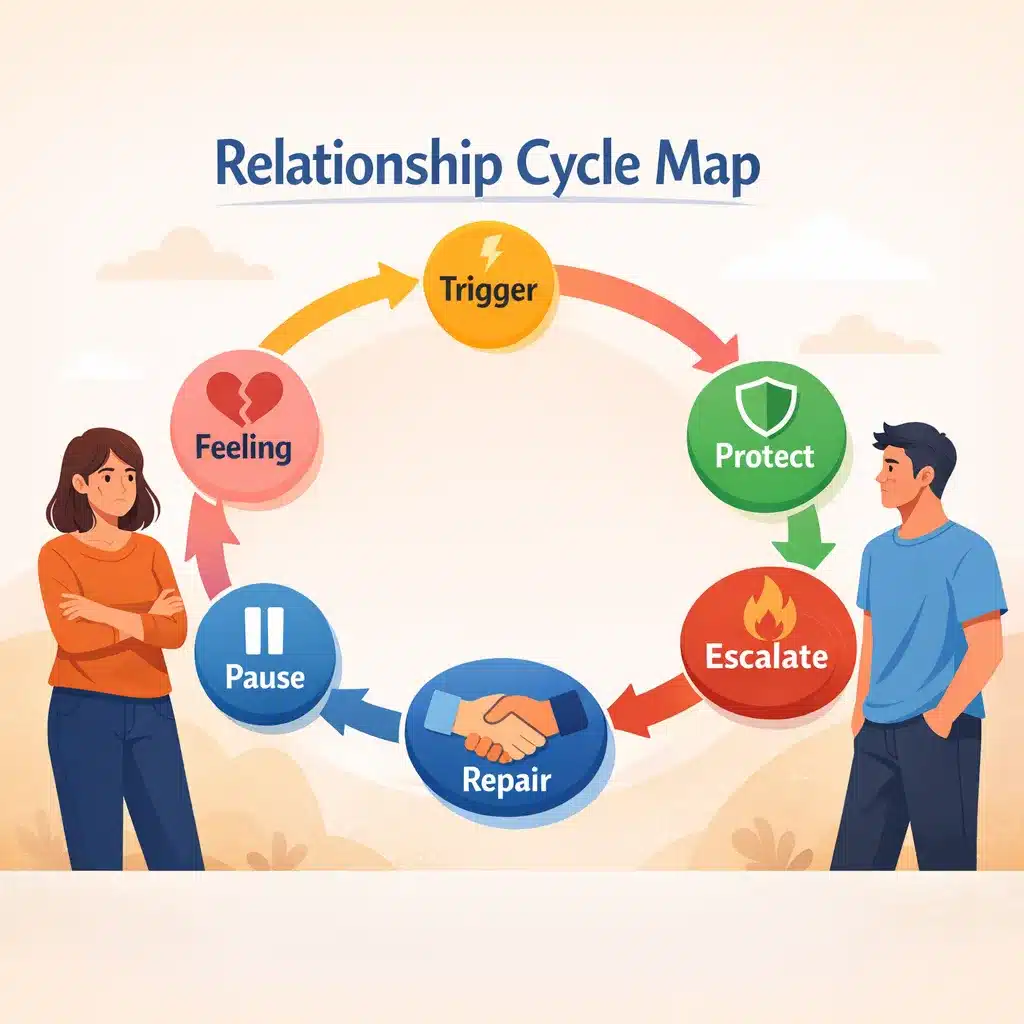
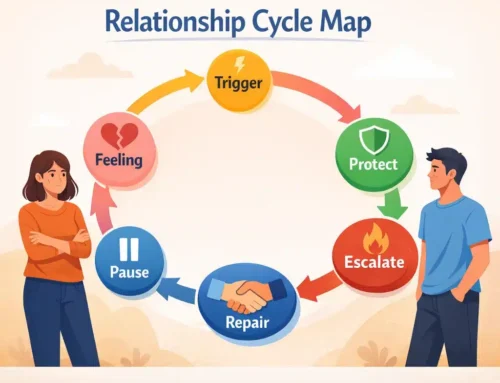
This is the classic loop:
- One partner feels hurt → pursues (questions, intensity, urgency).
- The other feels flooded → withdraws (silence, distance, shutdown).
- The pursuer feels abandoned → escalates.
- The withdrawer feels trapped → shuts down harder.
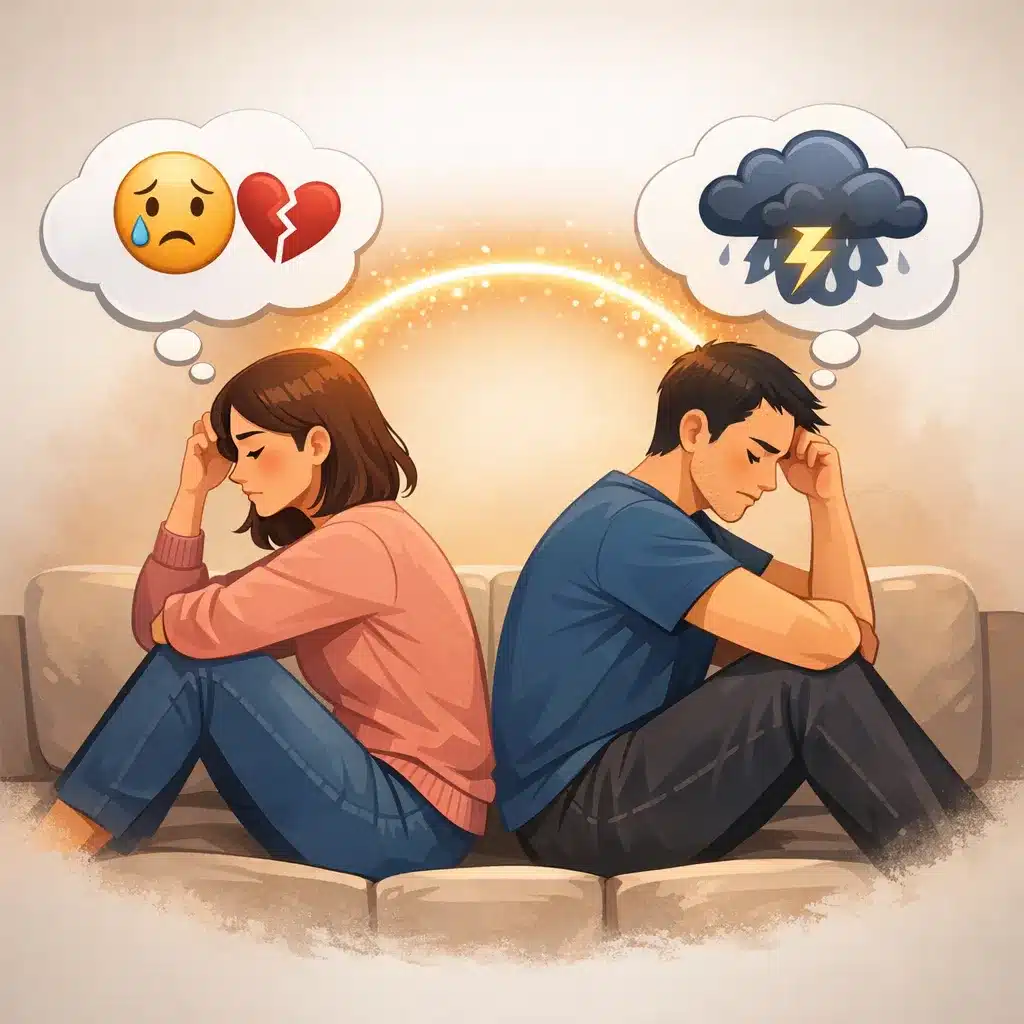
Both people feel justified. Both people feel unseen.
Emotional regulation for couples improves fast when you stop arguing content and start naming the cycle. Your enemy isn't your partner. It's the loop.
🧭 Move From “You’re the Problem” to “Our Pattern Is the Problem”
Blame creates defensiveness. Pattern-language creates teamwork.
Instead of:
- "You never listen."
- "You're too sensitive."
- "You always shut down."
Try:
- "When I feel unheard, I push harder."
- "When you feel pushed, you pull away."
- "Then I panic, and you freeze."
That shift is not "soft." It's strategic. It turns conflict into something you can study and change.
🤝 Emotional Regulation for Couples: Holding Two Truths Without Surrendering
Healthy couples hold dual truth:
- "I'm hurt."
- "You're overwhelmed."
Validation is not agreement. It's simply saying, "I get why you feel that."
Try these:
- "That makes sense, given your day."
- "I can see how that landed badly."
- "I'm not saying you're wrong. I'm saying I understand."
This is the core of emotional regulation for couples: mutual reality before solutions.
🛑 Regulate First, Talk Second (Otherwise You’re Just Sparring)
If you're flooded, you're not "talking it out." You're trading emotional punches.
Regulation can be simple:
- Unclench your jaw and shoulders.
- Slow your breathing.
- Drop your voice one notch.
- Sit, don't pace.
- Take a timed pause.
Stress resources explain how the body's alarm system impacts thinking and health.
A pause is not avoidance if you promise a return time and keep it.
⏳ Different Emotional Timelines: Fast Processor vs Slow Processor
Many couples are mismatched:
- One partner wants to talk now.
- The other needs time to sort feelings.
Neither is wrong. They just need a protocol.
A workable script:
- "I want to talk, and I'm too hot right now."
- "Give me 30 minutes. I will come back at 7:30."
- "I need reassurance we're okay while you take space."
This prevents the pursuer from feeling abandoned and the withdrawer from feeling trapped.
🧰 Emotional Regulation for Couples Toolkit: 6 Micro-Skills That Work Mid-Fight
These are small moves with huge payoff:
- Soften the start-up
Open with a feeling + request, not an accusation. - Name the emotion, not the crime
"I feel shut out" beats "You're ignoring me." - Ask one clean question
"What did you hear me say?" resets misunderstanding. - Offer a repair attempt
"Can we restart?" is a fire extinguisher. - Validate one point
Even 5% validation lowers defensiveness. - Choose one next step
Not ten. One.
The Gottman Method popularized "Four Horsemen" conflict markers and practical antidotes, which pairs well with repair attempts.
🧾 Quick Conflict Map Table (Use This Weekly)
| Trigger Moment | Body Signal | Best Micro-Skill |
|---|---|---|
| Tone feels sharp | Chest tight, urge to snap | Soften start-up + slow breath |
| Feeling ignored | Racing thoughts, urgency | Name emotion + one clean question |
| Overwhelm rising | Blank mind, numb, shut down | Timed pause + return time |
| Old wound activated | Heat in face, defensiveness | Validate 5% + repair attempt |
🧯 Repair Attempts: The Skill That Saves Relationships
A repair attempt is anything that reduces tension and invites reconnection:
- humor (kind, not mocking)
- a touch (if welcomed)
- "I'm getting defensive—pause?"
- "I love you. I'm not your enemy."
You don't need perfect wording. You need timing and sincerity.
If repairs keep failing, it often means one or both partners are too flooded. Go back to regulation first, then return.
📋 Emotional Regulation for Couples Homework: 7 Exercises That Build Real Change
Do these outside heated conflict. That's when learning sticks.
📝 Homework 1: Emotional Mapping (Solo → Share)
Answer privately:
- What emotion shows up first in conflict?
- What emotion do I try to avoid?
- What's my "danger sign" (raised voice, silence, sarcasm)?
- What did conflict feel like growing up?
Then share only what feels safe. The goal is awareness, not confession.
👂 Homework 2: Sharing Without Fixing (10 + 10 Timer)
Rules:
- Speaker talks for 10 minutes.
- Listener reflects back what they heard.
- No defending, no correcting, no solving.
Use: "What I'm hearing is…"
🔁 Homework 3: Write Your Cycle Like a Loop
On paper:
- Trigger → My reaction → Your reaction → My meaning → Your meaning
Name it like a silly villain: "The Panic-and-Disappear Loop."
Humor helps, and it also reduces shame.
🛑 Homework 4: The Time-Out Contract (The “Return Time” Rule)
Agree on:
- your early warning signs
- the exact pause length you need
- what you do during the pause (walk, water, breathing)
- the return phrase: "I'm back. I'm ready."
No return time = abandonment fear. Return time = safety.
💬 Homework 5: Translate Complaints Into Needs
Take three common complaints and rewrite them:
- Complaint: "You never help."
Need: "I need teamwork and relief." - Complaint: "You don't care."
Need: "I need reassurance and closeness."
This reduces blame and increases clarity.
🌿 Homework 6: Weekly Appreciation Check-In (15 Minutes)
Each partner shares:
- One thing you appreciated.
- One effort you noticed.
- One moment you felt connected.
No critiques in this exercise. Build the "positive bank" first.
🧩 Homework 7: The “Aftermath” Debrief (24 Hours Later)
After conflict, revisit calmly:
- What did I feel?
- What story did my brain make up?
- What did I need?
- What repair would help now?
This is where growth happens.
🧱 When One Partner Is Willing and the Other Isn’t
This is common. Here's what helps (and what backfires).
Works:
- modeling calm, clear requests
- owning your part quickly
- inviting, not cornering
- asking for small experiments ("Can we try 10 minutes?")
Backfires:
- lectures
- diagnosing your partner
- ultimatums during conflict
- "I watched a video so now you must change."
Change is contagious, but pressure makes people dig in.
🧑⚕️ When Extra Support Is Needed
If conflict links to trauma, long-term shutdown, or repeated emotional harm, get support. Couples therapy and trauma-informed approaches can help couples slow the cycle and rebuild safety.
Emotionally Focused Therapy (EFT) has a substantial evidence base in couple therapy research.
Support isn't failure. It's maintenance—like getting an alignment before your tires shred.
✅ Emotional Regulation for Couples: A Simple 14-Day Practice Schedule
Keep it boring and consistent. Boring wins.
- Days 1–2: Homework 1 (mapping) + share 10 minutes each
- Days 3–4: Time-out contract + practice one "return time"
- Days 5–6: Complaint → Need translation (3 examples)
- Days 7–8: Sharing without fixing (10 + 10)
- Days 9–10: Identify your cycle + name it
- Days 11–12: Appreciation check-in
- Days 13–14: Aftermath debrief (use the 4 questions)
Repeat the two hardest exercises next week. That's your growth edge.
❓ FAQs About Emotional Regulation for Couples
❓ What is emotional regulation for couples, in plain English?
It's the ability to calm yourself enough to stay connected while you disagree.
❓ Why do we say the same fight keeps happening?
Because the pattern repeats faster than the issue changes. Name the cycle, then change the steps.
❓ Is shutting down the same as not caring?
Usually no. Shutdown often signals overwhelm and nervous system flooding.
❓ How long should a break during conflict be?
Commonly 20–60 minutes, with a clear return time and follow-through.
❓ What if my partner won't come back after a pause?
Then the pause becomes avoidance. Agree on a return rule when calm.
❓ How do we stop interrupting each other?
Use a timer. Structure beats good intentions.
❓ Can emotional regulation for couples work if only one person tries?
Yes, progress is possible. One partner can reduce escalation and improve repair attempts.
❓ What's the fastest way to de-escalate?
Lower your voice, slow your breath, and validate one point.
❓ Are "Four Horsemen" behaviors really that serious?
They're common, but they predict worsening conflict if they become a habit.
❓ What do we do when we disagree on the facts?
Pause the facts. Start with feelings and needs first.
❓ How do childhood experiences affect adult conflict?
Early patterns shape how safe closeness feels, especially under stress.
❓ What if we're both "fighters"?
You need stronger pause rules and faster repair attempts, not more debate.
❓ What if we're both "avoiders"?
You need scheduled conversations so issues don't rot silently.
❓ How do I validate without agreeing?
Say "That makes sense," not "You're right."
❓ When should we seek professional help?
If fights feel unsafe, contempt is common, or issues never resolve.
❓ Can EFT help with emotional regulation for couples?
Often yes. EFT is built around attachment needs and emotional bonding research.
❓ What's one daily habit that helps most?
A 2-minute appreciation moment. Tiny deposits add up.
❓ How do we rebuild trust after repeated fights?
Consistency: repair attempts, follow-through, and fewer "injury repeats."
❓ What if one of us has anxiety or ADHD?
Use extra structure: timers, written notes, and short rounds. Keep it simple.
❓ What if we argue about texting, chores, and money constantly?
Those are usually proxy fights for safety, fairness, and connection.
🧩 Conclusion: The Practical Truth That Changes Everything
Marriage doesn't invent your wounds—it reveals them. However, that revelation can become your turning point.
Emotional regulation for couples is not about becoming emotionless. It's about staying connected while emotions rise, so problems become solvable again.
You can also browse more wellness content in Health.
🔗 Sources & References
- APA Dictionary: Fight-or-flight response (APA Dictionary)
- American Psychological Association: Stress effects on the body (American Psychological Association)
- NCBI Bookshelf (StatPearls): Physiology, Stress Reaction (NCBI)
- PubMed: Research review on Emotionally Focused Therapy (EFT) (PubMed)
- The Gottman Institute: The Four Horsemen (The Gottman Institute)
- University of Illinois: Adult attachment overview (Fraley) (Psychology Department Labs)

Related Posts





The Longevity Blueprint: AI-Powered Health Optimization
About the Author: Bernard Aybout (Virii8)