Approx. read time: 10.6 min.
Post: Unresolved Issues in Marriage 17 Steps That Work
Unresolved Issues in Marriage: How to Work on Forever When Emotions Are Heavy
Unresolved issues in marriage don't just "sit there." They quietly tax everything: your tone, your trust, your patience, and your hope. If you're asking, "How do we work on forever when we still feel raw?" you're not broken—you're noticing reality.
The goal isn't to force certainty. The goal is to reduce emotional volatility, build safety, and create repeatable repair. That's how "forever" becomes a direction again, not a threat.
🧭 Why unresolved issues in marriage feel heavier over time
Unresolved issues in marriage rarely stay contained to the original topic. Instead, they spread into interpretations: "You don't care," "I'm alone," "I can't trust you." Then every new disagreement feels like proof of an old wound.
These are the usual "roots":
- Hurt that didn't get fully acknowledged
- Apologies that sounded like explanations
- Boundaries that were crossed and never repaired
- Repeating patterns with zero follow-through
Over time, the fight isn't about the dishes or the text message. It's about the history attached to the dishes and the text message.
🔥 Why “forever” feels like a trap when emotions run hot
When emotions are high, "forever" can feel like pressure—almost like signing a contract while your nervous system is screaming. That's why couples start thinking in extremes: "We're doomed," or "We should just end it."
So here's the more useful question: "Can we build enough stability for the next 30 days?"
Forever is built in phases. Pressure ruins phases.
🧠 What your nervous system is doing during conflict
When conflict feels intense, your brain often treats it like danger. Your body shifts into defense: fight, flight, freeze, or fawn. Logic drops, tone sharpens, and listening becomes nearly impossible.
That's why "just communicate better" is bad advice by itself. You need emotion regulation skills first, then communication skills. Modern research describes emotion regulation as a trainable skill that improves adaptive responding.
🧱 Emotional safety: the missing prerequisite
If you try to solve problems without safety, you'll keep re-triggering the same cycle. Emotional safety means:
- You can speak without being mocked or punished later
- You can make mistakes without them becoming weapons
- You can disagree without fearing abandonment or retaliation
This is also why "winning" arguments is a clown goal. Winning costs safety. And safety is the foundation you're actually trying to rebuild.
Helpful "safety-check" questions:
- "Do you want comfort or solutions right now?"
- "Is now a good time, or do we schedule this?"
- "What would help you feel safe enough to keep talking?"
🗣️ Two-lane conversations: feelings first, solutions second
Here's the move that changes everything: stop trying to solve while someone is still flooded. First, get the emotion understood. Then solve.
Use this structure:
- Name the feeling (no blame)
- Name the meaning (what it represents)
- Name the need (what would help)
- Make one request (small, doable)
Example:
- "I feel dismissed."
- "It makes me think I don't matter."
- "I need reassurance and eye contact."
- "Can you repeat back what you heard before we decide anything?"
This aligns with what many evidence-based communication frameworks emphasize: observation over accusation, and needs over attacks.
🧩 The “one issue at a time” rule for unresolved issues in marriage
Unresolved issues in marriage feel infinite when you fight "the whole relationship" every time. So you need a rule:
One conflict. One topic. One time frame.
If the topic changes, you write it down for later.
A practical boundary:
- "We're discussing how we talk during conflict, not the 2019 vacation and your mother."
It sounds strict. It's actually merciful. It prevents emotional pile-driving.
🛠️ Repair attempts: the skill that stops fights from snowballing
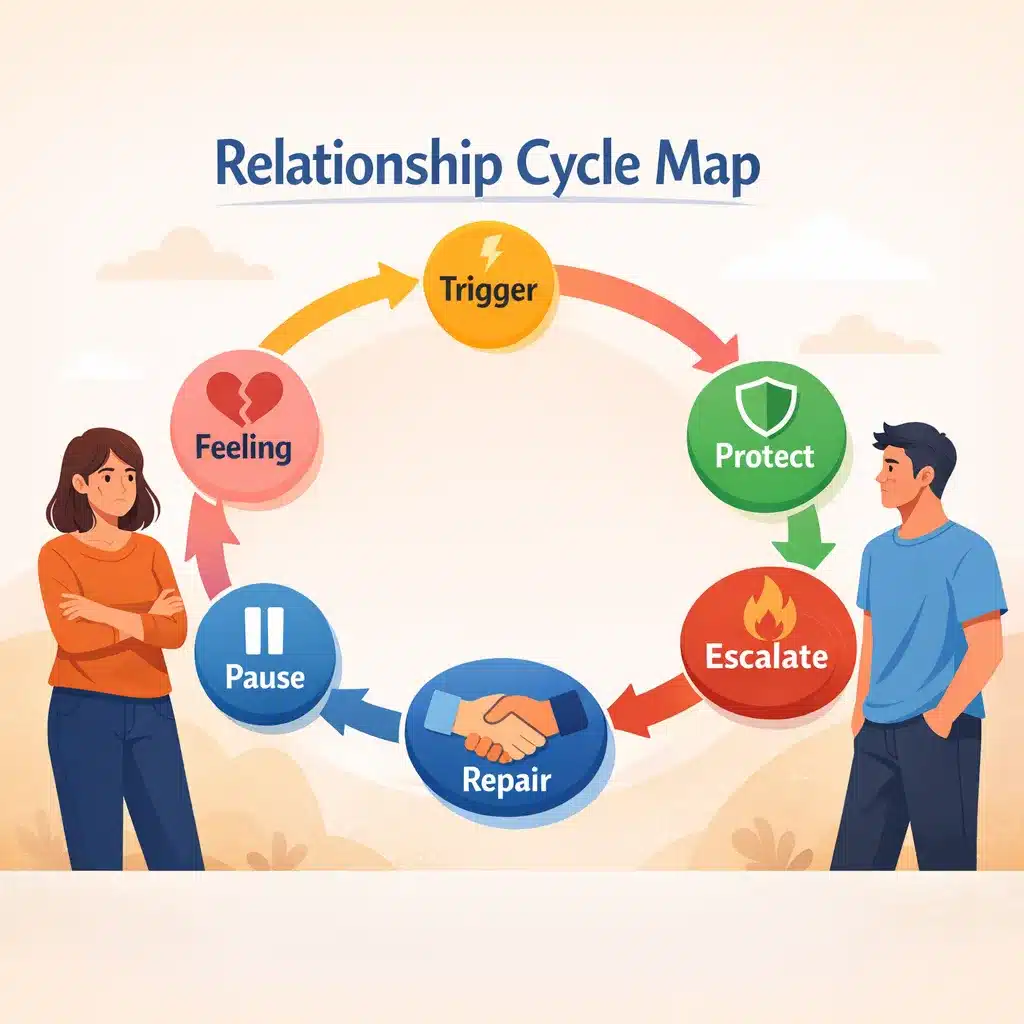
One of the most underrated relationship skills is the ability to repair mid-conflict. Repair attempts are small words or actions that interrupt escalation and signal, "We're on the same team."
Examples:
- "That came out harsh—let me restart."
- "I'm getting flooded. I want a 20-minute break."
- "I hear you. I'm not trying to hurt you."
Gottman's work highlights repair attempts as a major factor in whether conflict de-escalates. (The Gottman Institute)
🐎 The Four Horsemen and their antidotes
If you want a brutally honest diagnostic: watch for these four patterns during fights:
- Criticism (character attacks)
- Contempt (mockery, disgust, superiority)
- Defensiveness (denying impact, counterattacking)
- Stonewalling (shutting down, disappearing emotionally)
Gottman calls these patterns predictive of relationship breakdown when they dominate. (The Gottman Institute)
Antidotes you can practice:
- Criticism → gentle start-up ("I feel… I need…")
- Contempt → appreciation + respect (daily, not only in crisis)
- Defensiveness → take 10% responsibility (even a little)
- Stonewalling → physiological self-soothing + return time
🧾 Childhood patterns, attachment, and why you both get “stuck”
Yes—sometimes the fight isn't really about now. It's about what "now" activates.
- If someone grew up with unpredictability, they may crave reassurance and pursue.
- If someone grew up with criticism or emotional distance, they may withdraw and shut down.
Adult attachment research links attachment insecurity with different emotion regulation patterns under stress.
Also, adverse childhood experiences can shape stress responses and relational coping later.
Important reality check: this isn't about blaming childhood forever. It's about understanding why your partner's reaction looks "irrational" when it's actually protective.
💬 A script for hard talks that doesn’t blow up
Use this when you're about to talk about something sensitive:
Step 1: Schedule it
- "Can we talk at 7:30 tonight for 20 minutes?"
Step 2: Set the goal
- "The goal is understanding, not a verdict."
Step 3: Use the 60-second rule
- Each person gets 60 seconds uninterrupted.
- The listener mirrors back: "What I heard was…"
Step 4: End with one micro-agreement
- "This week, we'll do a check-in twice."
- "We'll pause if voices rise."
If you can't land a micro-agreement, you're not "failing." You're just not regulated enough yet.
🧮 Money, chores, intimacy, and other “proxy fights”
Many couples argue about logistics, but the real battle is symbolic:
- Money can mean safety, freedom, or control.
- Chores can mean respect, teamwork, or being seen.
- Time can mean priority, love, or rejection.
So ask: "What does this represent to you?"
You'll often find the hidden issue faster than debating the surface details.
🧪 Weekly marriage lab: homework that rebuilds trust
Here's where things get practical. If unresolved issues in marriage have built a backlog, you need repeatable reps, not one giant "talk."
1) The 10–10–10 Check-In (twice a week)
- 10 minutes: what went well
- 10 minutes: what felt hard (no fixing)
- 10 minutes: one request each
2) The Appreciation Minimum (daily)
Each person says one specific appreciation:
- "Thanks for handling bedtime even though you were tired."
Yes, it feels cheesy at first. Do it anyway. Contempt grows in silence.
3) The Repair Practice (after any conflict)
Each answers:
- "What did I feel?"
- "What was the story I told myself?"
- "What do I regret about my delivery?"
- "What do I need next time?"
4) The Trigger Map (once a week for a month)
Each person writes:
- My top 3 triggers
- What I fear in that moment
- What helps me calm down
Then swap and discuss with kindness.
5) The “One Change” Contract (weekly)
Each picks one behavior change:
- "I will lower my voice and restart if I spike."
- "I will return after a timeout at the promised time."
Consistency rebuilds trust faster than speeches.
🧯 When you need a timeout and how to do it without punishing
Timeouts work only if they're structured. Otherwise, they become abandonment.
A clean timeout looks like:
- "I'm flooded. I need 20 minutes."
- "I will come back at 8:10."
- "I'm not leaving the relationship. I'm calming my body."
If you want a simple method: use a STOP-style pause (stop, take a breath, observe, proceed).
🧑⚕️ When couples therapy is the smart move
Couples therapy isn't a last resort. It's often preventive maintenance, especially when the same conflicts loop without repair.
Consider help if:
- You can't discuss topics without escalation
- One partner stonewalls or becomes contemptuous
- Trust has been damaged and you keep re-opening it
- You feel more like roommates than partners
NHS resources describe couples therapy as a structured space to explore what went wrong and learn better communication.
If there is abuse or you feel unsafe, prioritize safety and professional support immediately.
🧰 A 30-day plan to reduce unresolved issues in marriage
If unresolved issues in marriage feel endless, run this as a reset:
Week 1: Safety
- Two 10–10–10 check-ins
- No problem-solving during flooding
- Daily appreciation
Week 2: Repair
- Practice repair phrases mid-conflict
- One "repair review" after any disagreement
Week 3: Patterns
- Identify your top conflict loop
- Replace one horseman with one antidote
Week 4: Future
- Discuss values: money, family, boundaries, expectations
- Pick one shared goal for next month
Small wins compound. That's the whole point.
✅ Conclusion: working on forever in phases
You don't build forever on top of panic. You build it on emotional safety, honest patterns, and consistent repair. And yes—unresolved issues in marriage can be worked through, but only when both people stop treating conflict like war and start treating it like information.
❓ FAQs
❓ What are unresolved issues in marriage, exactly?
They're repeat conflicts or hurts that never got fully repaired. They keep resurfacing because the emotional "account" never got settled.
❓ Why do unresolved issues in marriage come back during small arguments?
Because your brain links current stress to past pain. The topic is small, but the meaning feels huge.
❓ How do we stop fighting about everything?
Pick one issue at a time and set a time limit. Also, reduce flooding first, then problem-solve.
❓ What if one partner shuts down during conflict?
Treat it as overwhelm, not disrespect—at least at first. Use timeouts with a return time, and keep talks shorter.
❓ What if one partner gets loud or reactive?
Build in a restart rule: "If voices rise, we pause." Then return after 20–30 minutes calmer.
❓ Are unresolved issues in marriage always fixable?
Not always. However, many improve when both partners commit to safety, repair, and behavior change.
❓ What's the fastest way to rebuild trust?
Consistency. Do what you said you'd do, especially after conflict.
❓ How do we apologize so it actually lands?
Name the impact, take responsibility, and state what you'll do differently. Avoid defending while apologizing.
❓ What are "repair attempts"?
They're small phrases or actions that stop escalation mid-fight and signal teamwork. They matter more than being "right." (The Gottman Institute)
❓ Why does "forever" feel scary right now?
Because the present feels unstable. Build stability first; then discuss long-term plans.
❓ Can childhood stuff really affect how we fight?
Yes. Early experiences shape stress responses and conflict habits. The point is insight, not blame.
❓ How do we talk without spiraling into old topics?
Use the "parking lot" rule: write down side issues and return later, one at a time.
❓ What if we disagree on what "emotional safety" means?
Ask for specifics: tone, timing, reassurance, or space. Define it behaviorally, not conceptually.
❓ When should we consider couples therapy?
When the same issues loop, trust is damaged, or conversations escalate fast. Therapy can add structure and safety.
❓ How long does it take to resolve unresolved issues in marriage?
It depends on severity and consistency. Many couples feel change within weeks when they practice repair and check-ins.
❓ What if only one person is trying?
That's a real problem. A relationship can handle imperfections, but it can't survive sustained indifference.
❓ How do we handle conflict when we're both emotional at once?
Pause, regulate, then take turns. Use a timer and reflect back what you heard before responding.
❓ What's one habit that helps immediately?
A twice-weekly 10–10–10 check-in. It prevents emotional backlog from piling up.
Conflict Patterns vs. Repair Tools (Quick Reference)
| Escalation Habit | What It Sounds Like | Better Replacement |
|---|---|---|
| Criticism | "You always…" | "I feel… and I need…" |
| Defensiveness | "Well you do it too!" | "You're right about this part…" |
| Stonewalling | Silence / leaving | "I need 20 minutes, I'll be back at…" |
| Contempt | Mocking / eye-rolling | Daily appreciation + respect rules |
Sources & References
- Gottman Institute — Manage Conflict: Repair and De-Escalate (The Gottman Institute)
- Gottman Institute — The Four Horsemen (The Gottman Institute)
- American Psychological Association — Healthy Relationships (American Psychological Association)
- NHS — Healthy Relationships & Conflict (nhs.uk)
- CDC — Adverse Childhood Experiences (ACEs) (CDC)
- PMC — Adult Attachment, Stress, and Romantic Relationships (PMC)
Related Videos:

Related Posts:
Emotional Regulation for Couples 17 Conflict Skills
The Fasting mimicking diet Unlock Wellness with the 5 day Plan
When Work Becomes Harm: Understanding, Surviving, and Recovering from a Toxic Workplace
Safe Driving Tips: 21 Smart Ways to Stay Safer Anywhere
Midlife Regrets 17 Hard Lessons People Share Most Today
Related Posts





The Longevity Blueprint: AI-Powered Health Optimization
About the Author: Bernard Aybout (Virii8)